


 Dawn.com
 Stench, toxic gases from garbage dump along Karachi’s Malir river plague residents, commuters
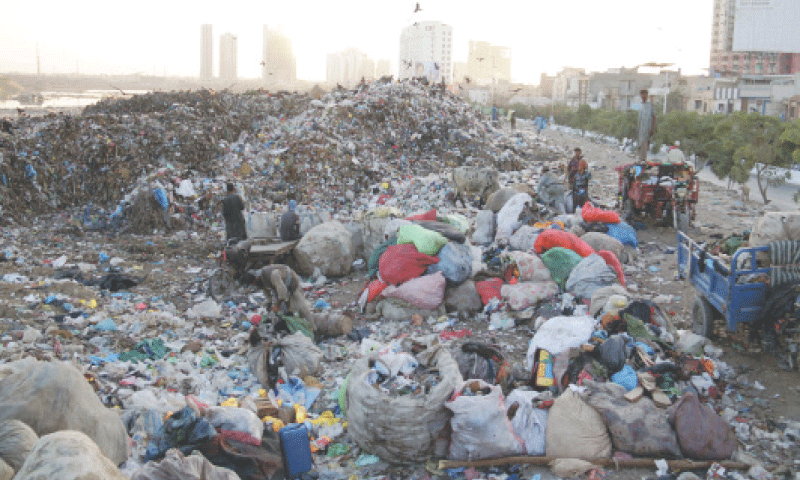
• People living in Defence View say persistent smell, swarms of birds at ‘govt-managed garbage transfer station’ have made life miserable • Complain night-time movement of garbage trucks makes sleep difficult • SSWMB chief says ‘GTS Imtiaz’ functions as intermediary point where waste is first brought before being transferred to landfill sites • Claims facility will be upgraded into a covered centre by next year KARACHI: Residents of Defence View and adjacent localities, students of nearby educational institutions and thousands of commuters using Shaheed-i-Millat Expressway are forced to endure the stench of garbage collected by authorities from across district East and dumped along the Malir riverbank. The area is also polluted with dust, harmful fumes and toxic gases emanating from the piles of garbage. Known as GTS Imtiaz (Garbage Transfer Station-Imtiaz), because of its proximity with the Qayyumabad outlet of the chain of department stores, the garbage dump is managed by the Sindh Solid Waste Management Board (SSWMB). Dawn visited the locality where the area residents said the pungent smell, dust, toxic gases and air pollution from the site have not only disrupted daily life, but have also given rise to various health problems. The GTS Imtiaz is one of the centres where waste collected from district East is temporarily transferred before being moved to landfill sites. However, residents claim that a facility which should have been located on the outskirts of the city has instead been established near a residential area, severely affecting the entrance to the Defence Housing Authority. Locals said that upon entering the district, the overwhelming stench of garbage greets the people, while hundreds of kites and other birds circle the area, creating an unsightly and unhygienic environment. According to the World Health Organisation and UN-Habitat guidelines, waste should not be left in the open at transfer stations, as these facilities are meant only for temporary storage before transfer. Open-air storage produces foul odours, harmful gases, dust, attracts flies and birds, and increases disease risks, especially near residential areas. The UN guidelines add that proper transfer stations should use sealed containers and covered halls to control odours; without this, the facility becomes a dumping site, threatening public health and urban living. It also mentions that children, the elderly and patients with pre-existing health conditions are particularly vulnerable. Continuous odours also contribute to mental stress, sleep disruption and reduced quality of life, while improper management encourages pests and risks contaminating nearby rivers or streams. A study by the Agency for Toxic Substances and Disease Registry (ATSDR), a public health agency within the US Department of Health and Human Services, states that organic waste emits gases like hydrogen sulphide, ammonia and methane during decomposition, producing a rotten-egg smell. Prolonged exposure can cause breathing difficulties, worsen asthma and allergies, trigger headaches and nausea, irritate the eyes, nose and throat, and affect the nervous system. Frustrations grow over health risks, daily discomfort In a visit to the area, Dawn talked to residents as well as students of a nearby private university. Defence View Phase II resident and MBBS student Maria said she and her family were facing a variety of health problems. She added that the continuous smell and air pollution, particularly affecting respiratory health, have had a severe impact on her mother. A passer-by said that people chose to live in upscale areas expecting better facilities and a cleaner environment. “But when one enters the district and is immediately hit by a stench and pollution, the whole idea of living here seems pointless. The difference between affluent and ordinary areas disappears,” he added. A student from Iqra University, located opposite the GTS Imtiaz, said the city already struggles with pollution, and daily garbage transfers at this site make the situation worse. “This is totally unfair,” he added. A group of three other students from the same university shared that in the morning, when garbage is moved, the dust is so thick that it becomes “difficult to see, significantly reducing visibility”. They also highlighted that a month ago, smoke from burning garbage would fill the entire university campus and classrooms, causing health issues, though burning has ceased over the past month. Student Amna said that while a large transfer station is located on the opposite side of the university, a smaller station has been set up in the university parking area, leaving students “surrounded by garbage on both sides”. Defence View Phase III resident Shamim Iqbal said that when garbage is moved at nights, the stench makes it almost impossible to sleep. “Even with windows and doors closed, the smell is so strong it causes nausea,” he said. Salim, a resident of Gulshan-i-Ibrahim, Junejo Town, said that he had previously lived near Defence View Phase III but was forced to relocate due to his father’s respiratory condition. “The odour is so overpowering that even breathing becomes difficult,” he added. A local shopkeeper said that the smell and pollution attracted flies over food items, creating serious hygiene and health issues. Residents expressed concerns that the GTS’s location near the Malir River could exacerbate environmental risks, particularly during rains, when garbage and contaminated water might flow into the river. They demanded that transfer stations be relocated away from residential areas or properly covered in accordance with recognised environmental and health standards. SSWMB response The SSWMB Managing Director, Tariq Ali Nizamani, told Dawn that the GTS Imtiaz functions as an intermediary point, where waste is first brought before being transferred to landfill sites. He added that four of the six GTS facilities in Karachi — GTS Imtiaz, Dinga Morr, Sharafi and Gutter Baghicha — are in the process of being modernised, including GTS Imtiaz. Mr Nizamani added that the work on the GTS Imtiaz was expected to be completed by early next year. “Once modernisation is complete, the facility will be upgraded into a covered centre to improve the collection and transfer of waste,” he added. Regarding complaints about garbage burning, the MD said that previously some scavengers would remove usable items from the site and burn the remaining waste. However, eight guards have now been deployed by the board to prevent such incidents from recurring. He explained that decomposing waste produces methane gas, which poses a fire risk, considering that water bowsers have also been stationed on site to respond immediately to any potential hazards. Published in Dawn, December 15th, 2025