


 Ruptly
 Rise of the Pharaoh - Egypt unveils ancient Amenhotep III statues after decades-long restoration
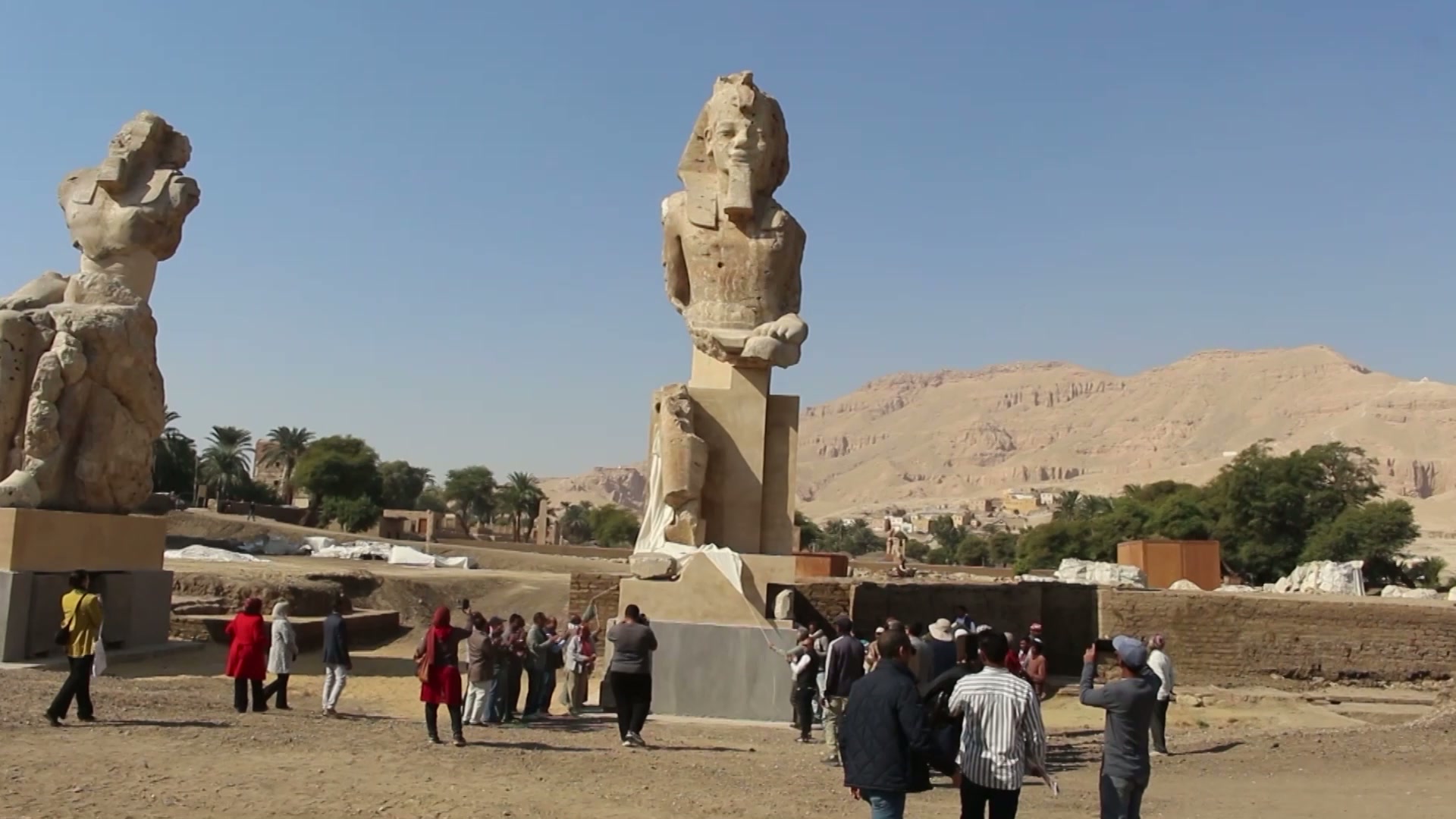
"Two statues of ancient Egyptian Pharaoh Amenhotep III were formally unveiled on Sunday at their original site in the king’s mortuary temple on Luxor's West Bank, marking the culmination of a decades-long restoration and reassembly project. Footage shows the towering statues, some still missing sections, alongside engravings at their bases. Visitors and officials are seen taking pictures as the restored monuments are revealed. "The project initiated in 1998 by reducing the groundwater level at the location. In 2025, the restoration of the dispersed blocks was completely conducted and re-installed in its original location," said Mohamed Ismail Khaled, Secretary-General of Egypt’s Supreme Council of Antiquities. “It is evident that the statues are incomplete as many parts are still missing parts because the temple was repurposed as a quarry during certain periods and used as a source of building material for other adjacent buildings and archaeological sites,” he added. Meanwhile, Hourig Sourouzian, head of the restoration project, said the work was 'absolutely important' in protecting Egypt's ancient heritage. "Otherwise […] they will disappear simply. They are threatened by water, by salt, by vegetation, by vandalises and by encroachment. This Egyptian heritage, the artistic heritage and the historical heritage must remain,” he said. Egypt’s Ministry of Tourism and Antiquities confirmed that the unveiling id part of a conservation programme launched in 1998 in cooperation with the German Archaeological Institute in Cairo. The project has involved the discovery, documentation, recovery and reinstallation of statues and architectural elements from Amenhotep III’s mortuary temple. The restored statue measures approximately 10 metres in height after re-erection and weighs around 60 tonnes. The monument is expected to become the second-largest statue at the site, after the famed Colossi of Memnon. Known as the 'Temple of Millions of Years', Amenhotep III’s mortuary temple was constructed in the first half of the 14th century BC and is regarded as the largest mortuary temple ever built in Egypt. The complex suffered major destruction following a powerful earthquake around 1200 BC, before being reused as a quarry in later periods. Over centuries, flooding and silt deposits further buried and damaged the remains."