


 Daily Finland
 Why peace deal on Ukraine still distant after Berlin talks?
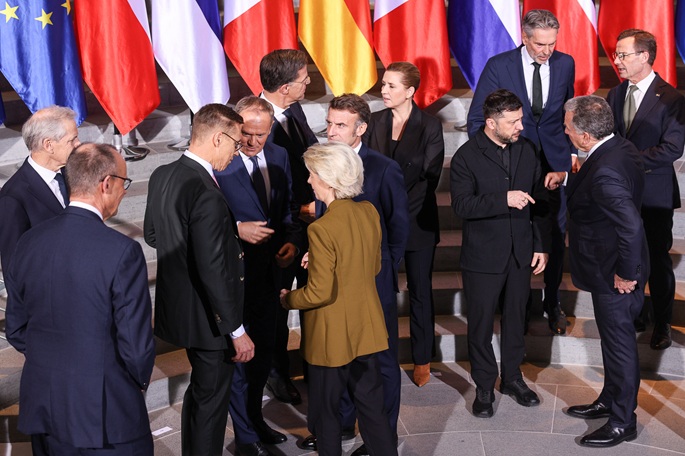
Ukrainian President Volodymyr Zelensky on Monday concluded lengthy talks with U.S. President Donald Trump's special envoy Steve Witkoff and Trump's son-in-law Jared Kushner in Berlin, describing the talks as "productive," reported Xinhua. The talks, which also brought together several European leaders, underscored a shared view that diplomatic efforts should be sustained to bring the conflict to an end. Yet beyond the official optimism, obstacles linger. Security guarantees were drafted out, while territorial disputes remained unresolved. WHAT OBSTACLES? Territorial disputes remain the hardest nut to crack in the talks. Still, it remains unresolved after hours of gruelling back-and-forth negotiations that started months ago. German newspaper Die Welt reported that U.S. negotiators were pressing Ukraine to give up the Donbas region as part of the settlement. When asked at a press conference on Monday whether the United States was demanding Ukraine's withdrawal from territory it controls, Zelensky said Ukraine and the United States still hold differing positions on territorial issues. Before the Monday meeting, Zelensky had voiced rejection of the U.S.-proposed plan to establish a "free economic zone" in parts of the eastern Donbas region, saying it is unfair due to a lack of clarity over governance. He stressed that Ukraine needs clear security guarantees before making decisions on the front line. "In my view, the most important thing is that the plan be as fair as possible," Zelensky told reporters before meeting with U.S. envoys. "The plan truly should not be just a piece of paper, but a meaningful step toward ending the war." Zelensky said Ukraine could suspend its bid to join NATO in exchange for Western security guarantees to prevent renewed conflict with Russia if a peace agreement were reached, with Kiev seeking protections comparable to those granted to alliance members -- assurances the United States has so far not offered. He said that Ukraine stands ready to agree on security guarantees based on NATO Article 5 as a part of a compromise in the peace process, the Ukrinform news agency reported. "From the very beginning, Ukraine's desire was to join NATO, these are real security guarantees. Some partners from the United States and Europe did not support this direction," he told reporters. "The basis of that agreement is basically to have really, really strong guarantees, Article 5-like," a senior U.S. official said. "Those guarantees will not be on the table forever. Those guarantees are on the table right now if there's a conclusion that's reached in a good way." WHY DOES PEACE REMAIN ELUSIVE? Meanwhile, 10 European leaders, including French President Emmanuel Macron, British Prime Minister Keir Starmer and European Commission President Ursula von der Leyen, joined talks and issued a joint statement on Monday, welcoming "significant progress." The leaders pledged to work together to provide robust security guarantees, including maintaining Ukraine's armed forces at a peacetime level of 800,000 troops. German Chancellor Friedrich Merz said diplomatic momentum had made a ceasefire "conceivable." Although cautious optimism has been voiced, the complexity of the situation casts doubt over the likelihood of achieving a lasting peace. Finnish President Alexander Stubb stressed that the crucial issue would ultimately be whether Ukraine is willing to cede territory in return for security guarantees from the United States, while Swedish Prime Minister Ulf Kristersson agreed that many difficult questions remain, "not least about territories and about whether Russia actually wants peace." European leaders sought to reassert themselves on the Ukraine issue last week, with British Prime Minister Keir Starmer hosting Zelensky, Macron and Merz in London. They called the situation a "critical moment" and promised increased aid to Kiev alongside greater economic pressure on Moscow. The talks come ahead of an EU summit set to consider proposals to channel billions from frozen Russian assets to Ukraine -- a plan Moscow has vowed to retaliate against. EU discussions on how to finance future support, including the use of Russian state assets, have grown increasingly fraught, an EU official said on Monday. The display of European unity contrasts with criticism from Trump, who called Zelensky "disappointing" and labeled European leaders "weak," suggesting Washington could scale back its support. WHERE DOES RUSSIA STAND? Russian Foreign Minister Sergey Lavrov on Monday slammed Europe as a "quack doctor" for missing opportunities to help resolve the Ukraine crisis, while expressing optimism over recent engagements with the United States. He blamed Europe for providing Kiev with weapons, money and intelligence, saying Europe is "waging a war" with Russia. Likening Europe's approach to that of a "quack doctor," he said, "They only prescribe medicines that make you feel better for five minutes. They will never make a proper diagnosis." Lavrov said Wednesday that Russia will respond to any deployment of European military forces in Ukraine, as well as attempts to seize Russian assets in Europe. Trump's envoys are claiming serious progress in the talks, but there are still no clear indications that the Kremlin is willing to accept conditions that would lead to a sustainable peace. The Kremlin has indicated willingness to engage in dialogue while also raising specific objections to key components of the U.S. proposal. The U.S. side has yet to provide Russia with any details of the vision presented during the discussions, Kremlin Spokesman Dmitry Peskov said on Monday, adding that Moscow hopes to see concrete proposals for resolving the Ukraine issue once the talks are concluded. Peskov stressed that guarantees ensuring Ukraine's non-accession to NATO constitute one of Russia's fundamental positions, describing the issue as "one of the cornerstones" of any settlement process. Meanwhile, fighting has continued on the ground. Zelensky said that Russia had launched over 1,500 drones and dozens of missiles in the past week, as fresh strikes hit Odesa and Zaporizhzhia, injuring civilians and damaging infrastructure. Ukraine also claimed it had critically damaged a Russian submarine in a joint operation at the Black Sea port of Novorossiysk, which was later denied by Moscow.