


 Business Recorder
 Sindh PA session: Opposition fails to get public-interest motions adopted
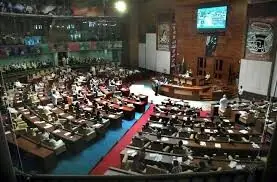
KARACHI: The opposition was unable to secure the adoption of most of its public-interest resolutions during the Sindh Assembly session on Tuesday. However, the House passed one resolution paying tribute to those supporting the Pakistan Army during the 1971 war against India in then East Pakistan, now Bangladesh. On the private members’ day, the House opened its session under the chairmanship of Speaker, Awais Qadir Shah. At the outset, the Assembly offered Fateha for the martyrs of Army Public School Peshawar and the former East Pakistan tragedy. Moving the resolution on former East Pakistan, MQM lawmaker Ijaz-ul-Haq said the House should pay tribute to the Biharis who sacrificed their lives alongside the Pakistan Army. Responding to this, Sindh Home and Parliamentary Affairs Minister Zia-ul-Hassan Lanjhar said there was no question of opposing such a resolution and saluted the martyrs of East Pakistan. However, PPP’s Ghulam Qadir Chandio objected, saying the resolution created an impression that only one community had made sacrifices, and added that the mover had included some inappropriate points. At this stage, the Speaker ruled that remarks made by Ijaz-ul-Haq beyond the text of the resolution be expunged from the record. Ijaz-ul-Haq expressed disappointment, saying political workers like them felt hurt, adding that they had always raised slogans for Pakistan and had even given their lives for the country. Later, the House adopted the resolution. During the sitting, MQM’s Taha Ahmed presented a resolution calling for financial autonomy for local governments to ensure democratic stability. Provincial Minister Jam Khan Shoro said Article 140-A of the Constitution had been introduced by the PPP and that a Supreme Court verdict on the matter also existed. He explained that Article 140-A clearly states that provincial governments decide how much authority to devolve to local councils. He said institutions like the Water Board and WASA had already been handed over to mayors, and suggested that all stakeholders sit together to decide the extent of powers. He stressed that legislation was the Assembly’s responsibility. Minister Zia-ul-Hassan Lanjhar supported this view and said the issue should be resolved through mutual consultation, assuring that a committee would be formed on the matter. Following this assurance, Taha Ahmed withdrew his resolution. Another resolution was moved by MQM’s Adil Askari, stating that a general university should be established in Karachi in view of the city’s large population. Opposing the resolution, Minister for Universities Ismail Rahoo said the Sindh government was providing more than Rs42 billion in grants to higher education institutions and universities. He informed the House that Karachi already had 30 public-sector universities and that new universities were also being established in the city. He added that the government not only provided funds but also sponsored various programmes, and said an Education City was being developed on Kathore Road, with more universities planned. The House later rejected the resolution. During proceedings, MQM’s Qurrat ul Ain presented a resolution to modernise the fire brigade system. The Minister for Parliamentary Affairs supported the proposal, and the House passed the resolution. MQM’s Sabir Qaimkhani also moved a resolution regarding forests and tree plantation, which was rejected after Parliamentary Secretary, Heer Ismail Soho opposed it. Another resolution was moved by MQM’s Aamir Siddiqui, stating that funds had been received for road-cutting works in Karachi but were not being utilised to repair broken roads. The government opposed the resolution, with Parliamentary Secretary Siraj Qasim Soomro saying the work was already underway and should be discussed after completion. The Assembly session was later adjourned till Friday at 2:30 pm. Separately, Sindh Minister for Social Welfare Mir Tariq Talpur informed the Assembly that his department had rescued 1,600 children from beggars over the past five years. Responding to written and supplementary questions during Question Hour, he said the Social Welfare Department had three centres in Karachi, Hyderabad and Sukkur, where children up to the age of 17 were kept. He said the child helpline was operational 24 hours a day and that rescued children were placed in protection homes. He clarified that children aged between five and 17 engaged in work fell under the definition of child labour, and said the department worked jointly with the Labour Department against child labour. Talpur said the department’s three centres provided all facilities to orphan children, including education and food. He added that complaints regarding children were acted upon immediately through the helpline. He also informed the House that a shelter home with a capacity of 200 children was operating, where children were given full education and comprehensive care. In response to another question, he said the decision to cancel NGO licences was taken by the cabinet, and that no NGO registration had been cancelled in the past two years. He clarified that child trafficking did not fall under the jurisdiction of the Social Welfare Department. Copyright Business Recorder, 2025