


 Dawn.com
 President assents to bill for setting up minorities’ commission
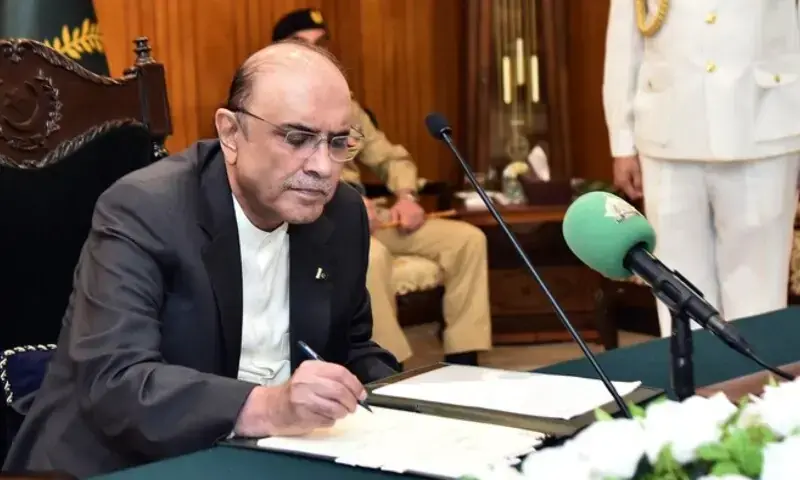
President Asif Ali Zardari on Wednesday assented to three bills on the advice of the prime minister, including one for establishing a statutory body to protect and promote the rights of minority communities in the country. According to a statement released by the Presidency, Zardari approved hree pieces of legislation on the advice of Prime Minister Shehbaz Sharif. These include the Qanun-e-Shahadat (Amendment) Bill 2025, the King Hamad University of Nursing and Associated Medical Sciences Bill 2025 and the National Commission for Minorities Rights Bill 2025. The statement added that the Daanish Schools Authority Bill 2025 was sent back to the premier “in view of the need for provincial consultation”. “In the case of establishment of Daanish schools in the provinces, prior consultation with the respective provincial governments is essential,” the statement quoted the president as saying. The Daanish Schools Authority Bill 2025 was passed with a majority vote during a joint session of Parliament earlier this month amid stiff opposition from both sides of the aisle. The opposition was based on fears that a provision giving the law an overriding effect would affect the anti-Ahmadiyya ordinance promulgated in 1984. A motion seeking leave of the House to take up the bill for immediate consideration was opposed by around one-third of the members present in the joint sitting. A total of 160 members voted in favour of the bill while 79 opposed it. The bill was, however, passed with certain amendments, including the omission of the clause giving it overriding effect and a change to withdraw the suo motu powers earlier proposed for the National Commission for Minorities’ Rights. During the session, Law Minister Azam Nazeer Tarar made it clear that the bill would neither dilute the anti-Ahmadiyya provisions nor affect any court judgement. “Neither the law nor the Constitution, nor our conscience, allows us to make a proposal that contradicts the Holy Quran and Sunnah,” he remarked. He said the Constitution and the state had declared Ahmadis as non-Muslims, but they did not accept this and therefore did not fall within the ambit of the bill. He said that when the decision declaring Ahmadis non-Muslims was challenged, the Supreme Court had held that the protection under Article 20 of the Constitution was not available to those who did not recognise their non-Muslim status. The minister said four amendments had been suggested to the original draft and these had been incorporated into the proposed legislation. Saying that minorities were defined as “non-Muslims” in the Constitution, he added: “This is a commission for non-Muslims. Our Hindu, Christian and Parsi brothers are as good Pakistanis as we are.” Tarar recalled that a 2014 Supreme Court judgement had called for the constitution of a commission for minorities. The matter had landed in the joint sitting after around 10 years, he added, before the debate on the bill began. He underlined that the proposed commission would not have punitive powers and would instead send its recommendations to the government. “Our Christian, Hindu, Parsi, Sikh and other non-Muslim brothers and sisters deserve a forum to address issues — whether forced conversions, job quotas, sanitation workers’ rights or other matters of dignity,” he told the joint sitting.