


 Business Recorder
 Pakistan’s ‘doctor brides’: overqualified, stuck at home and full of regret
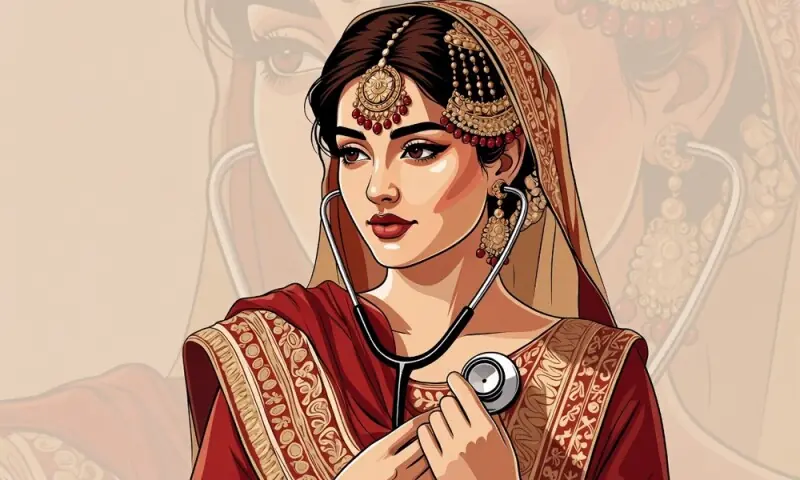
When Sabah Malik recalls being the only female surgeon working in heavily male-dominated workplaces in Pakistan, it is with a sense of pride. Yet, when her husband demanded their daughter study medicine, she says she stood firmly opposed. She didn’t want her daughter to end up like her: a “doctor bride” — overqualified, underemployed, stuck at home and full of regret. “My husband still blames me for putting her off the [medical] track, but I always reply that I cannot force my daughter to do something she doesn’t want to do just because it will bring her better suitors,” says Malik, who asked to be identified by a pseudonym due to fears of reprisal from her family. Eighteen years after her husband forced her to stop practising medicine, Malik still feels remorse about leaving behind a career she was deeply passionate about. As with most marriages in Pakistan, hers was arranged, and during the courtship process her qualifications as a doctor were a big part of the appeal for her husband and in-laws. But once they settled into their relationship, she says, her husband first refused to let her treat male patients, and then refused to let her work at all — he wanted a wife who was a doctor, but not one who actually worked as a doctor. Malik’s circumstances are far from unusual. In Pakistan, women outnumber men in medical colleges with 80 percent enrolment, yet many no longer practice after getting married. They’re known as “doctor brides”, a term coined by columnist Rafia Zakaria for turning a medical degree into “a degree dowry whose value does not lie in its actual use.” Professional matchmakers say families enjoy the sense of status that comes with landing a doctor bride but maintain traditional expectations about the roles she’s supposed to perform: raising children and managing the household. Sabah’s husband first refused to let her treat male patients, and then refused to let her work at all The public health implications of this trend are serious: research conducted in September 2023 reveals that out of the 104,974 female medical graduates residing in Pakistan, as many as 35% are unemployed. Healthcare researchers believe narrowing this gender gap could play a key role in addressing chronic healthcare shortages in a country that ranks 130th out of 195 countries in the Global Health Security Index. Pakistan has 1.1 doctors per 1000 people, according to the latest World Bank data — in comparison, the European Union has 4.3 doctors per 1000 people, while the global average is 1.7 doctors per 1000 patients. The phenomenon led to a nationwide debate about whether public resources are being wasted educating women who will leave the workforce - in 2014, the Pakistan Medical Commission suggested introducing a quota to limit the number of female students in medical school, arguing that women enjoyed excelling academically but were not as interested in pursuing a career as men. This led to a backlash from activists and practitioners, who accused the commission of taking a conservative stance and exploiting the circumstances to push back against female practitioners. The situation in Pakistan reflects a phenomenon taking place across South Asia — women’s education is higher than ever before, but female workforce participation is falling. Many economists call this a “U-shaped relationship” common in middle-income countries, with women’s workforce participation dropping as they leave traditional agrarian roles when the economy advances — but the participation rates are especially low in South Asia, and in Pakistan the health sector is seen as one that would strongly benefit from the increased participation of trained female doctors. The medical degree is a ticket for better marriage proposals Despite living in a comfortable home with children she adores, Malik says she feels no satisfaction with her life and there is a toll on her mental health. “I would be in a better position today physically and mentally had I been working. What was the use of me studying so much if in the end, I had to stay a housewife and look after the household chores?” she says. Both Malik’s sisters also studied medicine. Their parents encouraged them because they thought it would bring them better marriage proposals, she says. “I’ve seen a lot of families with all the girls being doctors for this reason,” says Maha Javed, a doctor bride in Karachi who also asked to be identified by a pseudonym because her family would react negatively if they learned she was interviewed. Javed pursued medicine because it was her passion, not because it was a ticket to a good marriage. In 2009, she got accepted into Ziauddin University, one of the top medical schools in the country. Then came the marriage proposal, but Javed says it came with a condition: she would have to drop out of school. Once married, her days revolved around cleaning and cooking for her in-laws. “I had no life outside the kitchen and the house,” Javed says adding that she feels envious upon viewing her batchmates pursuing medical practise. “This was one thing I really wanted to do in my life,” she says. “So yes, there are regrets.” A study published in The National Center for Biotechnology Information shows that parents in Pakistan perceive the medical degree as a ‘safety net’ should something go wrong with the marriage, rather than a step towards a sound career. When Malik’s husband refused multiple pleas to let her work, she turned to her father for support. Her father instead urged her to stabilize her marital life by caving into her husband’s demands. “He told me that he had provided me with good education only so I could support myself in difficult times when no male heir was present to help me,” she recalls. Malik says that today, she feels resentful of her husband, who she says is excelling in his professional field. “What I have observed is that men simply do not want their wives to move ahead of them professionally,” says Malik. “It is their psyche.” A remote opportunity Ambitious and driven, Sara Saeed Khurram never thought it would happen to her. Yet after the birth of her first daughter in 2004, she stopped practising radiology and started staying at home to take care of her child. “I realized that I had become a doctor bride,” she recalls. “I couldn’t work, which pushed me into postpartum depression.” Looking for ways to keep working while at home, Lahore-based Khurram eventually found an opportunity with a clinic in Karachi in 2005. The city was experiencing an influx of refugees from the war in Afghanistan. Doctors were no longer showing up to work, afraid of the violence, creating a demand for remote consultations. As awareness of the doctor bride phenomenon grew, Khurram realised they comprised a large, untapped workforce. Drawing from her experience of video consulting, she eventually launched Sehat Kahani, a 24-hour telemedicine company which seeks to recruit from this pool of stay-at-home doctors. Today, Sehat Kahani has completed over 4.2 million consultations and has 65 e-clinics nationwide. More women practitioners could help address specific health sector shortcomings in Pakistan, which has one of the worst infant mortality rates in the world. In many countries with strong female participation in the workforce, women often make up a large proportion of paediatricians or family medicine practitioners — women accounted for 52% of paediatrics in the United States. Just as she fought her husband over her daughter’s studies, Malik fought for her sister to complete her medical degree because that was what she really wanted to do. She says her sister’s husband resisted, even on the day of the final exam — but in the end, her sister prevailed. “I often tell my husband: ‘You shouldn’t have married a doctor if you wanted someone who just did the dishes,” says Malik “That’s a cook’s job.”