


 Business Recorder
 Talk at children’s summit: Ahsan identifies critical development challenges
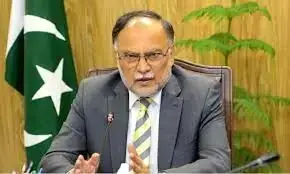
ISLAMABAD: Minister for Planning, Development and Special Initiatives, Ahsan Iqbal Wednesday said Pakistan’s development challenges are not due to a lack of policies but due to political instability, inconsistent implementation and insufficient investment in children, warning that without urgent reforms and a focus on education and child welfare, the country cannot compete in the 21st century. Speaking at a conference titled “Shaping Policy through Evidence: Strengthening Systems for Children in Pakistan,” he said that improvement in physical infrastructure alone cannot deliver real progress. “No matter how much we invest in roads, bridges, or buildings, it is worth little if our social and economic foundations are weak,” he said, calling Pakistan’s development base uneven and unstable. Ahsan Iqbal noted that national visions, such as Vision 2010 and Vision 2025, emphasized continuity in planning. However, political instability prevented their execution. “No economic plan in our history has been allowed continuity. Programs are repeatedly disrupted, and results suffer,” he said. Describing the current period as a decisive phase for the country, he urged policymakers and leaders to learn from the successful economies. “We must decide whether to repeat the mistakes of the last 78 years or choose a different path,” he said. He compared public policies to seeds, emphasizing that even the best-designed policies need a supportive environment to succeed. “A seed alone cannot grow without the right soil, water, climate, and stability,” he said, highlighting Pakistan’s failure to provide such an environment. Referring to international experience, the minister outlined four pillars for sustainable development: peace, political stability, long-term policy continuity, and continuous reform. “There is no progress without peace or political stability. Policies need at least ten years to produce results. Interrupt them, and progress returns to zero,” he said. He cited examples of India, Bangladesh, Malaysia, and Singapore, where long periods of stable governance allowed consistent policies to transform economies. However, he warned that stability must be accompanied by reform. “Without continuous reform, stability only maintains the status quo,” he said. Professor Iqbal added that Pakistan does not lack ideas or technical knowledge. Reports from international donors and consultants are plentiful, but a “knowing-doing gap” prevents action. Citing research by Stanford University professors Jeffrey Pfeffer and Robert Sutton, he said successful organizations turn knowledge into action. “Many institutions know what should be done, but their systems and incentives block change,” he said. Turning to human development, the minister stressed education and child welfare as national priorities. He noted that while Pakistan’s economic indicators resemble middle-income countries, social indicators lag far behind. “A structure cannot be stable if half the foundation is weak,” he said. Using the 2023 census, he highlighted rising population growth, now around 2.55% per year, with over 6.5 million children born annually. He questioned whether the country has enough resources to ensure children’s health, education, and well-being. Expressing concern over child stunting, he said Pakistan has remained at about 40% for four decades. “This means 40% of children are physically weak and mentally underdeveloped. In today’s world, where creativity and brainpower drive success, we cannot compete like this,” he warned. He called for urgent and sustained investment in children. “To secure our future, we must end stunting and unlock the physical and mental potential of our children. Only stability and policy continuity can make reforms deliver lasting results,” he concluded. Copyright Business Recorder, 2025