


 Business Recorder
 EDITORIAL: Bondi’s warning
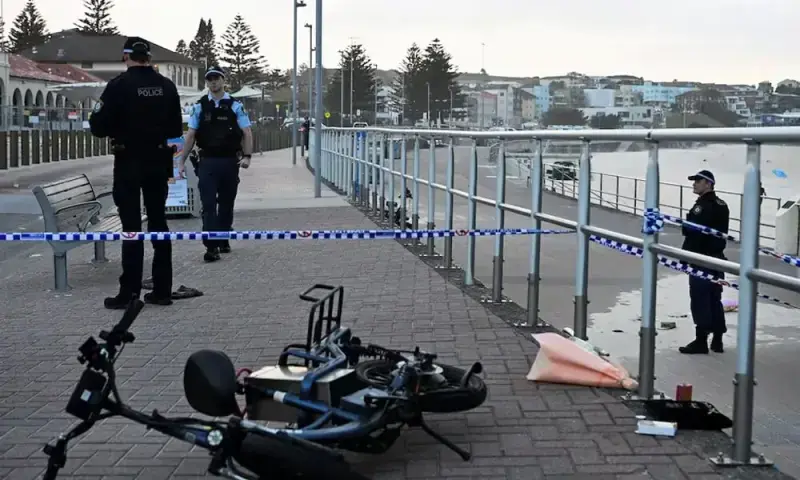
EDITORIAL: Sadly, the attack at Sydney’s Bondi Beach is yet another reminder of how quickly violence rooted in extremist ideology can erupt far from traditional conflict zones. The targeting of a public gathering, the loss of innocent life, and the shock felt across Australia and beyond demand unambiguous condemnation. Clearly, terrorist non-state actors continue to demonstrate an alarming ability to radicalise individuals across borders, exploiting grievances and identities to justify acts that are indefensible by any moral or political standard. Condemnation alone, however, is never sufficient. What follows such attacks matters just as much as the outrage that accompanies them. In this respect, Australia’s response offers a telling contrast to how some states react when confronted with gun violence. Immediately after the attack, the Australian government began openly discussing tighter gun controls, revisiting licensing standards and enforcement gaps. This instinct to move quickly is not unprecedented in that part of the world. New Zealand responded to the Christchurch mosque massacre by rapidly tightening its gun laws, pushing through legislative changes with broad political backing and little tolerance for delay. That seems to have set the right standard, at least for some countries. That willingness to act stands in sharp contrast to countries where gun regulation remains politically untouchable despite repeated tragedies. There, the cycle is depressingly familiar: expressions of sympathy, ritualised debates over “root causes,” and a return to inertia while weapons remain easily accessible. Bondi reinforces a basic truth that policymakers in some countries, like the US, resist acknowledging: mass violence is not just a security failure, it is a regulatory one. Controlling access to lethal weapons is not a cure-all, but it is a necessary starting point. Another troubling dimension of the episode has been the conduct of media, particularly in the early hours after the attack. Sensationalism thrives in moments of uncertainty, and the rush to assign blame often precedes verified facts. Some foreign outlets, especially sections of Indian media, were quick to direct suspicion toward Pakistan before basic details had been established. When it later emerged that the attackers were indeed of Indian origin, some reputational damage had already been done. This pattern is not new, but its consequences grow more serious each time it is repeated. Irresponsible speculation does not merely misinform; it inflames public sentiment and deepens prejudice. Yet it continues unchecked. Social media compounded the problem. In the scramble for virality, unverified names and images circulated freely, dragging innocent people into the storm. One Australian national sharing a name with a suspect reportedly feared for his and his family’s safety as online accusations spiralled out of control. This is the darker side of digital platforms that function as judge, jury and amplifier all at once. The harm caused by such misidentification is real, and often irreversible, yet accountability remains elusive. These failures of restraint matter because they intersect with the very dynamics extremist groups seek to exploit. Terrorism feeds on polarisation, on the erosion of trust, and on narratives that pit communities against one another. When media outlets and online platforms abandon basic standards of verification, they become unwitting partners in that project. Equally dangerous is the temptation to use such attacks to advance unrelated political agendas or to stigmatise entire communities. Violence carried out by individuals must never be allowed to define millions of people who share neither their beliefs nor their actions. Bondi should therefore be read as a broader warning. Security is not achieved solely through intelligence operations or reactive policing. It also depends on responsible governance, credible regulation, disciplined media practices and a public sphere that values accuracy over outrage. Australia’s willingness to re-examine its gun laws deserves attention, not because it guarantees safety, but because it recognises that prevention requires action, not platitudes. If there is a lesson here for the rest of the world, it is a simple one. Tragedies do not become turning points automatically. They do so only when states, institutions and societies choose to respond with seriousness rather than spectacle. Anything less risks ensuring that the next warning arrives in the same brutal form. Copyright Business Recorder, 2025