


 Business Recorder
 Street crime down 44%, 89% major drug dealers busted: Sindh CM
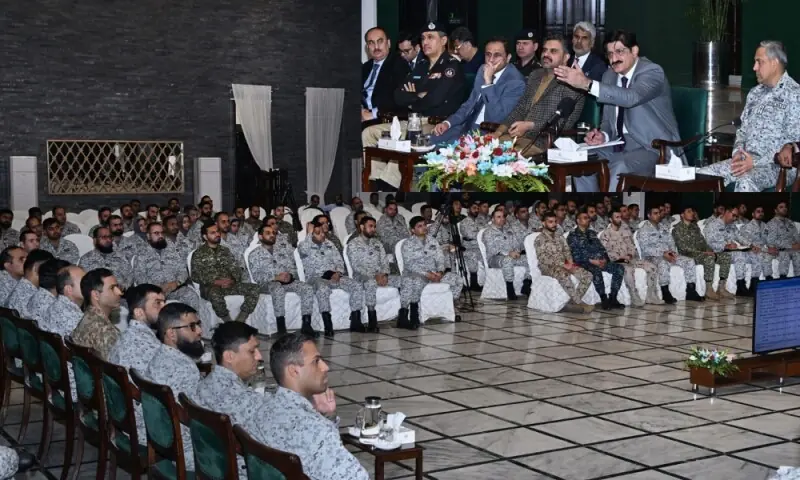
Sindh Chief Minister Syed Murad Ali Shah on Thursday announced wide-ranging reforms and technology upgrades in the Sindh Police, claiming they have led to major improvements in law and order across the province. “Police reforms and the use of technology have led to major improvements in law and order across Sindh. Mobile phone and vehicle snatching and theft have fallen by over 44 percent, and an 89 percent arrest rate has been recorded among top-category drug sellers. Around 12,000 CCTV cameras have been integrated with national databases, and the electronic tagging of repeat offenders has enhanced monitoring and deterrence.” CM said this while addressing officers of the 55th PN Staff Course and 23rd Correspondence Staff Course led by Rear Admiral Sohail Ahmed Azmie, Commandant PN War College / Commander Central Punjab at the CM House. Sindh ministers, inspector general of police and secretaries also attended the event. Sindh Police to recruit 2,000 ASIs The CM noted that Sindh Police, established in 1843 and among the subcontinent’s oldest forces, now has 162,000 personnel, 618 police stations across 31 districts and a budget of nearly Rs190 billion. He said the force, which has lost 2,553 personnel in the line of duty, is being modernised in structure, operations and welfare. CM Murad said the government has focused on the basic unit of policing, the police station, through renovation, upgradation and financial autonomy. “Hundreds of police stations have been given dedicated budgets, while SHOs and investigation officers have been empowered as Drawing and Disbursing Officers to speed up decision-making and improve accountability,” he maintained. The CM highlighted several technology-driven initiatives. “The Police Station Record Management System now records all case-related entries and is digitally linked with forensic, chemical, DNA and medico-legal labs, as well as the court system, allowing judges to see case progress online,” he said. The Sindh Smart Surveillance System, installed at toll plazas with AI-enabled cameras, is integrated with criminal and Excise Department data and has helped arrest hundreds of suspects, he said, adding that a modern CTD Fusion Centre uses open-source intelligence, big data and advanced video and audio tools to strengthen counterterrorism. Other systems include the Hotel Eye Management System, which tracks hotel guests and has led to numerous arrests; the Employee Verification System, which uses biometrics to verify workers and has helped catch thousands of criminals; and the Talash device, which lets officers verify a person’s record on the spot through biometric checks. Body-worn cameras have also been introduced to improve transparency in patrol and traffic duties. Sindh Assembly forms panel to discuss e-challan issue The CM pointed to specialised units such as Centralised Investigation Cells, with trained investigation officers and dedicated labs; the Special Security Unit, which has provided security for international cricket and other high-risk events; the Rapid Response Force for emergencies and high-risk missions; the Crowd Management Unit, including a women’s wing; and the Sindh Police Highway Patrol, being equipped with vehicles and personnel to secure major highways. Traffic management, he said, is also being modernised through an online driving licence system and an AI-based enforcement and e-challan platform. He backed his claims with crime statistics, saying that between January 2024 and November 2025, incidents of mobile and vehicle snatching and theft fell by over 44 percent, while deaths and injuries during robberies dropped by more than 60 percent. Murad described a major shift in strategy in the Kacha (riverine) areas, where the government has moved from reactive to offensive operations under a framework of attack, surrender, de-weaponisation and mainstreaming. “Since 2024, intensified operations supported by technology in Sukkur, Ghotki, Kashmore and Shikarpur have led to hundreds of dacoits being killed, injured or arrested, large quantities of weapons recovered, and dozens of wanted bandits with head money surrendering,” he said. From January to November 2025, the CM said, the police have also pursued an aggressive campaign against organised crime and narcotics, achieving an 89 percent arrest rate among top-category drug sellers. The chief minister stressed that the government is equally focused on police welfare. Families of martyred officers receive substantial compensation, continued salaries until retirement age, employment opportunities, health insurance, scholarships for children and cash assistance for weddings. He said these measures recognise and honour the sacrifices made by the force. Looking ahead, CM Murad said large-scale technological projects such as the Karachi Safe City Project - featuring 12,000 CCTV cameras integrated with national databases - and electronic tagging of repeat offenders will further enhance monitoring and deterrence. The expansion of the Sindh Smart Surveillance System to more entry and exit points of major cities, he added, will help curb terrorism, smuggling and cross-border crime. The chief minister concluded that the provincial government is committed to building a professional, technology-enabled and community-focused police force and to ensuring that every citizen feels safer and every sacrifice by the police is respected. The visiting officers, he said, appreciated the briefing and acknowledged the progress made in modernisation, operational effectiveness and welfare.