


 Dawn.com
 US grapples with defining mandate for Gaza stabilisation force
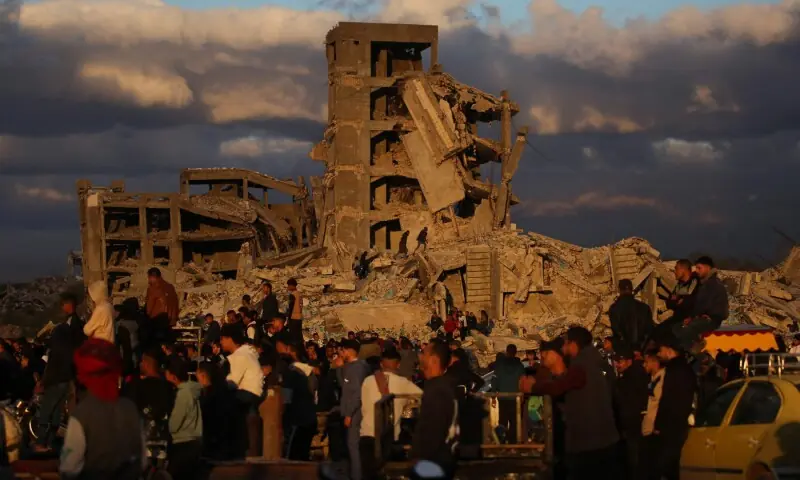
The United States (US) is facing a delicate balancing act in defining the mandate for a proposed International Stabilisation Force (ISF) in Gaza. Any plan must address the concerns of potential troop-contributing countries while also satisfying Israel’s security demands — a combination that has so far proven elusive. As diplomats gathered this week in Doha and Miami, it became clear that clarity on legal authority, rules of engagement, and operational responsibilities is a prerequisite for any country, particularly Muslim-majority nations, to commit troops. Until these questions are resolved, phase two of the Gaza peace plan risks remaining largely a blueprint on paper rather than an actionable plan. Consultations in Doha and Miami Earlier this week, the United States and its partners convened a conference in Doha, Qatar, bringing together representatives from more than two dozen countries to discuss key aspects of the ISF, including leadership, rules of engagement, and operational structure. The meeting, however, failed to produce a mandate that would satisfy both Israel and potential troop contributors. The lack of consensus highlighted the challenge Washington faces in moving from a diplomatic framework to an actionable plan. Turkish officials, for example, reiterated their readiness to participate, despite Israel’s objection to their participation. On Friday, Washington hosted senior officials from Qatar, Egypt, and Turkiye in Miami to advance discussions on the second phase of the ceasefire. The talks, led by US President Donald Trump’s special envoy Steve Witkoff, aimed to bridge gaps rather than finalise agreements. Israel and Hamas were not directly represented. The second phase envisions three intertwined steps: the withdrawal of Israeli forces from Gaza, the establishment of an interim governing authority, and deployment of the proposed ISF to maintain order. Officials described the discussions as constructive but acknowledged slow progress. The talks occurred amid continued hostilities. An Israeli strike on a shelter in Gaza City’s Tuffah neighbourhood killed at least six Palestinians and wounded several others. Diplomats have warned that deploying an international force without a clearly defined mandate could place troops directly in harm’s way. ‘Mandate first, commitments later’ In his remarks during a press briefing on Friday, US Secretary of State Marco Rubio emphasised that defining the mandate is a prerequisite for troop contributions. Key questions remain unresolved, including the force’s legal authority, command structure, funding, rules of engagement, and duration. “We owe countries more answers before we can ask them to firmly commit,” Rubio said, noting that several states have expressed willingness to consider participation, but no formal commitments should be expected at this stage. Rubio specifically mentioned Pakistan , noting that Islamabad had offered to be considered for participation but had not formally committed. He described Washington as “very grateful to Pakistan for their offer to be a part of it, or at least their offer to consider being a part of it,” while stressing that clarity on mandate and operational details is needed before any troop contribution. Pakistan, Rubio added, could be a key partner if a mandate is finalised and concerns expressed by Muslim nations are addressed. Rubio also outlined plans for a “Board of Peace” and a Palestinian technocratic committee to oversee day-to-day governance. “I think the next step here is announcing the Board of Peace, announcing the Palestinian technocratic group that will help provide daily governance. And then once that’s in place, I think that will allow us to firm up the stabilisation force, including how it’s going to be paid for, what the rules of engagement are, what their role will be in demilitarization and so forth,” he said. US officials view these interim bodies as essential to providing a political framework that legitimises the ISF. Without such structures, foreign troops risk operating in a political vacuum, caught between competing claims of authority. Disarmament — the main sticking point Disarmament of Hamas remains highly contentious. Bassem Naim, a Hamas official, insisted that talks must compel Israel to end truce violations and allow increased humanitarian aid. Earlier this week, Hamas chief Khalil al-Hayya said that the group had a “legitimate right” to hold weapons and that any proposal for the next phases of the Gaza ceasefire must uphold that right. Hamas has resisted full disarmament, arguing such steps cannot precede a credible political settlement. Israel, meanwhile, demands assurances that Gaza will not again become a Hamas stronghold. Rubio indicated that Washington aims to dismantle Hamas’ military capabilities while leaving room for further negotiation. Meanwhile, the humanitarian situation in Gaza remains dire. While the famine has officially been declared to have been averted , UN agencies warn that the population remains at serious risk. Diplomatic tensions are compounded by the US House’s vote to sanction the International Criminal Court over its war crimes investigation — a move welcomed by Israel but criticised by human rights groups and several Muslim nations. A long, uncertain road Rubio estimated that full implementation of the second phase of the Gaza peace plan could take two to three years. So far, the ISF remains largely conceptual rather than deployable. What the Doha and Miami talks, along with Rubio’s statements, reveal is a broader reality: phase two is as much a political transition as a security arrangement, and no country — including Pakistan — is likely to commit troops until the ISF’s mandate, authority, and political framework are clearly defined. Header image: Displaced Palestinians stand next to destroyed houses in Nuseirat camp in the central Gaza Strip on December 19, 2025.