


 Dawn.com
 SMOKERS’ CORNER: OUT OF CONTEXT ORWELL
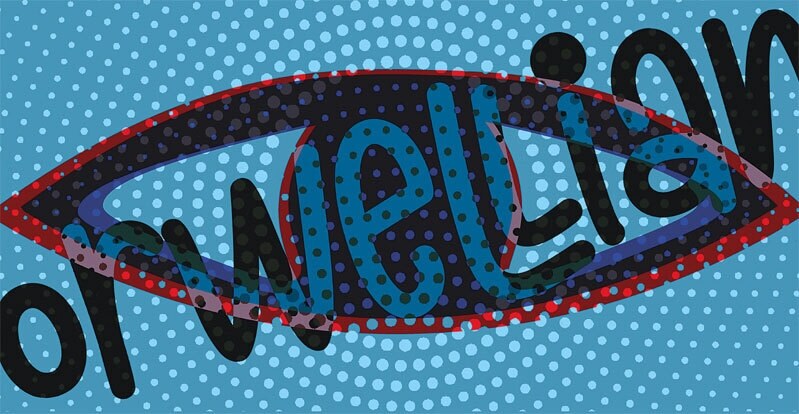
Illustration by Abro George Orwell’s classic novel Nineteen Eighty-Four , published in 1949, explores a fictional totalitarian regime that maintains absolute power by dismantling individual thought, memory and personal connection. Orwell wrote the novel after witnessing the rise of fascism in Germany and, especially, the Stalinist system in the Soviet Union. A self-described socialist, Orwell fought against fascists in the Spanish Civil War (1936-39). But he critically differentiated between ‘democratic-socialism’ and the communism practised in the Soviet Union. By the time Nineteen Eighty-Four was published, totalitarianism in Germany had fallen, but Stalinism persisted. Orwell was particularly disturbed by the Soviet Union’s trajectory, having already satirised it in his 1945 allegory Animal Farm . In Nineteen Eighty-Four , he presented a warning about communism’s potential to create a terrifying dystopia. The term ‘Orwellian’ quickly entered political discourse as a universal descriptor for state overreach, the manipulation of truth and society’s tendency toward mass surveillance and the erosion of individual privacy. From e-challans to clamping down on fake news, almost everything is lazily labelled as ‘Orwellian’ these days by people who do not understand exactly what George Orwell’s writing was critiquing However, since the conclusion of the Cold War in 1991, one can argue that the term ‘Orwellian’ has been stripped of its original meaning, often serving as a catch-all phrase for any unpopular policy. Recently, a friend described the e-challan traffic cameras installed in Karachi as “Orwellian”. He was serious. In a 2021 essay, American novelist Rachel Klein observed that Orwell’s novel and the term ‘Orwellian’ have become political shorthand for censorship and authoritarianism, often used by those who wish to decry state power but without truly understanding Orwell’s specific critiques. Individuals frequently cite the novel and the term due to personal grievances, such as facing social media bans, increased taxation or ‘unpopular’ judicial decisions, regardless of the novel’s actual context. This linguistic drift mirrors the devaluation of the word ‘fascism’. Orwell himself noted in 1944 that the word ‘fascism’ had lost its weight, becoming a mere synonym for the word ‘bully’. Historically, fascism was a systematic, amoral ideology that sparked genocides and a global war while attempting the total psychological subjugation of society. As a word, it just cannot be used nonchalantly or in a matter-of-fact manner. The term ‘Orwellian’ has also become trivialised. Many scholars posit that the manner in which the term is applied to modern inconveniences qualifies it to become obsolete. To understand why this is so, one must look at how modern society differs from the one in Orwell’s novel. The nature of social control in reality is dramatically different from the dystopian world envisioned in Orwell’s Nineteen Eighty-Four . American-Canadian cultural theorist Henry A. Giroux observes that while, in the novel, the state enforced surveillance through omnipresent/unavoidable telescreens, today, surveillance is largely voluntary. People willingly exchange their biometrics, habits and movements via the convenience of smartphones, social media and smart home devices. Furthermore, according to Indian assistant professor Anuradha, instead of the monolithic state serving as the primary overseer in Orwell’s narrative, in today’s reality, the main overseers in this regard are private corporate entities. This paradigm is often termed “surveillance capitalism”, where corporations harvest massive amounts of personal data, converting the human experience into data and selling it for profit, making the corporate entity, rather than the state, the primary overseer of the 21st century. This has actually weakened the role of the state. In fact, the state is also struggling to come to terms with this reality. In Nineteen Eighty-Four , the state physically deleted or rewrote history, but modern day control is often achieved through information saturation and/or through an overwhelming abundance of content, misinformation and algorithmic echo chambers that intentionally obscure the distinction between truth and fiction. These are often the doings of new tech corporations and citizens, and not so much of the state. In other words, these conditions are largely being produced by non-state actors. In another stark contrast, Nineteen Eighty-Four depicted a world defined by constant war and extreme scarcity, enforced rationing and austerity. Many modern societies, however, are driven by hectic consumption, fuelled by advertising and rapacity. Adding to this conceptual dilution is the trivialised way Orwell’s novel and the term ‘Orwellian’ are currently used by the political left and right. They accuse each other of being ‘Orwellian’, much like they use the term ‘fascist’/‘fascism’. Both sides have drained these words of their actual meaning, using them instead as clichés for anything they disagree with. Both have hollowed out the actual meaning of these terms, employing them as facile labels for disagreement. A lot of people, both on the right and the left, frequently apply the term ‘Orwellian’ when private companies such as X and Facebook ban accounts. Yet, ‘Orwellian’ strictly describes state-sponsored control of thought and language. Nothing’s private in his novel. The term is also misapplied to government policies such as pandemic lockdowns or public health mandates, despite Orwell’s support for state intervention during crises. The pushback against clamping down on fake news is also termed as ‘Orwellian’ by many ‘free speech’ advocates. The irony is that it is the pushback that is actually ‘Orwellian’, because the creation of an alternative reality through fake news and claims using political jargon is arguably the very essence of the distortion that Orwell warned against. Orwell’s true target was totalitarianism in all its forms, encompassing both the right and the left. In 2021, the American writer Benjamin Newcomb wrote that the term ‘Orwellian’ has become too vague, too cliché and too pretentious to be of use anymore. It is invoked to describe any number of events that its user finds distasteful. The issue is not that ‘Orwellian’ is an ill-conceived word, but that it is a word whose meaning has frayed. Sales of Nineteen Eighty-Four have once again spiked in recent years. Indeed, Orwell is back in vogue, but still quite out of context. Published in Dawn, EOS, December 21st, 2025