


 Dawn.com
 Fencing champion Banin Nasry sets sights on Olympics after double gold at national games
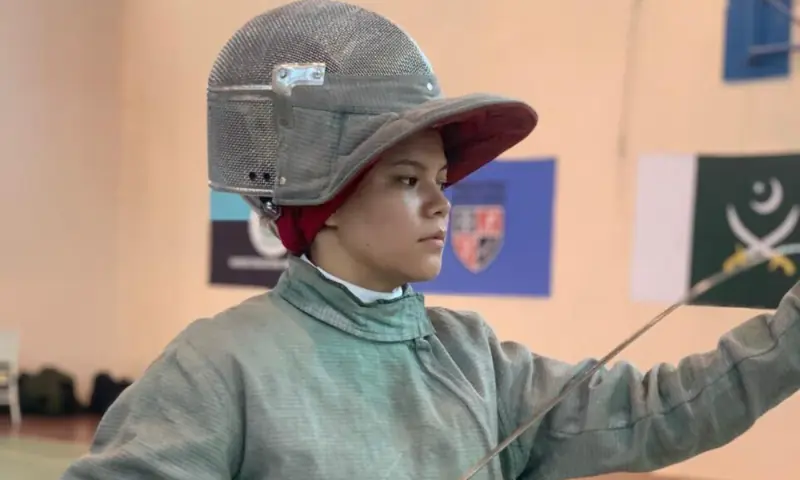
National champions are typically forged from years of rigorous training, determination and a foray into the sport in childhood. But Umul Banin Nasry is anything but typical. Her journey to fencing stardom began with one element; curiosity. Barely one month after taking up the sport, she won gold at the national fencing championships, although her gold medal at last month’s 3 5th National Games holds a sense of greater grandeur for her. Now, as the 21-year-old awaits her international debut and a chance to become Pakistan’s first fencer at the Olympics, her journey is intentional, fuelled by an unwavering commitment to training and family support in defiance of societal disapproval. It all began five years ago. Banin was intrigued by some women at her college in Quetta practicing “weird stepping movements”, only to find out it was for a sport called fencing. She tried her hand at it — quite literally — and immediately fell in love with a sport she had only seen online. Her coach signed her up for the 4th National Fencing Championships, where her unexpected gold medal solidified her commitment to the sport and a departure from flag football that she had also played at a national level. She entered the mindset of a champion right after becoming one; five hours of training every day — “there’s no days off, no excuses” — and a daily schedule that revolved around her desire for excellence in the sport. In the lead up to the national games, Banin spent all day training at Ayub National Stadium. Even when the Covid-19 pandemic brought the world to a halt, Banin would show up to an empty stadium to train. “The first time I competed, I was up against athletes who trained abroad and had experience I was nowhere close to,” she told Dawn over the phone from Quetta, where she had promptly resumed training after claiming four medals at the national games in Karachi, including two golds. It was the final jewel in her national crown after she won silver at the National Games in her hometown in 2023. “I trained till I became mentally invincible, telling myself that my opponents are just athletes like myself, nothing else.” Her literal journey in the sport was costly. Roundtrip transportation from her house till Ayub National Stadium where she trained cost one thousand rupees per day, which was unaffordable. The only solution was to walk for nearly 30 minutes from her house till a checkpost and then taking a rickshaw to the stadium from there. Men stared at her as she walked alone. Society whispered about how and why her family had allowed her to take up a sport like this, oblivious to her national accolades. But her family was unwavering in their support from the start. After all, she belongs to Pakistan’s Hazara community that boasts exceptional talent in football and martial arts, where Banin’s younger brother is provincial Taekwondo champion. Younger sister Maheen followed in her footsteps and took up fencing, winning a bronze for team Navy at the National Games. Umul Banin (L) and youger sister Umul Maheen Nasry at the 35th National Games in Karachi in December. — Photo via athlete Banin credits her eldest brother with her sporting success. The only non-athlete sibling in the family, Arif Nasry filled the financial gaps for Banin by scouting for sponsors and getting two ahead of the National Games. He meticulously manages her social media accounts to promote her through a digital platform. Government recognition has been sparse, and appreciation for her provincial and national triumphs has been empty promises of cash prizes that have never materialised. But Banin’s biggest cheerleader has been Haji Muhammad Qasim, secretary of the Balochistan Fencing Association. He arranges for the athletes’ equipment which only comes from abroad and is not locally manufactured. He staunchly defends his athletes when their families complain that medals are meaningless and sports have no value. “Without him, I don’t think I would have gotten as far as I have,” Banin said, her voice heavy with genuine admiration for her guru. Of course, her coach Mehmood Sharif is the main driving force. Just a couple years older than Banin, 23-year-old Mehmood himself is a two-time national champion and recently represented Pakistan at the Islamic Solidarity Games in Riyadh. The competition would have been Banin’s international debut, but a lack of funds delayed her dreams till 2026. She’s hoping to travel to Iran at the start of next year for intense training for a couple months before making the national team for the Commonwealth Games in July and Asian Games in September. “My journey has just begun,” Banin said less than a week after her national triumphs, with her two gold medals accounting for half of those won by Balochistan. She admitted that having access to electrical fencing equipment — the kind used in competitions for scoring and precision — gave her an edge in the sport compared to manual equipment typically used in training. It’s almost as if everything has aligned for her to reach greater heights in the sport, despite the socioeconomic hurdles in her way. Banin poses with her medals and the team trophy at the 35th National Games. — Phoot via athlete She already knows her Olympic debut will be a tribute — and beacon of hope — to the women who weren’t allowed to fulfill their passions like she was. “When I make it big on the international stage, I want to silence all those who say that women don’t belong in sports and are immoral if they do. “What men can do, women can do too, and I want all those women who are forced to sit at home to know that.”