


 Dawn.com
 Fazl favours do-over of ‘tainted’ 2024 & 2018 polls
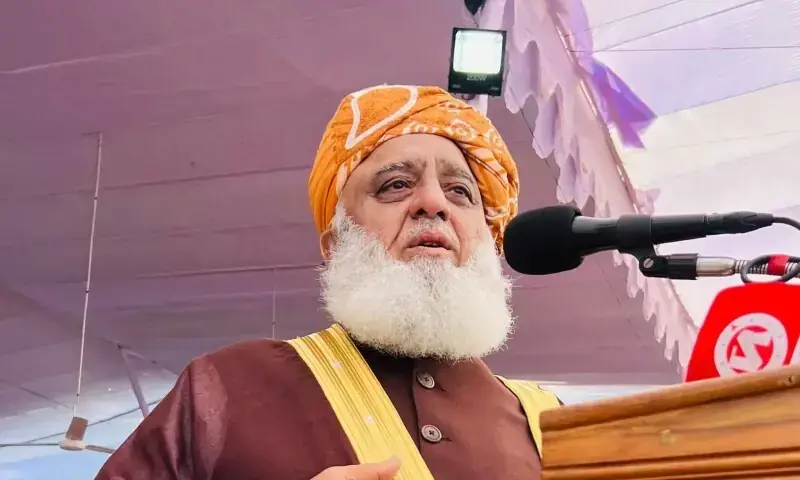
• JUI-F chief warns against attempts to make Constitution ‘controversial’, seeks dissolution of all govts • Maulana stresses need to introspect on Afghan policy, expresses concern over plan to join Gaza force • Criticises move to force seminaries to obtain certificates from govt KARACHI: As political parties from the ruling and opposition camps propose talks to end the political confrontation, Jamiat Ulema-i-Islam (JUI-F) chief Maulana Fazlur Rehman on Monday demanded fresh elections across the country to do away with the governments allegedly born out of rigging. Positioning himself as the one political figure courted by both the government and the opposition, Maulana Fazl declared that the 2018 and 2024 polls were “rigged and did not reflect the will of the people”. Standing alongside the government’s key ally, MQM-P’s appointed Sindh Governor Kamran Tessori, Maulana Fazl questioned the legitimacy of Prime Minister Shehbaz Sharif’s government while also, without naming it, casting doubt on the past record of the country’s largest opposition party, the PTI. “Fresh elections must be held,” he responded to a question. “Neither the 2018 elections nor the 2024 polls reflected the will of the people. The governments born out of establishment-backed rigging should come to an end. From Sindh to Khyber Pakhtunkhwa, these governments should be brought to an end and fresh elections must be held across the country.” This is not the first time he has demanded snap polls; in fact, less than a week after the Feb 8 elections, his party had rejected its results and demanded fresh polls. The JUI-F chief made a similar call in September last year as his party engaged the PTI as well as the ruling coalition, apparently to make a political comeback. The JUI-F was also instrumental in the passage of the 26th Amendment. Speaking at Governor’s House, where he was conferred an honorary doctorate from Sir Syed University, Maulana Fazl warned that the government’s current actions were “making the Constitution controversial and disputed”. He was referring to the 27th Amendment, which was passed despite opposition from his party. Responding to a question, Maulana Fazl described the 27th Amendment as legislation passed through a “forced majority,” but at the same time, he defended the 26th Amendment passed last year, in which he had played a key role. “The 26th Amendment was passed by consensus, so it is not appropriate to make it disputed,” he said. “The 27th Amendment, however, was one-sided. You did not have a majority, meaning the majority was created through force. Then, all those things from which you stepped back in the 26th Amendment were included in the 27th Amendment, which is why the Constitution is now being seen as disputed. We should avoid turning the Constitution into a subject of dispute.” Tensions with Afghanistan When asked to comment on recent tensions with Afghanistan, the JUI-F chief questioned the government’s policies and urged the authorities on both sides of the border not to drag people into the internal state matters because of state actions. “Afghanistan should not be viewed only in today’s context,” he said. “We should discuss 78 years of our Afghan policy. Pakistan has never had a truly friendly government in Afghanistan. Could this be a failure of our own policy? If we build any narrative, we would definitely put the blame on the other side, but we need to take a look at ourselves as well and ask whether our Afghan policy has failed. This should be a matter of debate.” When asked about his opinion on the proposed deployment of the armed forces in Gaza, he referred to “bitter experiences of the past” and asked the government to “refrain from this and avoid making ourselves controversial”. “A so-called peacekeeping force is not really about peacekeeping – it becomes a war-fighting force. We should avoid making the mistake of becoming part of an international alliance and then turning our guns on Palestinians. We must refrain from this and avoid making ourselves controversial,” he said in reference to the US-proposed International Stabilisation Force (ISF). Later, addressing a conference of clerics, Maulana Fazl defended the role of seminaries and warned that any government action to undermine them under any regulatory cover would put the educational fate of thousands of students at risk. He also criticised “attempts to force” seminaries to obtain certificates from the education ministry and called for the independence of religious institutions. “We announced at the all-parties conference in Lahore that the agreements reached by our senior scholars will not be reopened for discussion,” he said. Addressing curriculum debates, the Maulana said that scholars have long strived to create a cohesive syllabus, but their recommendations were often ignored. He expressed support for modern subjects alongside religious studies. Published in Dawn, December 23rd, 2025