


 Dawn.com
 Jinnah’s democratic legacy: challenges & prospects
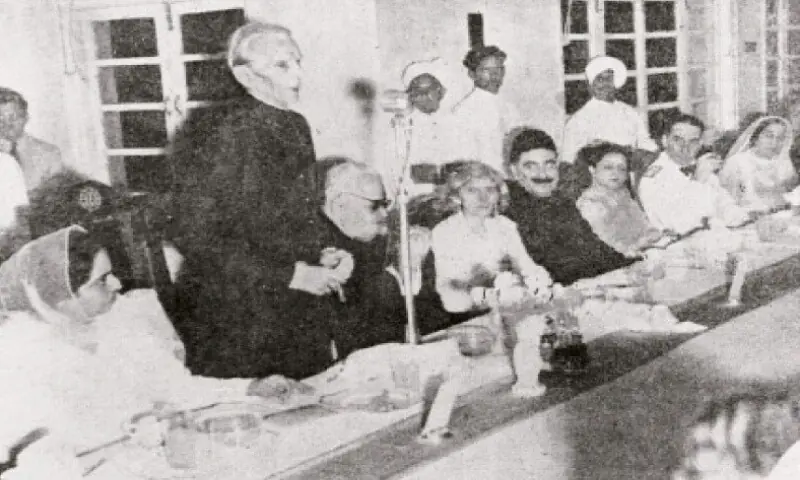
THE Quaid categorically declared that no power on earth can undo Pakistan. QUAID-I-AZAM Mohammad Ali Jinnah, a charismatic statesman, laid the foundation for a modern democratic state, Pakistan, to safeguard the fundamental rights of Muslims who were a minority in pre-Partition India. Pakistan was born as a secular democratic state, but its welfare and prosperity will always depend upon the restoration of Jinnah’s democratic legacy. Despite cultural, religious, or ethnic distinctions, Jinnah steadfastly believed that each Pakistani is an equal citizen; justice, honesty, and impartiality are the guiding principles that protect the right to life, property, and religious beliefs. Hence, for Jinnah, democracy ensures justice for all. Pakistan’s great founder wanted neither a theocratic state nor a feudal one. For Jinnah, democracy was a matter of conviction. ‘Democracy’ means people-centred decision-making, which enables individuals not only to elect their representatives but also to devise public policies, enact laws and amend constitutions through public reasoning for the common good. Democracy treats all citizens as equal members of the state. “Let us lay the foundations of our democracy” Democracy is one of the cardinal attributes of a modern state. The new independent states in the subcontinent, Pakistan and India, adopted the British democratic political structure in their respective countries. The constitutional approach was the only political solution for this region, and it was more than necessary for the two neighbours to develop democratic systems to preserve the principles of equal citizenship, justice and freedom of expression. The rule of law is essential for democracy. In The Legacy of Quaid-i-Azam , Dr Javid Iqbal states that Mohammad Ali Jinnah, being a celebrated lawyer, had a firm belief in the rule of law rather than the rule of individuals. The rule of law strengthens institutions, not individuals. He writes: “Quaid-i-Azam obviously stood for a strong, independent and irreproachable judiciary because human rights could not be protected and enforced without such a judiciary”. Jinnah has repeatedly asserted that only an independent judiciary can protect the democratic rights of all people in a state. Democracy is the foundation of Pakistan. In a speech at Sibi Durbar on February 14, 1948, the Quaid declared: “Let us lay the foundations of our democracy based on truly Islamic ideals and principles. Our Almighty has taught us that our decisions in the affairs of the State shall be guided by discussions and consultations”. In The Legacy of Quaid-i-Azam, Dr Javid Iqbal states that Mohammad Ali Jinnah, being a celebrated lawyer, had a firm belief in the rule of law rather than the rule of individuals. The rule of law strengthens institutions, not individuals. Jinnah also announced, forcefully so, that the affairs of the state should be decided through debate and dialogue to serve the people of his great nation. Jinnah, time and again, professed that the constitution of Pakistan must be democratic. In a broadcast to the people of the USA in February 1948, he said: “The constitution of Pakistan has yet to be framed by the Pakistan Constituent Assembly. I do not know what the ultimate shape of this constitution is going to be, but I am sure that it will be a democratic type, embodying the essential principles of Islam…. It has taught equality of man, justice, and fair play to everyone. We are the inheritors of these glorious traditions and are fully alive to our responsibilities and obligations as framers of the future constitution of Pakistan”. Surely, this statement affirms Jinnah’s pristine vision for a democratic constitution of Pakistan. Did Jinnah want a theocratic state? This question seeks a distinction between an Islamic state and a Muslim state. An Islamic state means adopting a particular sect or religion as its constitution, which imposes a single ideology on all in the country. In contrast, a Muslim state provides religious freedom to all citizens. Hence, the father of the nation’s is a Muslim state grounded in the key principles of Islam. In a broadcast to the people of Australia on February 19, 1948, he insisted that “Pakistan is not a theocracy or anything like it.” So, our visionary founder’s Muslim state is a democratic state in which people can practice their beliefs, are free, equal and united; they cannot be subjected to any coercion, fear, exploitation or exclusion. When Mohammad Ali Jinnah was elected as the first president of the Constituent Assembly of Pakistan, he presented a broad vision for a Muslim democratic state in his historic speech on August 11, 1947. He elaborated on the government’s primary duty, identified social evils, determined the role of the state, and the obligations of citizens for a progressive Pakistan. “The first duty of a government is to maintain law and order so that the life, property, and religious beliefs of its subjects are fully protected by the state”. Jinnah insisted on the provision of the right to life, property, and liberty, including the right to religious practice, in Pakistan. A man of tremendous foresight, Jinnah also identified bribery, corruption, nepotism, and black-marketing as the major social evils that damage institutions, and urged the Assembly to eradicate these ills from society. He added: “Now, if we want to make this great State of Pakistan happy and prosperous, we should wholly and solely concentrate on the well-being of the people, and especially of the masses and the poor”. The Quaid’s was an unwavering conviction— without the well-being of the people, no state can prosper. The sense of a nation The founder stated that the progress of a state relied on the recognition of citizenship as a primary shared identity among its members. “If you … work together in a spirit that every one of you, no matter to what community he belongs, no matter what relations he had with you in the past, no matter what his colour, caste or creed, is first, second and last a citizen of this state with equal rights, privileges and obligations, there will be no end to the progress you will make”. It is the shared identity of being citizens of Pakistan, and not anything else, that can foster a sense of a nation among people despite their many differences. “You are free; you are free to go to your temples; you are free to go to your mosques or to any other places of worship in this State of Pakistan. You may belong to any religion or caste or creed – that has nothing to do with the business of the State…We are starting in the days when there is no discrimination between one community and another, no discrimination between one caste or creed and another. We are starting with this fundamental principle that we are all citizens and equal citizens of one State…. Now, I think we should keep that in front of us as our ideal, and you will find that in the course of time Hindus would cease to be Hindus and Muslims would cease to be Muslims, not in the religious sense, because that is the personal faith of each individual, but in the political sense as citizens of the State”. These words serve as evidence of Jinnah’s immaculate vision for Pakistan. QUAID-I-AZAM speaking at the Independence Day dinner at the Governor-General’s House in Karachi on August 14, 1947. Jinnah’s democratic legacy is one of equal rights. For instance, he entrusted Jogendra Nath Mandal to be the first law minister of the Constituent Assembly of Pakistan, paving the way for the participation of minorities in governance. “I shall always be guided by the principles of justice and fair play without any.… prejudice or ill-will, in other words, partiality or favouritism. My guiding principle will be justice and complete impartiality, and I am sure that with your support and cooperation, I can look forward to Pakistan becoming one of the greatest nations of the world.” Our democratic inheritance from the founding father cannot be squandered. In his essay, What if Mr Jinnah returned? Khaled Ahmed wondered whether the founder would prefer a constitution that keeps the judiciary independent of the executive? Alternatively, what if the father of the nation appeared in the parliament, public offices, courts, and police stations as an impartial spectator to see whether his citizens are being treated fairly and have access to justice? Would the Quaid not be happier to witness his own vision of fair play, merit, impartiality, freedom, and the rule of law being practiced in the public offices of Pakistan? Pakistan has moved away from Jinnah’s progressive idea of it. Soon after independence, the country stood trapped between neocolonial authoritarianism and theocracy. In The Sole Statesman , Ardeshir Cowasjee says “Jinnah intended Pakistan to be a democratic, forward-looking, modern, secular state. The bigots and the uneducated will always preach otherwise–and it will remain their privilege to do so”. He added that “Jinnah’s Pakistan died with him”. Later, Cowasjee also stated, “In a way, it was fortunate that Jinnah did not live long enough to see the negation of his principles, the perversion of his vision”. Pakistan’s imperfect present Now, Pakistan stands at the brink of an existential crisis due to numerous crucial challenges: theocracy, neocolonialism, overpopulation, violation of human rights, poor human development, extremism, political uncertainty, economic instability, corruption, poverty, brain drain, and a compromised educational system. All these challenges are manmade and therefore resolvable. Democracy is key as only opening dialogue and arriving at a political reconciliation will assuage discontent, mistrust and socioeconomic distress for a peaceful Pakistan. Democracy in Pakistan is hostage to the theocracy, a neocolonial mindset, egoistical authoritarianism and fascist tendencies. The theocratic mind always tends to control freedom and egalitarianism in the country. In Pakistan: Behind the Ideological Mask, Khaled Ahmed argues that dogmatic ideology is taking the state away from democracy toward fascism worldwide. In Pakistan, he believes, “The state has indoctrinated the masses in favour of a revival of the medieval state rather than a ‘modern’ state”. By doing so, the state refuses to meet modern challenges because indoctrination closes all doors to realistic solutions. There is a dire need to liberate the Pakistani mind from the theocratic mind to develop a rational and critical mind through quality education, which is integral for a Pakistan that is modern and truly democratic. The colonial legacy of governance has diminished the democratic culture of the country. In Confronting Empire , Eqbal Ahmad argued that Pakistan has never been able to decolonise since its independence. He stated that the situation remained the same after independence because “A British-trained army, a British-trained bureaucracy, and the same feudal landlords who had collaborated with the British, constitute the triangle of power…Nothing else has changed. So, the economic reality has not changed, and the political reality has not changed”. Eqbal Ahmad’s claim of neocolonialism is not easy to refute. So, it is undeniable that both theocracy and neocolonialism continue to derail Pakistan’s democratic process. Despite all these challenges, democracy still holds significant meaning, and promise, in Pakistan. For instance, its vibrant youth and cultural diversity are two major catalysts for reform and change. The youth forms a large part of Pakistan’s population. And it has, to some extent, attained political consciousness, which is mandatory for the advancement of democracy in the country. Cultural diversity is a blessing for any democracy; each culture has its own language, art, way of life and cuisine, which should be seen as a valuable opportunity to learn and integrate. Cultural diversity nurtures innovation, creativity and knowledge, while democracy cultivates reasoning in the public sphere. The Quaid categorically declared that no power on earth can undo Pakistan. However, a bright future for Pakistan depends on the extent to which it embraces Jinnah’s democratic ideals and principles in letter and spirit. The restoration of his values can make Pakistan invincible. Democracy is the sole cure for extremism, neocolonialism, the disease of corruption, poverty, and political instability. Jinnah believed in fostering the rule of law, independence of the judiciary, autonomy of institutions, decision-making through public reasoning, and the moral values of equality, freedom, fraternity, justice, fairness, and impartiality in the country. Pakistan, indeed, is Jinnah’s precious gift of freedom. But a future that is grounded in solidarity depends upon intellectual decolonisation through quality education to resolve contemporary sociopolitical, and economic problems. To conclude, Pakistan needs a paradigm shift from present policies for a progressive future. The writer holds a PhD from the University of Canterbury, New Zealand, and teaches philosophy at the University of the Punjab, Lahore.