


 Dawn.com
 Bilawal inaugurates new Rs72bn Indus Hospital building with 1,350 beds
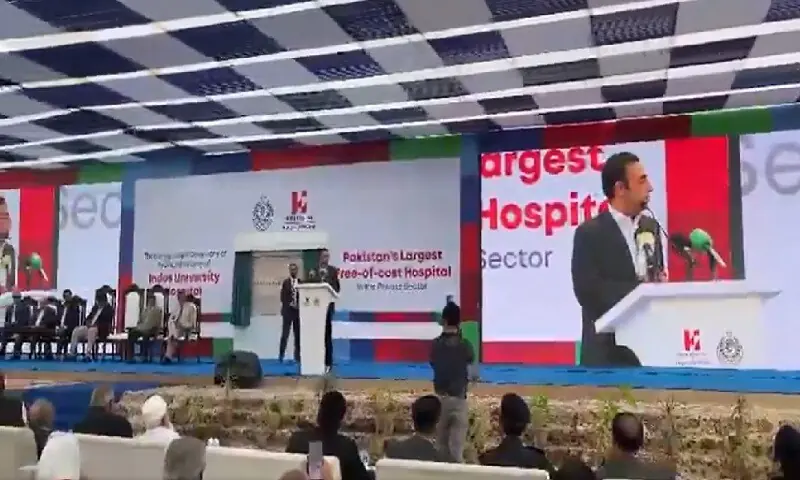
KARACHI: PPP Chairman Bilawal Bhutto on Thursday inaugurated a new building of the Indus University Hospital (IUH) – a major project being developed with the provincial government’s support, which is designed to become the country’s largest free-of-charge hospital upon completion over the next three years. The Rs72 billion facility will have an admission capacity for 1,350 patients. “This initiative is designed to meet Karachi’s growing healthcare needs. Upon full completion, the facility will offer comprehensive, free-of-charge healthcare services across a wide range of specialities, benefiting millions of patients annually,” said Bilawal at the inauguration, which was attended by senior government officials, including Chief Secretary Asif Haider Shah, Health Secretary Rehan Iqbal Baloch, several donors and representatives of the Indus Hospital and Health Network (IHHN). The inauguration of this landmark project on Christmas Day carried deep symbolic meaning, he added. “All religions teach us compassion and the duty to care for the poor, the sick and the most vulnerable segments of society.“ The PPP government, he noted, remained committed to providing world-class healthcare facilities to the people without discrimination of any kind, emphasising that care for the underprivileged lies at the very core of the PPP’s political philosophy. “ Roti, Kapra aur Makaan (bread, clothing and shelter) is not merely a slogan; it is a manifesto, an ideology and a way of life. We believe it is the fundamental responsibility of the state to protect and uplift the poor.” Highlighting the government’s performance in the health sector, the PPP chairman said that the province’s healthcare system had undergone a transformative change since the party had started running the government. “We are no longer competing with other provinces; we are competing on a global scale,” he said. He praised IHHN and other partners of the government for their invaluable contributions, stressing that these partnerships must be further expanded to strengthen healthcare facilities and improve their access to people living in underserved and remote areas. In his remarks, CM Murad Ali Shah recalled the financial challenges faced in materialising the Indus Hospital’s dream. “Dr Bari requested a grant of Rs250 to 400 million at the time when I was serving as the provincial revenue minister. A few days later, I visited the facility myself and met several old friends who were volunteering their professional services,” the chief minister recounted, adding that the initial government funds were used for land acquisition. Murad noted that the initial government grant of Rs300m to the hospital had gradually been raised to Rs8bn. “The government’s partnership with IHHN, which started with a hospital in Badin, continues to grow. Even today, we cannot imagine replacing Indus there,” he said, adding that the Jamshoro Regional Blood Centre was also handed over to the IHHN, which now has the capacity to supply around 20,000 blood bags across the region. In addition, he pointed out, the IHNN was also working with the government in areas such as tuberculosis control and rabies prevention, while more initiatives were being planned. The chief minister also announced plans to further strengthen healthcare services in Badin by linking the entire district to a main hospital and improving taluka headquarters hospitals in partnership with the IHNN. Sharing patient statistics, Murad said around 30 per cent of patients at the Indus Hospital came from Landhi and Korangi, 20pc from other parts of Karachi, while nearly 50pc arrive from outside Karachi, including large numbers from Balochistan and Punjab. “This demonstrates that the healthcare work done in Sindh is far ahead of other provinces, and we achieved this with the support of our partners,” he added. President IHNN Dr Abdul Bari Khan termed the project a transformative development for Pakistan’s healthcare system. He acknowledged the provincial government’s continued cooperation and emphasised that, upon completion, the IUH would set a new benchmark in healthcare. Chief Executive Officer IHHN Prof Syed Zafar Zaidi said IUH represented an evolution of a vision rooted in compassion, dignity and patient-centred care, bringing care, education and research under one roof. Chairman IHHN Board of Directors Abdul Karim Paracha expressed deep appreciation for the government of Sindh’s support in advancing healthcare services for the people of the province. The ceremony concluded with a tour of the newly opened sections of the hospital, including emergency and outpatient services, advanced diagnostic facilities and state-of-the-art operation theatres. Earlier in December, the Sindh Institute of Urology and Transplantation (SIUT), in partnership with the provincial government, launched two key facilities — Syed Haroon Ahmad Dialysis Centre and Zubeida Mustafa Lithotripsy Unit — at its trust hospital located on Sharea Faisal. Bilawal had claimed the Sindh government’s performance in the health sector under the public-private partnership model had been highlighted as a success, earning international recognition. He had also claimed the Economist Intelligence Unit — the research and analysis division of The Economist Group — rated Sindh as the sixth best in partnerships in Asia in 2018.