


 The Advocate
 How a police raid sparked L.A.'s Black Cat protests — which predated Stonewall and birthed The Advocate
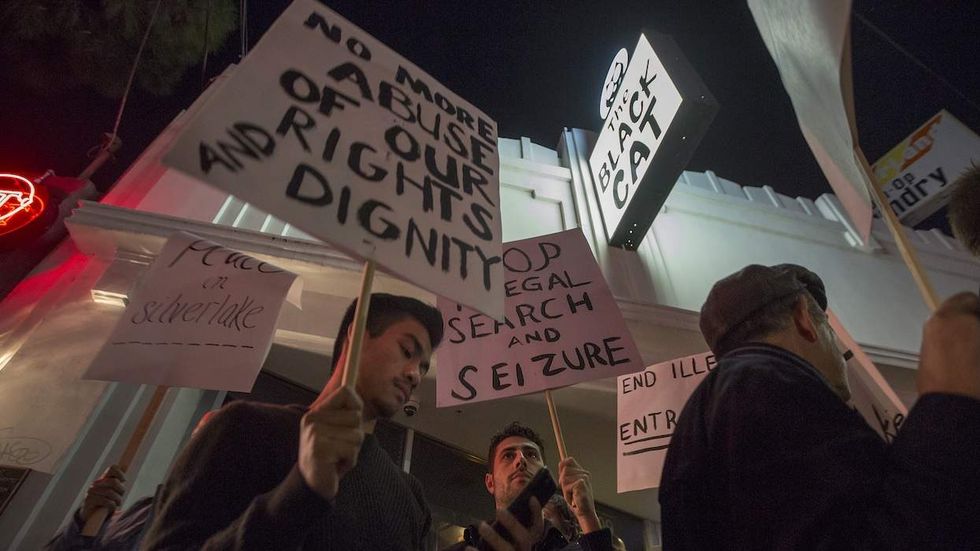
This story is part of History is Queer , an Advocate series examining key LGBTQ+ moments, events, and people in history and their ongoing impact. Is there a piece of LGBTQ+ history we should write about? Email us at history@advocate.com. It’s often said that Pride started with a protest. Actually, so did The Advocate. The Black Cat, a gay bar in Los Angeles’s Silver Lake neighborhood, was raided by police on New Year’s Eve of 1966. As balloons dropped from the ceiling to mark the New Year of 1967, undercover cops ripped Christmas decorations from the walls, brandished guns, then beat and cuffed 14 people. Two men arrested for kissing were later forced to register as sex offenders; one bartender suffered a ruptured spleen. Violent police raids on queer bars weren't uncommon in the '60s, but this time the gays didn't let it slide. Related: After the 2024 election, we can be inspired by these historical LGBTQ+ movements against oppression “The police brutality was unbelievable and extended down to another gay bar,” Alexei Romanoff, the last known survivor of the raid, told The Advocate in 2018. “Undercover police officers came in and started to beat the people who were there. Two men kissing longer than a few seconds was considered a crime, and so these people were charged with a lewd conduct. We were upset, as any community would be, so we started to organize.” “When you have an illegitimate law preventing people from doing certain things, that affects society, and you’ve got to stand up, you’ve got to say, ‘I’m mad as hell and I’m not gonna take it anymore,’ like we did,” he continued. Some political changes affected the situation. “There had been frequent gay bar raids in the Los Angeles area up through about 1964,” said Romanoff’s husband, historian David Farah, who joined in the interview. “There had been a truce called citywide, and there hadn’t been any gay bar raids for about two years [until that New Year’s Eve]. What had happened in the election of ’66 was Ronald Reagan was elected governor of California . He became governor that night at midnight, and with the change of party, the police decided they could go back and start raiding gay bars.” Reagan, a Republican who would go on to court the religious right when he ran for president, succeeded Democrat Edmund G. “Pat” Brown, father of future governor Jerry Brown. In 1967, there was a series of protests at the Black Cat, with some drawing 500 to 600 people, Romanoff said. A group called Personal Rights in Defense and Education, or PRIDE, organized the demonstrations. No local news outlet would cover them. So two gay men, Richard Mitch and Bill Rau, decided to take over the PRIDE newsletter and develop it into a newsmagazine, The Los Angeles Advocate. The first issue came out in September 1967. The magazine soon expanded into covering news nationally, becoming The Advocate as we know it today. It covered another uprising against police raids, the Stonewall riots, in 1969. Neither the Black Cat protests nor Stonewall immediately stopped police brutality against LGBTQ+ people or won equal rights — but a movement was coming together. Related: The 20+ best LGBTQ+ historic sites and artifacts to add to your bucket list In 2008, the city of Los Angeles designated the Black Cat site as a Los Angeles Historical-Cultural Monument for its role in the early LGBTQ+ rights movement. A plaque at the building details its importance. The original Black Cat eventually closed, and since then there have been bars under various names at the site, most of them catering to gay customers. But now it’s an upscale gastropub, with a general clientele, using the Black Cat name once again. In 2019, Eric Garcetti, then mayor of Los Angeles, praised the city’s role in civil rights. “Los Angeles doesn’t follow, we lead,” he told The Advocate. “I think many people think civil rights history is written in other parts of the country — the South for racial equity, New York for LGBTQ equality. Los Angeles can lay claim to being at the forefront of desegregated schools, of pushing forward [for LGBTQ+ rights] long before Stonewall happened, with the Black Cat, and Cooper’s Donuts a decade before.” At Cooper’s Donuts, a popular downtown L.A. meeting place for LGBTQ+ people, drag queens and hustlers rose up against a police raid in 1959. Officers tried to arrest three men for simply being there, and other patrons pelted the cops with coffee cups, doughnuts, and paper plates. Cooper’s Donuts will be the subject of a future history piece. Related: Beyond Stonewall: 9 Lesser-Known LGBT Uprisings The Black Cat protests have been commemorated in film. In 2017, the ride-sharing service Lyft released a short film called Silver Lake Out Loud, featuring Romanoff. A 2018 documentary, A Long Road to Freedom: The Advocate Celebrates 50 Years, covers the Black Cat along with other milestones in the LGBTQ+ rights movement. And the PRIDE name lives on as the name of one of our sister websites, Pride.com. “The spirit is still here,” Romanoff said at a Black Cat anniversary rally in 2017. “And I'm depending on all of you to go on and carry this forward.”