


 Business Recorder
 Ship recycling: Pakistan targets USD2bn market in a decade
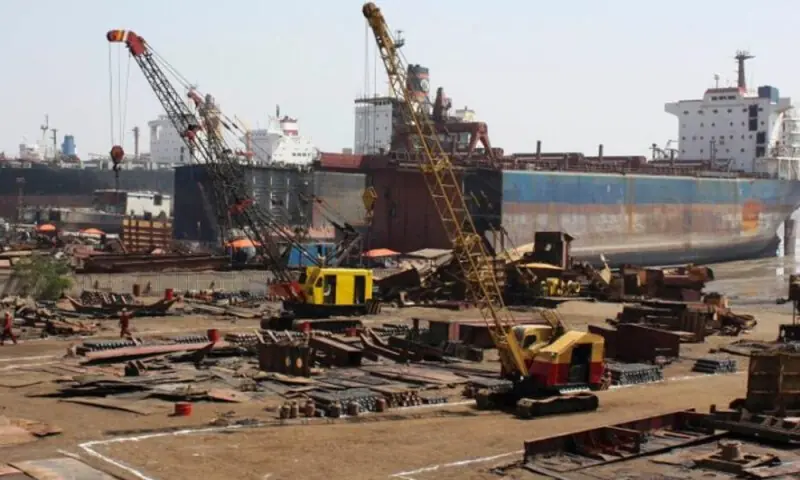
ISLAMABAD: Pakistan has outlined a plan to expand its national ship recycling market to USD 2 billion within the next decade as it is going to adopt the Hong Kong International Convention (HKC), implement the International Labour Organization’s recommendations, and invest in community-welfare initiatives—steps that form the core of the comprehensive plan to revive the Gaddani Ship Recycling Yard. The Ministry of Maritime Affairs has announced a wide-ranging uplift programme for Gaddani, under which the government will construct a 30-bed hospital, residential quarters for medical staff, new labour colonies, a school, a public park, upgraded water-supply facilities, and 32 kilometers of access roads. Officials described the initiative a long-overdue effort to improve worker welfare and infrastructure at the ship-breaking hub. Senior ministry officials said that globally, more than 15,000 vessels are expected to reach the end of their operational life over the next 10 years, presenting a major opportunity for Pakistan’s public and private sectors. They added that Pakistan is currently the world’s third-largest ship-recycling centre and aims to reposition Gadani as a global model for green ship recycling. Pakistan announces multi-billion upgrade for Gaddani, new Green Ship Yard at Port Qasim According to London-based Clarksons Research, global ship-recycling demand is projected to increase from the current 6–7 million light displacement tons (LDT) annually to over 15 million LDT by 2030. The global ship-breaking and recycling market is estimated to exceed USD 10–12 billion per year over the next decade. Officials said Pakistan could secure a significant share of this market through effective implementation of the ILO’s labour standards and full compliance with the HKC, which governs environmental and safety responsibilities across the ship-recycling value chain. Despite its economic importance, the ship-breaking sector has yet to receive formal industrial status and remains largely unregulated. The sector generates substantial employment and supplies a large volume of re-rollable scrap to Pakistan’s iron and steel industry. However, government oversight has historically been limited, working conditions precarious, and infrastructure severely degraded. Although the industry earns over Rs 5 billion annually, little has been reinvested to improve safety standards. Environmental and health concerns remain significant. Multi-year environmental studies conducted by the Pakistan Council of Scientific and Industrial Research (PCSIR) and the National Institute of Oceanography (NIO) have detected elevated levels of lead, chromium, cadmium, and mercury in coastal waters and sediments around Gaddani. In line with ILO recommendations and acknowledging the scale of reforms required, the federal government has approved a Rs 12 billion modernization programme for the ship-breaking sector. According to ministry officials, the investment will fund waste-management plants, fire-control systems, an environmental-monitoring laboratory, training centres, coastal infrastructure, and compliance-certification mechanisms. Officials emphasized that compliance with the Hong Kong Convention is not merely a regulatory obligation but a pathway to economic recovery. With 135 designated plots spread across 10 kilometers, Gaddani is already undergoing transformation. Eleven yards are nearing eco-friendly completion, while 20 additional yards are expected to commence green operations by June 2026. The ministry also stressed the importance of close coordination with the Government of Balochistan to position Gadani as a regional benchmark for climate-aligned ship dismantling. The ILO has previously highlighted systemic deficiencies at Gadani, particularly in emergency-response systems, personal protective equipment, and chemical-exposure controls. Since 2021, ILO-supported capacity-building initiatives have introduced training modules, safety standard operating procedures, and pilot monitoring units at selected plots. The ILO’s 2023 progress review noted that Pakistan could regain international market access by institutionalizing hazard controls and aligning operations with global labour-safety standards. Federal Minister for Maritime Affairs Junaid Chaudhry said that under the broader national maritime strategy—focused on environmental sustainability and climate resilience—the government is also establishing a national centre of excellence for green ports, shipping, and integrated maritime industries in Karachi. International private-sector interest is also re-emerging. Recently, a delegation from PakEco Marine Solutions and Dubai-based PakEco Ship Recycling met Balochistan Governor Sheikh Jaffar Khan Mandokhel, briefing him on plans to establish a modern, HKC-compliant green yard. Officials said such projects could attract USD 150–200 million in foreign direct investment, create thousands of jobs, and strengthen Pakistan’s position in the global circular steel economy. Additionally, officials noted a significant opportunity in nearly 400 vessels from Russia and Ukraine expected to be abandoned, scrapped, or retired due to war-related disruptions and insurance constraints. Gaddani has the capacity to dismantle 30–31 percent of these vessels annually, based on its ability to break up approximately 125 ships of all sizes, including super-tankers. Copyright Business Recorder, 2025