


 Dawn.com
 Signs of forgotten city found beneath Taxila’s first settlement
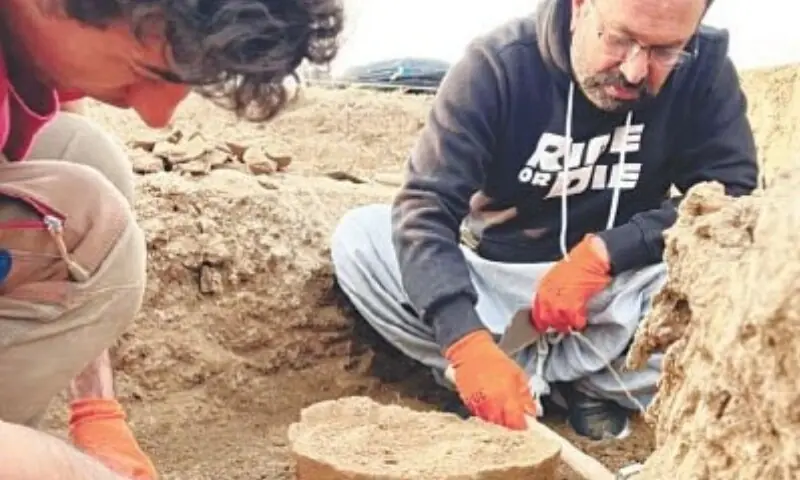
Archaeologists carry out excavation at Bhir Mound remains on Friday.—Dawn • Evidence pushes civilisation timeline beyond 6th century BC • Uncovered ruins reveal advanced streets and drainage systems • Pottery, seals, other items indicate thriving commerce before arrival of Greeks TAXILA: An excavation team working at the ancient remains of Bhir Mound, recognised as the first city of the Taxila Civilisation, has made a major archaeological breakthrough, uncovering compelling evidence of a well-organised urban settlement that predates the sixth century BC. This significant discovery holds the potential to rewrite the early history of civilisation in the region, suggesting that Taxila was a thriving city centuries earlier than scholars previously believed, existing even before the emergence of Achaemenid or Greek influence. Mr Dogar described the current discovery as one of the most important in recent decades. He said the evidence confirms Taxila’s role was not merely that of a centre of learning or military activity, but as a fully developed urban civilisation that flourished in the region’s earliest historical phases. Officials from the Punjab Department of Archaeology, who are currently conducting the extensive excavation at the ancient site, told Dawn on Friday that the newly unearthed remains point definitively to continuous human habitation. The findings reveal a sophisticated civic structure, placing Taxila among the earliest known urban centres of South Asia. Archaeologists at the site have uncovered specific remnants such as stone and mud-brick walls, carefully planned street and an advanced drainage system. These structural findings clearly indicates an organised and forward-looking society. Aasim Dogar, the deputy director of the Punjab Department of Archaeology, said that the current evidence points towards a much older timeline than traditional historical accounts suggest. “Evidence of second century, fourth century and sixth century culture deposits are found, and the further deep trench may lead to discovery beyond the sixth century,” Mr Dogar said. He explained that pushing deeper into the stratigraphy may rewrite the history of the first city of Taxila beyond the sixth century BC, creating a historical profile “resembling it to Harappa and Gandhara grave culture”. Beyond the structural discoveries, a significant number of physical artifacts have been recovered from the site. Mr Dogar revealed that the team has found finely crafted pottery bearing intricate designs, ancient coins, and seals dating back to the second century B.C. These items reflect established trade networks and include stone and metal tools used in construction and daily life. These findings collectively demonstrate that the settlement supported a complex social and economic system long before the period traditionally associated with Taxila’s rise. Mr Dogar noted that the site flourished during the periods of Achaemenid, Greek, and Mauryan influence and was occupied at the time of Alexander the Great’s arrival in 326 BC. The deputy director provided a detailed history of the exploration at Bhir Mound to contextualise the current success. He noted that the first extensive archaeological investigations were conducted by Sir John Marshall between 1918 and 1934, work that formed the basis for the original chronological and cultural interpretation of the site. A later excavation was led by Sir Mortimer Wheeler in 1944-1945. According to Mr Dogar, Wheeler focused on stratigraphic clarification and introduced modern excavation techniques to the region. These methods heavily influenced subsequent archaeological work in Pakistan. After a hiatus of nearly two decades, renewed archaeological work is now being carried out by the Punjab Department of Archaeology.. Mr Dogar believes the breakthrough will draw international scholarly attention and significantly enhance Taxila’s standing on the global archaeological map. Mr Dogar said that for the first time in excavations in Taxila, the latest Japanese and Chinese software and hardware technology are being utilised. This includes advanced GPS technology and scanners, alongside the geo-mapping of the city through the use of drone technology. “This is just the tip of the iceberg,” Mr Dogar said. “There are likely many more layers of history buried beneath Bhir Mound waiting to be uncovered.” Published in Dawn, December 27th, 2025