


 Dawn.com
 Analysis: After years of drift, 2025 brings thaw in Pak-US ties
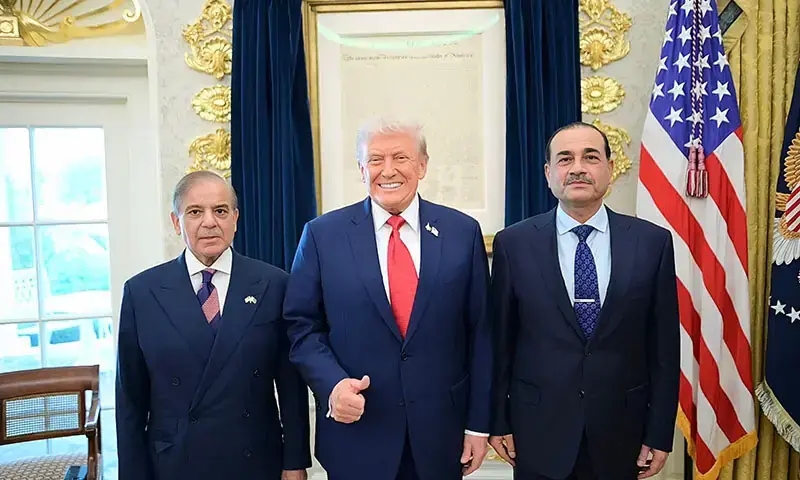
• Trump-Munir meeting reshapes diplomatic tone • Analysts caution against jumping to conclusions as ties rely on ‘personal relationship’ THE year 2025 will be remembered in Islamabad and Washington as a period of surprising warmth in bilateral ties, marked by high-level engagement, strategic recalibrations, and complex regional developments. After years of drift, Pakistan-US relations saw a notable thaw, but beneath the optimism lies a layered and complex reality shaped by history, personalities, and shifting global alignments — prompting analysts to urge restraint in reading the moment as a lasting reset. The year’s diplomacy pivoted with an unprecedented White House meeting between President Donald Trump and Pakistan’s army chief, Field Marshal Syed Asim Munir, widely viewed as a game-changer. The meeting set the tone for renewed engagement and discussions on trade, security, and regional diplomacy. Sherry Rehman, federal minister and former ambassador to Washington, described the shift as personality-driven but consequential. “In both countries, particularly in Washington, leading personalities have swung the pendulum back toward a warming of ties,” she said. She noted that the “Trump-Munir bromance ” was a key ingredient in reshaping the dynamic, while other strategic plays had also tilted the graph to an upward trend. Ms Rehman noted that the relationship would be best served by embedding it in the firm ground of strong commercial and economic ties. She highlighted the US investment in Pakistan’s mineral sector as a potential anchor for long-term engagement. “The scale of investments, their contractual longevity, and capacity to generate local jobs will be critical in determining the trajectory of ties.” On broader foreign policy, she noted: “Pakistan’s interests will be best realised by maintaining a classic policy balance amid growing multipolarity and conflict in global affairs.” She added that Islamabad should continue retaining its “bedrock friendship” with Beijing while avoiding being caught in any zero-sum competition arising between two leading global powers. War and US’s statements The May 2025 India-Pakistan air war injected urgency to US’s engagement with Islamabad. In the aftermath of the ceasefire, President Trump publicly highlighted Islamabad’s role in preventing the escalation to a wider conflict. Pakistan also recognised President Trump’s role in averting a nuclear crisis in South Asia and nominated him for a Nobel Peace Prize. Analysts noted that President Trump’s repeated public commendations — reportedly over 30 mentions of Pakistan’s performance — strengthened Islamabad’s diplomatic standing. “A new president was more open and realised that Pakistan could play a role in furthering American strategic interests in both the economic and security domains,” said Uzair Yunus, a Washington-based South Asia analyst. The broader context included US-India tensions over trade, tariffs , and New Delhi’s growing ties with Russia. These frictions, combined with the US’s focus on Pakistan’s stabilising role in South Asia, increased Islamabad’s leverage in Washington’s strategic calculus. Regional diplomacy The Trump administration also highlighted Pakistan’s potential role in the Middle East, including possible participation in a Gaza peace force and mediation in Iran-related initiatives. While the force is still being finalised, discussions underscore its emerging relevance. Ms Rehman warned that regional volatility would test Islamabad’s diplomacy. While Pakistan’s hard power, demonstrated in the May conflict, had altered perceptions of it as a middle power, she said the real challenge lay in navigating partnerships without compromising core foreign policy values or domestic priorities. Caution urged Maleeha Lodhi, Pakistan’s former ambassador to Washington, London, and the UN, urged caution against overreading recent developments. “The recent warmth shows that a hopeful beginning has been made for a reset in Pak-US ties,” she said, “but one should avoid hastily concluding ties are on a sustainable upswing.” She noted that the current turnaround rested heavily on a personalised relationship between Trump and Pakistan’s army chief, making it short-term. “Durable relations are built on shared interests and convergences between countries,” she added. “I see the hybrid government’s US policy predicated on sycophancy, sweetheart business deals, and willingness to fall in line with Trump’s Middle East agenda.” Michael Kugelman, senior fellow for South Asia at the Atlantic Council, echoed the need for realism. He noted that while the resurgence in bilateral ties was certainly one of Islamabad’s biggest surprises this year, it was important not to overstate the resurgence. He noted that beyond a few memorandums on critical minerals and limited counterterrorism cooperation, substantive collaboration remained modest. Looking ahead Ms Rehman emphasised the domestic angle, stressing the importance of transparency, skills development, and social inclusion in managing international investment. She also highlighted people-to-people ties, noting that even during downturns, travel, cultural exchanges, and diaspora links had sustained the relationship. In the end, 2025 might not mark a full revamp of ties between the two countries, but it stands out as the year both sides found enough common ground to try again — a meaningful step for a relationship long defined by cycles of tension and rapprochement. Published in Dawn, December 28th, 2025