


 Dawn.com
 Dolphin pod appears in Gwadar after seawater turns green
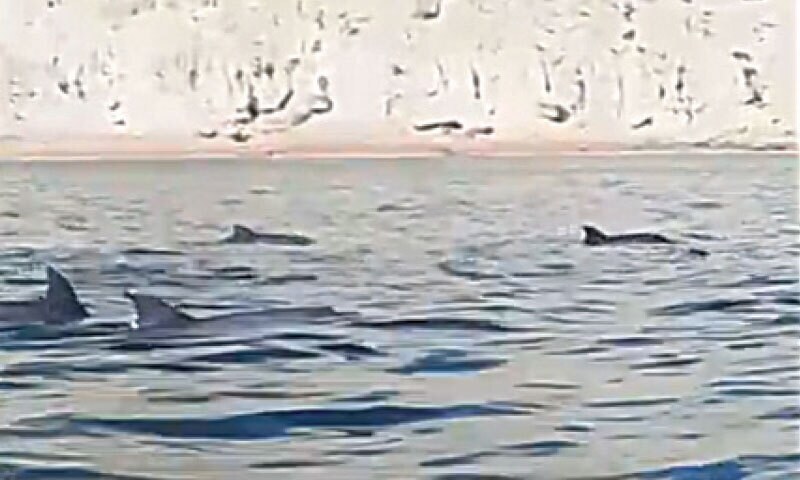
KARACH: A pod of bottlenose dolphins was spotted on Sunday morning in the coastal waters of Gwadar, currently affected by an algal bloom. According to experts, the algal bloom, which has turned seawater green along Pakistan’s coast as well as neighbouring Iran is caused by a single-celled organism Noctiluca. “These dolphins are often seen in this season and recorded by fishermen. The ongoing bloom is neither toxic nor poses any threat to fishermen,” Director of Marine Fisheries, Balochistan, Ahmed Nadeem told Dawn , adding that such blooms were observed in the area once to twice a year. About its possible impact on fisheries, Mr Nadeem said: “There is no serious negative impact, though it does contribute to marine productivity once it starts decomposing at the bank of the sea and turns into nutrients for marine life.” According to him, the bloom doesn’t cause bad smell. “Small fish that get trapped in the bloom and die cause the stench.” Algal bloom termed ‘beneficial’ as fish freely congregate in the area Seconding Mr Ahmed’s opinion, Muhammad Moazzam Khan, Technical Adviser at the World Wide Fund for Nature-Pakistan (WWF-P), said that Noctiluca blooms were not harmful in most cases and rather increased productivity of marine water. “It is heartening that pods of bottlenose dolphins are seen within the Gwadar (West Bay), which verifies that the bloom is not affecting the marine biodiversity of the area,” he said. Asked about the mass fish mortality reported from Ormara (East Bay) in 2016, which was also reportedly caused by a Noctiluca bloom, he said a symbiont called Protoeuglena noctilucae (a tiny green flagellate microorganism) wasn’t present in the bloom. “Hence, Noctiluca did not produce oxygen but rather consumed all oxygen in the seawater of the area, resulting in mass fish mortality. However, currently we are seeing green Noctiluca bloom. What has given it this colour is Protoeuglena noctilucae that produces oxygen under the sunlight and contributes to marine productivity.” According to WWF-P, the winter bloom is a characteristic of the northern Arabian Sea. There have been studies conducted by the organisation, which indicate that the bloom is triggered by the spread of cold water from upwelling in some part of the Arabian Sea and its spread under the influence of eddy formation during this period. Linking this bloom, it says, with Eutrophication is not scientifically substantiated. Noctiluca scintillans is a small, free-floating organism that may appear in red, orange, green, or even colourless forms. Published in Dawn, December 29th, 2025