


 Dawn.com
 India’s Chenab dam plan riles eco-activists, Pakistan alike
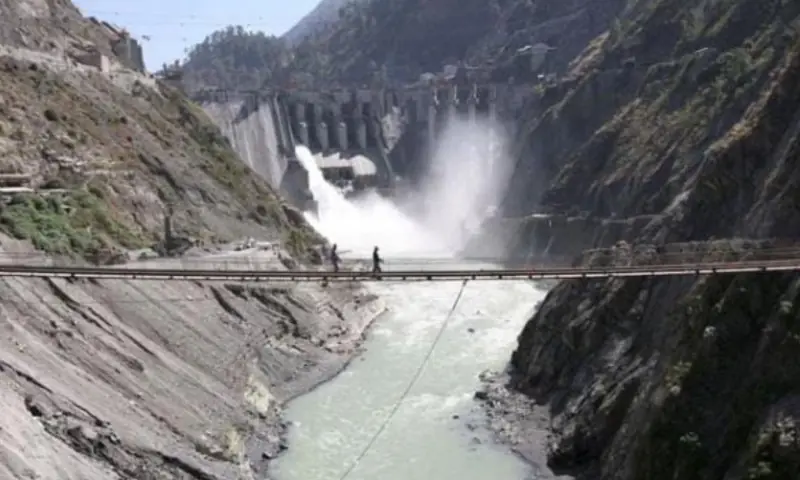
• Environment ministry okays ‘run-of-the-river’ Dulhasti Stage II, to be built in held Kashmir • Indian govt forging ahead with several hydel projects in Indus basin after unilaterally suspending treaty • Water weaponisation in climate change-prone region ‘neither sane nor acceptable’, warns Sherry Rehman NEW DELHI / ISLAMABAD: India’s Ministry of Environment has been pondering clearances for a slew of controversial hydroelectric projects on the Chenab River in the aftermath of the Pahalgam incident earlier this year. Yet, it does not seem to share serious apprehensions that leading environmentalists have expressed over their threat to a fragile Himalayan ecology. Last week, a panel under the ministry approved the 260-megawatt Dulhasti Stage-II hydropower project on the Chenab River in Kishtwar district of India-held Jammu and Kashmir, according to The Hindu . Earlier, in October, it was reported that environmental clearances were revived for the larger Sawalkote hydro-electric project on the same river. The clearances came against the backdrop of India unilaterally suspending the Indus Waters Treaty (IWT) after blaming Pakistan over the Pahalgam incident — an allegation Islamabad had denied, terming the suspension of the 1960 treaty “an act of war”. Earlier this month, Pakistan’s Foreign Office had sounded the alarm on New Delhi’s “weaponisation of water” following abrupt variations in the flow of the Chenab and Jhelum rivers, which caused consternation among farmers in Punjab. At the time, Foreign Minister Ishaq Dar had noted that the Permanent Court of Arbitration (PCA) had also reaffirmed the continued validity of the treaty and its dispute-resolution mechanisms. In addition, he cited concerns expressed by UN rapporteurs over India’s actions in connection with the treaty. The projects The Sawalkote project has been in the works for decades, and has faced numerous delays related to forest clearances and the compliance compulsions of the Indus Waters Treaty. As of now, the 1,856MW project is still said to be in the pre-construction stage. Its environment clearances have been reheated several times over. The Dulhasti Stage II is a 258MW project, conceived as a complementary run-of-the-river scheme to utilise the water discharged from the existing 390MW Dulhasti Power Station “more efficiently”. It is a smaller component of the frequently discussed Chenab basin projects. It is expected to cost around $35 million. According to The Hindu, “With the treaty now in abeyance, the centre is pushing ahead with several hydroelectric projects in the Indus basin, such as Sawalkote, Ratle, Bursar, Pakal Dul, Kwar, Kiru, and Kirthai I and II.” The total land requirement for the project is estimated at 60.3 hectares. This project will require 8.27 hectares of private land from two villages, Benzwar and Palmar, in Kishtwar district, The Hindu reported. Environmental concerns The question environmentalists are posing focuses greatly on a primary concern related to climate change. Water bodies are drying up rapidly. Chenab forms at the confluence of Chandra and Bhaga rivers in Lahaul and Spiti, Himachal Pradesh. According to the Indus Waters Treaty, Chenab is a Western River, allocated to Pakistan. India is permitted limited consumption use and unlimited non-consumption use of Chenab. From the treaty’s signing up to the year 2004-05, studies estimate that glacial volume in the Chenab basin has reduced by a whopping 33.3pc. This is what the South Asia Network on Dams, Rivers and People NGO says: “For a river whose flows are made up of 50% meltwater when it leaves India at Akhnoor, this is shocking for both India and Pakistan”. “Glaciers, the water stored in them, the slow release of this water in spring and summers is the key to water security of the entire Himalayan region. Sixty per cent irrigation in the entire Indus basin depends on glacial melt. As the glaciers are concentrated in the Indian Himalayas, their health and sustenance is crucial for millions in both countries.” In the Hindu mythology, the River Saraswati, which is said to have made up a troika with the Ganga and Yamuna rivers, disappeared in ancient times. In the real world, many more rivers and water bodies face a similar fate. Chenab is among them. Sherry expresses alarm While there was no immediate reaction from Pakistan’s Foreign Office, former climate change minister Senator Sherry Rehman protested against this weaponisation of water, saying that it was “neither sane nor acceptable”. In a post on X, the PPP leader wrote, “In flagrant violation of the Indus Waters Treaty (IWT), India has just given approval to the Dulhasti Stage-II hydropower project on the Chenab River in Indian Illegally Occupied Jammu and Kashmir (IIOJ&K). “As per the IWT, which cannot be unilaterally revoked, as recent UN rapporteurs have confirmed, Pakistan has control over the waters of the Indus, Jhelum, and Chenab rivers, while the Ravi, Beas and Sutlej rivers fall under India’s control,” she said. “Following the illegal suspension of the treaty, India has decided to fast-track several disputed hydroelectric projects in the Indus Basin. These projects include Sawalkot, Ratle, Bursar, Pakal Dul, Kwar, Kiru, and Kirthai-1 and 2. Dulhasti Stage-II is considered part of this strategy,” she said. “This weaponisation of water is neither sane nor acceptable in a region on the frontlines of climate change and environmental stress. It will inflame tensions in a bilateral relationship already bristling with hostility and distrust,” she said. Published in Dawn, December 30th, 2025