


 Dawn.com
 At UNSC, countries voice concern at possible forced displacement of Palestinians following Israel’s recognition of Somaliland
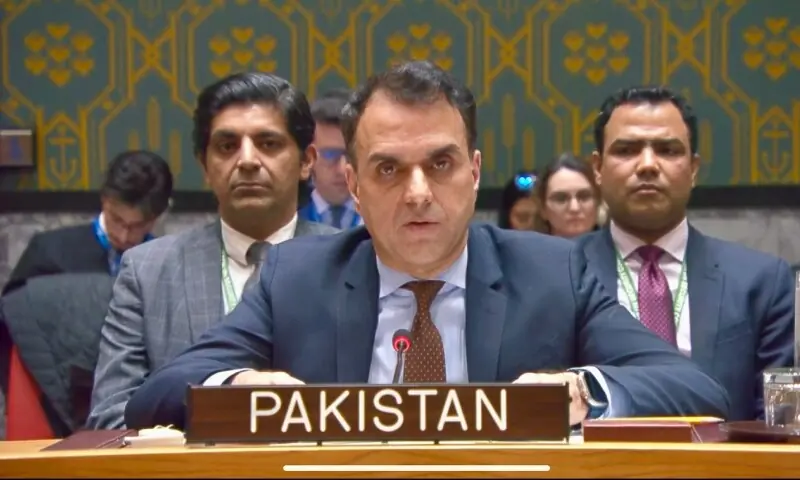
Several countries, including Pakistan, at the United Nations have questioned whether Israel’s move to recognise Somalia’s breakaway region of Somaliland is aimed at forcibly relocating Palestinians from Gaza or to establish military bases. Pakistan has stated that Israel’s “unlawful recognition” is “deeply troubling” against the backdrop of previous references to it being a “destination for the deportation of Palestinian people, especially from Gaza”. The remarks were made by Pakistan’s Deputy UN Ambassador Muhammad Usman Iqbal Jadoon during a United Nations Security Council (UNSC) briefing on Israel’s recognition of Somaliland. Israel became the first country to recognise Somaliland as an independent and sovereign state on Friday. In his remarks, Jadoon said, “Against the backdrop of Israel’s previous references to ‘Somaliland’ of the Federal Republic of Somalia as a destination for the deportation of Palestinian people, especially from Gaza, its unlawful recognition of ‘Somaliland’ region is deeply troubling.“ In March, the Associated Press reported that the US and Israel had reached out to officials in Sudan, Somalia and Somaliland to discuss using their territories as potential destinations for forcibly relocating Palestinians from Gaza. “For decades, Israel’s dispossession and occupation of Palestinian land have been a central source of instability and conflict in the Middle East. It is now exporting this destabilising conduct to the Horn of Africa, with serious implications for regional peace and security,” he said. He said that Pakistan unequivocally rejected any proposals or plans aimed at the forced displacement of Palestinians. He noted that a previous UNSC resolution had endorsed US President Donald Trump’s Gaza peace plan, noting that it stated that “no one will be forced to leave Gaza”. “Any actions that advocate or imply displacement or resettlement not only violate international law but also undermine the prospect of a just and lasting peace,” he said. “We reaffirm our steadfast support for the Palestinian people in their legitimate struggle for self-determination. The only path to lasting peace and stability lies in the realization of an independent, contiguous and sovereign state of Palestine on pre-1967 borders, with Al Quds Al Sharif as its capital,” he said. In his remarks, Jadoon also expressed Pakistan‘s “unwavering and steadfast support to the sovereignty, unity, and territorial integrity” of Somalia. He condemned Israel’s “unilateral and unlawful recognition” of Somaliland, calling it a direct assault on Somalia’s international borders. “The ‘Somaliland’ region remains an integral, inseparable, and inalienable part of Somalia. No external actor has either the legal standing or the moral authority to alter that fundamental reality,” he said. He also highlighted that a group of Organisation of Islamic Cooperation countries and Pakistan had rejected Israel’s move. The envoy also said that “continued, predictable support for Somalia’s security sector and stabilisation efforts remains indispensable for preserving the hard-won gains against terrorism”. “Therefore, at this pivotal juncture, when Somalia is focused on defeating extremism, any action that diverts attention, weakens cohesion, or fuels division is profoundly irresponsible,” he said. He concluded his remarks by calling on the UNSC and the international community to reject all actions that “undermine Somalia’s unity and territorial integrity”. “On our part, we remain firmly and resolutely committed to standing with the government and people of Somalia in the country’s march toward peace and prosperity,” he said. Meanwhile, the 22-member Arab League, a regional organisation of Arab states in the Middle East and parts of Africa, said it rejected “any measures arising from this illegitimate recognition aimed at facilitating forced displacement of the Palestinian people or exploiting northern Somali ports to establish military bases,” Arab League UN Ambassador Maged Abdelfattah Abdelaziz told the UNSC. Somalia’s UN Ambassador Abukar Dahir Osman said Council members Algeria, Guyana, Sierra Leone and Somalia “unequivocally reject any steps aimed at advancing this objective, including any attempt by Israel to relocate the Palestinian population from Gaza to the northwestern region of Somalia“. Meanwhile, the United States defended Israel’s right to recognise the breakaway territory, comparing it to the recognition of a Palestinian state by numerous countries. “Israel has the same right to conduct diplomatic relations as any other sovereign state,” Tammy Bruce, deputy US ambassador to the UN, said. “Earlier this year, several countries, including members of this council, made the unilateral decision to recognise a nonexistent Palestinian state, and yet no emergency meeting was called to express this Council’s outrage,” she added, accusing colleagues of “double standards”. Slovenian ambassador Samuel Zbogar, whose country has recognised the Palestinian state, rejected Washington’s comparison. “Palestine is not part of any state. It is illegally occupied territory, as declared by the International Court of Justice, among others,” while Somaliland “is part of a UN member state and recognising it goes against” the UN Charter, Zbogar said. United Kingdom Ambassador James Kariuki reaffirmed the country’s support for “the sovereignty, territorial integrity, political independence and unity of Somalia”. Israel’s representative Jonathan Miller said the move was “not a hostile step towards Somalia, and it does not preclude future dialogue between the parties,” calling it “an opportunity to strengthen stability”.