


 Dawn.com
 Pakistan inks climate resilience initiatives with Asian Development Bank
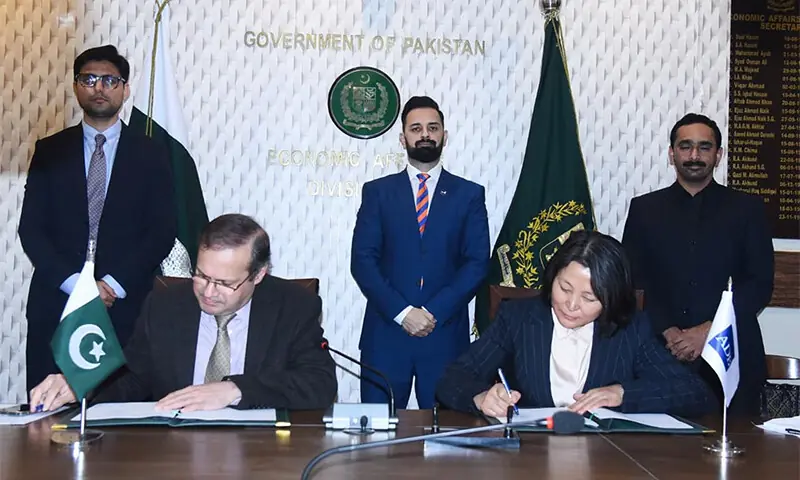
Pakistan and the Asian Development Bank (ADB) on Tuesday signed two major climate resilience initiatives—one focused on Sindh and the other on Punjab—according to a statement issued by the Economic Affairs Division. The projects include the $180.5 million Sindh Coastal Resilience Sector Project (SCRP) and the $124 million Punjab Climate-Resilient and Low-Carbon Agriculture Mechanisation Project. Economic Secretary Muhammad Humair Karim “expressed his sincere appreciation for ADB’s role as a trusted development partner and its continued support to Pakistan in advancing climate resilience, sustainable agriculture, and inclusive growth”, the statement read. Karim highlighted that the SCRP will promote integrated water resource and flood risk management and restore nature-based coastal defences. It is also expected to strengthen the institutional and community capacity for strategic action planning. “The project, financed through $140.5m from [the] ADB (including [a] $140m loan and [a] $500,000 technical assistance grant), $40m from the Green Climate Fund and $20m as counterpart funding from the Government of Sindh, will directly benefit over 3.8 million people in Thatta, Sujawal and Badin districts,” the statement read. It added that according to the secretary, the Punjab Climate Resilient and Low Carbon Agriculture Mechanisation Project will enhance agricultural productivity and climate resilience in 30 districts of the province. “The project amounting to $129m, financed [by a] $120m ADB loan, [a] $4m ADB grant and [a] $5m as counterpart funding from the Government of Punjab, will improve [the] access of small farmers to climate-smart machinery, introduce circular agriculture practices to reduce residue burning, establish testing and training facilities and empower 15,000 women through skills development and livelihood diversification,” the Economic Division stated. The statement added that the secretary hailed both initiatives as “transformative in nature”, adding that the SCRP would safeguard livelihoods, food security and biodiversity along the province’s coastal belt, while the Punjab mechanisation project would drive sustainable, low-carbon agriculture and inclusive development. ADB Country Director Emma Fan appreciated the federal government’s strong commitment to these initiatives and emphasised the significance of the SCRP in addressing climate risks and protecting coastal communities, the Economic Division said. She further highlighted the Punjab mechanisation project as “a critical step in modernising agriculture and reducing emissions”. Pakistan and the ADB “expressed their commitment to effectively utilise the financing for [the] successful and timely completion of the two initiatives”, the statement added. On December 25, Pakistan and the lender signed two major initiatives totalling $730m — a power transmission strengthening project and an accelerating state-owned enterprise (SOE) transformation programme — which would relieve overloading of existing transmission lines and improve operational efficiency. At the beginning of this year, Pakistan and ADB signed an agreement to provide $200 million in support to the country’s ailing power distribution system through network improvement. In the recent agreement, the second power transmission strengthening project amounts to $330m, while the accelerating SOE transformation programme is worth $400m, according to a statement. Ministry of Economic Affairs Secretary Muhammad Humair Karim appreciated the Manila-based lending agency’s role and its continued support in advancing critical infrastructure and governance reforms, the statement said.