


 Dawn.com
 Bhir Mound dig yields yet more ancient artefacts
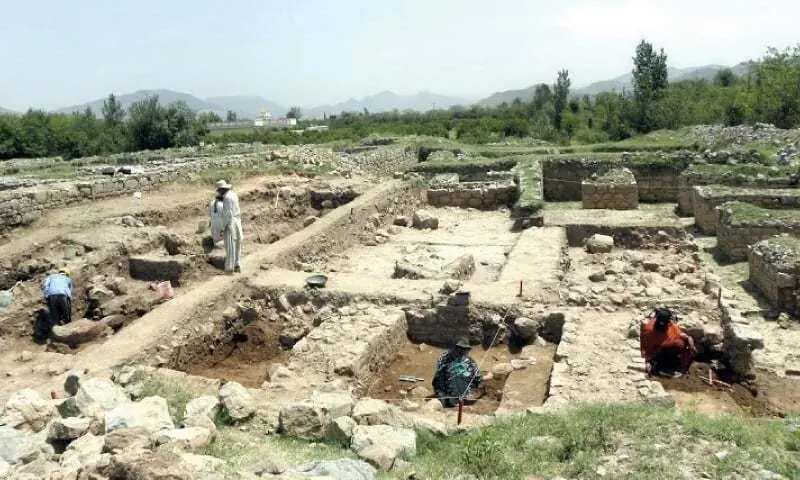
• 6th-century BC lapis lazuli, rare bronze coins bearing image of Emperor Vasudeva recovered • Findings expand material narrative of ancient Gandhara; link Taxila to trade with Badakhshan Coins and decorative lapis lazuli stones, dating back to the 2nd and 6th centuries BC, were unearthed during recent excavations.—Dawn TAXILA: Archaeologists excavating the ancient Bhir Mound have unearthed decorative stones dating to the 6th century BC and rare coins from the 2nd century AD, a discovery officials are hailing as the most significant at the site in a decade. The finds were made during ongoing excavations at the Unesco-listed site, which is regarded as the earliest urban settlement of the extensive Taxila civilisation. Experts uncovered fragments of metamorphic decorative stone identified as lapis lazuli, alongside the rare bronze coins attributed to the Kushan dynasty, dramatically pushing forward the material narrative of ancient Gandhara. Aasim Dogar, the deputy director of the Punjab Department of Archaeology who serves as head of the excavation team, confirmed the preliminary analysis of the artefacts. “The decorative stones are lapis lazuli, a prized semi-precious stone, while the coins belong to the Kushan period,” Mr Dogar said. The excavation team relied on specialised forensic assistance to date the metal artefacts. Mr Dogar noted that detailed numismatic analysis conducted by specialists from the University of Peshawar confirmed that the coins bear the image of Emperor Vasudeva. Vasudeva is recognized by historians as the last of the ‘great Kushan rulers’ who presided over the region. According to Mr Dogar, the obverse of the recovered coinage depicts Vasudeva, while the reverse features a female religious deity. Mr Dogar described this specific imagery as a distinct hallmark of Kushan-era religious pluralism, which often blended various theological traditions. The artefacts were discovered on the northern side of the archaeological remains, specifically within the B-2 trench — one of 16 distinct trenches currently excavated at the site. Dogar said the surrounding archaeological evidence reveals that these specific remains constituted a residential area. These latest discoveries affirm that Taxila reached the zenith of its political, cultural, and economic influence under Kushan rule, particularly between the 1st and 3rd centuries AD. “Under emperors such as Kanishka the Great, Taxila emerged as a major administrative, commercial, and intellectual centre,” Mr Dogar said. Mr Dogar added that widespread Kushan patronage of Buddhism during this era led to the construction of stupas, monasteries, and vast religious complexes. The period also marked the rise of Gandharan art, a distinctive synthesis of Greek, Roman, Persian, and Indian traditions, with Taxila serving as its core hub. Malik Tahir Suleman, a renowned numismatist, told Dawn that Kushan coins serve as some of the most critical historical sources for understanding ancient South and Central Asia. “Issued between the 1st and 4th centuries AD, Kushan coins evolved from Indo-Greek imitations into a sophisticated imperial currency system,” Mr Suleman said. “Struck mainly in gold, copper, and bronze, they reflect the empire’s economic strength and vast trade networks, including links with Roman markets.” Mr Suleman said Kushan coinage is distinguished by its rich iconography and multilingual inscriptions. He explained that they often depict rulers in Central Asian attire on one side and a remarkable range of deities — from Helios and Mithra to Shiva, Nana, and the Buddha — on the other. Beyond the coins, the discovery of the deep-blue lapis lazuli fragments provides vital clues regarding ancient supply chains. Mr Dogar noted that the stone has been valued for millennia across ancient civilisations. “Its presence at Taxila points to long-distance trade links, particularly with Badakhshan in present-day Afghanistan, a historic source of lapis lazuli,” Mr Dogar said. Published in Dawn, January 2nd, 2026