


 Dawn.com
 Trump says US ‘will run’ Venezuela until ‘safe’ transition following Maduro’s capture
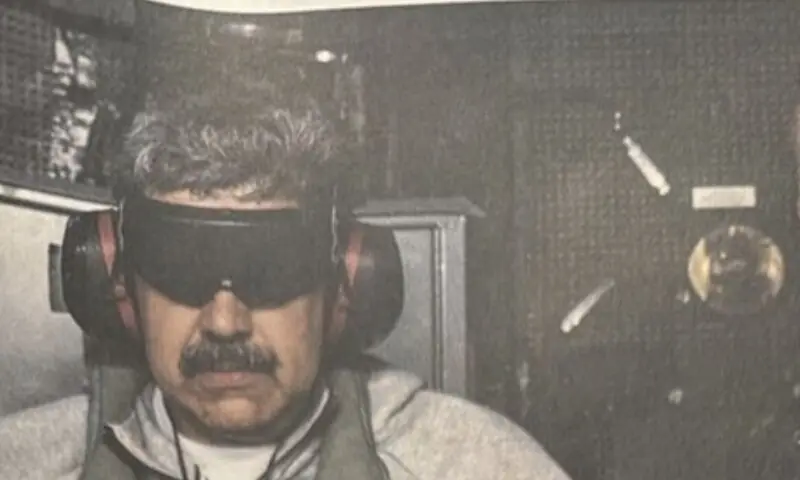
Key Developments Trump says US forces have captured Venezuelan leader Nicolas Maduro after launching a “large-scale strike”; hails “brilliant” operation US president says Washington will govern Venezuela until transition takes place Maduro and his wife indicted on weapon and drug charges, US attorney general says Venezuelan defence minister calls for united front of resistance in the face of “the worst aggression” ever US State Dept deputy chief declares ‘new dawn’ for Venezuela Venezuela calls for emergency UN Security Council meeting following strikes US President Donald Trump said on Saturday that Washington would govern Venezuela after the capture of Venezuelan leader Nicolas Maduro in a military operation on Saturday morning. American forces had captured Maduro early on Saturday morning after launching a “large-scale strike” on the South American country. Addressing a press conference at his Mar-a-Lago resort in Florida, Trump said, “No nation in the world could achieve what America achieved yesterday,” he said. Trump added that the US would “run the country” until a safe, proper and judicious transition takes place. “We don‘t want to be involved with having somebody else get in and we have the same situation that we had for the last, long period of years,” the US president said. “So we’re going to run the country, until such time as we can do a safe, proper and judicious transition. We’re going to run it, essentially.” Trump added: “All Venezuelan military capacities were rendered powerless as the men and women of the US military, working with law enforcement, successfully captured Maduro in the dead of night.” Moreover, he said that the US military caused a blackout in Caracas to execute the operation to capture Maduro. “It was dark. The lights of Caracas were largely turned off due to a certain expertise that we have,” Trump said. He added that the US is ready to launch a second and much larger wave of attacks if needed, adding that Washington assumed a second wave would be necessary. “The first wave … was so successful we probably don‘t have to do a second, but we’re prepared to do a second wave, a much bigger wave,” Trump stated. Continuing his address, Trump said that Venezuela’s oil industry “was a bust” and that US oil companies would come in, repair the oil infrastructure and “start making money for the country”. In a Truth Social post earlier today, Trump wrote: “The United States of America has successfully carried out a large-scale strike against Venezuela and its leader, President Nicolas Maduro, who has been, along with his wife, captured and flown out of the country. “This operation was done in conjunction with US law enforcement,” the US president added. In an interview with Fox News , Trump said Maduro and his wife, Cilia Flores, were taken to a ship after their capture by US forces and will be transported to New York. “They were indicted in New York and they will be taken to New York,” he said, stating that the Venezuelan president and his wife were aboard the USS Iwo Jima. The White House posted a photograph of Maduro aboard the vessel wearing a blindfold and ear defenders, which Trump also shared on Truth Social. In a brief phone interview with The New York Times , Trump hailed the “brilliant” operation. “A lot of good planning and a lot of great, great troops and great people,” the paper quoted Trump as saying. Venezuela has since demanded an emergency meeting of the UN Security Council to discuss the US attacks. “Faced with the criminal aggression committed by the US government against our homeland, we have requested an urgent meeting of the United Nations Security Council, which is responsible for upholding international law,” Venezuelan Foreign Minister Yvan Gil wrote on the Telegram messaging platform. It was unclear if the US would now stand back while other senior figures in Venezuela’s ruling party — like Vice President Delcy Rodriguez — fill the void or if there would be pressure for their ouster as well. ‘It was an amazing thing’: Trump Speaking on Fox News , Trump praised his team for the operation and described watching the operation as it took place. “I watched it like I was watching a television show,” he said. “If you would have seen the speed and the violence … it was an amazing thing and an amazing job these people did.” Elaborating on watching the operation unfold, he said that it was an “extremely complex manoeuvre” and that multiple helicopters were employed. “We watched it and we watched every aspect of it,” Trump said. “I’ve never seen anything like this. It was amazing to see the professionalism, the quality of leadership.“ The US president did mention that there were “a few injuries on our side”, but noted that no American personnel were killed. Trump said that the operation was initially going to take place four days ago, but was delayed because of bad weather. “The weather has to be perfect and we had just the perfect weather,” he explained. He added that Maduro was in a “house that was more like a fortress” when US forces captured him. “We had nobody killed and we lost no aircraft. “We had to do it, it’s a war,” Trump emphasised. Moreover, he added that Maduro “wanted to negotiate at the end”, but Trump refused. “I told him ‘you have to give up, you have to surrender’,” Trump said, adding that he spoke with Maduro a week ago. Reacting to US lawmakers calling the strike “unjustified [and] illegal”, Trump said, “These are weak, stupid people and they’re trying to save themselves from almost destroying our country.” Next steps Asked about the next steps for Venezuela, Trump said, “We‘re making that decision now. We’ll be involved in it very much.” He added that the people of Venezuela were happy and that the US “wanted to do liberty for” them. When asked if he would fully support Nobel Peace Prize winner Maria Corina Machado taking power, Trump noted that there is already a Venezuelan vice president but slammed the Venezuelan elections as “rigged”. “People have little loyalty, if any loyalty to him (Maduro),” Trump said. Trump further said that Washington will be “very strongly involved” in Venezuela’s oil industry. “We have the greatest oil companies in the world, the biggest, the greatest, and we’re going to be very much involved in it,” he said. Speaking about Maduro loyalists remaining in Venezuela, Trump warned that anyone loyal to the Venezuelan president “is going to have a bad future”. When asked if the operation in Venezuela was a message to Mexico, Trump said “it wasn’t meant to be”, adding that Mexican President Claudia Sheinbaum is not running the country, but the cartels. “We have to do something … we lost 300,000 people … to drugs,” he claimed. “They come in through the southern border and something’s going to have to be done about Mexico.” Maduro indicted on drug, weapon charges In a post on X, US Attorney General Pam Bondi announced that Maduro and his wife, Cilia Flores, had been charged in the Southern District of New York. The charges include narco-terrorism conspiracy, cocaine importation conspiracy, possession of machine guns and destructive devices, and conspiracy to possess machine guns and destructive devices against the United States. “They (Maduro and Flores) will soon face the full wrath of American justice on American soil in American courts,” she wrote. “On behalf of the entire US DOJ (Department of Justice), I would like to thank President Trump for having the courage to demand accountability on behalf of the American people, and a huge thank you to our brave military who conducted the incredible and highly successful mission to capture these two alleged international narco traffickers.” ‘New dawn, the tyrant is gone’ “A new dawn for Venezuela! The tyrant is gone. He will now — finally — face justice for his crimes,” US Deputy Secretary of State Christopher Landau said on X. US Senator Mike Lee said the country had completed its military action, quoting Secretary of State Marco Rubio. “He anticipates no further action in Venezuela now that Maduro is in US custody,” Lee, a Republican initially critical of the operation, wrote on X after what he said was a telephone call with Rubio. Rubio, meanwhile, uploaded a screenshot of one of his old posts on X today, which claimed Maduro was not the president of Venezuela. The old post, dated July 27, 2025, reads: “Maduro is NOT the President of Venezuela and his regime is NOT the legitimate government. “Maduro is the head of the Cartel de Los Soles, a narco-terror organization which has taken possession of a country. And he is under indictment for pushing drugs into the United States,” Rubio added. Fuerte Tiuna, Venezuela’s largest military complex, situated in the south of Caracas, and Carlota airbase in the north, were among the targets of the strikes. Blasts were also heard in La Guaira, north of the capital, where Caracas’s airport and port are located. A US official said Maduro was captured by elite US special forces troops. Proof of life Venezuelan Vice President Rodriguez said the government does not know the whereabouts of President Maduro or Flores, in an audio played on state TV. “We demand immediate proof of life of President Nicolas Maduro and the first combatant Cilia Flores,” Rodriguez said. Smoke rises near Fort Tiuna, after U.S. President Donald Trump said the U.S. has struck Venezuela and captured its President Nicolas Maduro, in Caracas, Venezuela, January 3, 2026. — Reuters Meanwhile, Venezuelan Defence Minister Vladimir Padrino López accused the United States of hitting residential areas. The “invading” US forces “have desecrated our soil, going so far as to strike, using missiles and rockets fired from their combat helicopters, residential areas populated by civilians,” Lopez said in a video statement shared on social media. He also said the South American country would launch a “massive deployment of all land, air, naval, riverine and missile capabilities … for comprehensive defence“. The defence minister called for a united front of resistance in the face of “the worst aggression” ever against Venezuela. Fire at Fuerte Tiuna, Venezuela’s largest military complex, is seen from a distance after a series of explosions in Caracas on January 3, 2026. — AFP Venezuela’s Interior Minister Diosdado Cabello, meanwhile, said that the country “will overcome” the wave of US military strikes. Considered one of the most powerful men in Caracas, Cabello told a local television broadcast, “At the end of these attacks, we will overcome,” adding that “this is not our first battle against our people… we have managed to survive under all circumstances. The opposition, headed by Machado, had no immediate comment but has said for 18 months that it won the 2024 election and has a democratic right to take power. However, her whereabouts, after recently fleeing Venezuela in disguise to pick up her Nobel prize, were unknown. Separately, Colombian President Gustavo Petro said he ordered the deployment of military forces to the Venezuelan border. Petro described Washington’s actions as an “assault on the sovereignty” of Latin America and said they would result in a humanitarian crisis. Petro made no mention of Maduro’s capture, despite the Venezuelan leader being one of his government’s closest allies in the region. Action in Venezuela recalls past US interventions While various Latin American governments oppose Maduro and say he stole the 2024 election, direct US action has revived painful memories of past interventions and is generally strongly opposed by governments and populations in the region. Washington has not made such a direct intervention in Latin America since the invasion of Panama in 1989 to depose military leader Manuel Noriega. Trump‘s action recalls the ‘ Monroe Doctrine ’, laid out in 1823 by President James Monroe, laying the US claim to influence in the region, as well as the “gunboat diplomacy” seen under Theodore Roosevelt in the early 1900s. In his Mar-a-Lago press conference, Trump made reference to the Monroe Doctrine but said “We’ve superseded it … they call it the Donroe Doctrine”. Night view of Caracas taken after a series of explosions heard on January 3, 2026. — AFP In the early hours on Saturday, explosions rocked Caracas and elsewhere, prompting Maduro’s government to declare a national emergency and mobilise troops. It said attacks also took place in the states of Miranda, Aragua and La Guaira. Blasts, aircraft and black smoke could be seen across Caracas from about 2am local time (0600 GMT; 11am PKT) for roughly 90 minutes, according to Reuters witnesses and images circulating on social media. Residents expressed shock and fear as they captured video of billowing smoke and bright orange flashes in the sky. “My love, oh no, look at that,” said one woman in a video, gasping at blasts in the distance. Carmen Marquez, 50, a resident of the eastern part of the capital, said she went to her roof and could hear planes at different altitudes, though she could not see them. “Flare-like lights were crossing the sky and then explosions could be heard. We’re worried about what‘s coming next. We don’t know anything from the government, only what the state television says,” she said. Political backlash in the US? Trump’s stunning announcement follows months of steadily mounting US military and economic pressure on leftist leader Maduro and his country’s oil-export-dependent economy. The US president said in December, “it would be smart for [Maduro]” to step down“ and has also said that the Venezuelan leader’s “days are numbered”. It was unclear under what legal authority the latest US strikes were carried out. Legal experts have raised questions about the legality of attacks on suspected drug vessels in the region, which have killed more than 110 people so far. Trump‘s move risks drawing backlash from the US Congress, which has the constitutional right to declare war, and from his own political base, which favours an ‘America First policy’ and largely opposes military intervention abroad. MST Marquee analyst Saul Kavonic said oil prices were likely to jump on the near-term risk to supply, but that the US strike could be bearish in the medium term if a new Venezuelan government results in sanctions being lifted and renewed foreign investment. Venezuelan state-run energy company PDVSA’s oil production and refining were normal and its most important facilities had suffered no damage according to an initial assessment, two sources with knowledge of the company’s operations said. Picture of fire at Fuerte Tiuna, Venezuela’s largest military complex, after a series of explosions in Caracas on January 3, 2026. — AFP Trump’s claim of Maduro’s capture comes two days after Maduro attempted to engage with Trump, offering cooperation on fighting drug trafficking and illegal migration. The US has accused Maduro of running a “narco-state” and rigging an election. Trump had also repeatedly promised land operations in Venezuela. The Venezuelan leader, who succeeded Hugo Chavez to take power in 2013, has said Washington wants to take control of its oil reserves, the second-largest in the world.