


 Autocar
 Dream desert drive: Flat out in the savage 815bhp Ford Mustang GTD
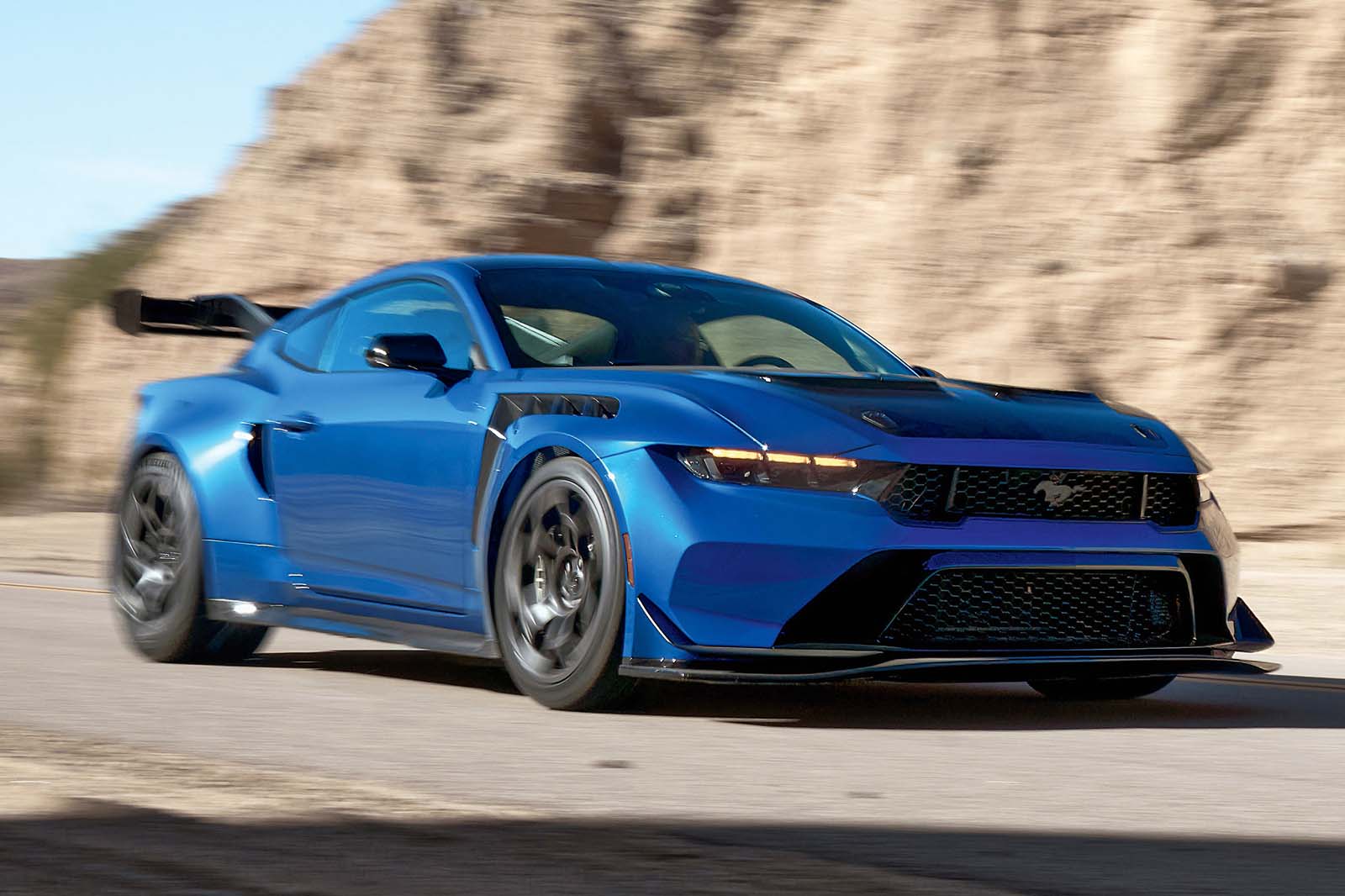
Hunkered stance hintsat the track-derived car’s racing roots The GTD is the most extreme Mustang ever to wear numberplates - we take unleash its wild side I wonder if Ford would have liked to build this car 10 years ago. Back then it was planning to return to Le Mans, given it was approaching 50 years since the GT40 had won there, and senior Ford bods wanted to do that with a Mustang. It was the swankiest car they made and they thought it would be good to see it racing: win on (Saturday and) Sunday, sell on Monday. But the more Ford's engineers looked into it, the more they thought they couldn't make it competitive. The Mustang would be a big car for endurance racing's GTE category, and while various 'Balance of Performance' allowances would be made for that, giving it more power than some rivals, there would be a limit to how fast they could make a car with such a large frontal area. So on the sly the engineers started developing the GT, with its narrow cockpit and standing just 1.8 inches higher than the 40in-tall GT40. The bosses were convinced, and it was so naturally fast that race cars routinely had their power capped so they didn't run away with it in competition. But it was a race car that became a road car, rather than the other way around. The Mustang itch seemingly remained unscratched, because a decade and a generation of Mustang later, Ford still really wanted to race one at Le Mans, so it made a GT3-class variant. With a gearbox mounted at the rear, suspension by Multimatic (the Canadian company that co-developed, builds and helps race the car) and more trickery besides, it has a Le Mans class podium to its name. You're looking at the road car that was developed alongside it to celebrate the fact. You could think of it as a GT3 RS or Speciale variant of the Mustang. It's called the GTD, which comes from IMSA racing's 'Grand Touring Daytona' category, by the way. I'm guessing they didn't have VW Golf GTDs in the US to confuse it with. What I can tell you is that no Golf ever sounded like this, as the Mustang fires up very early in the morning in a covered garage at a Californian hotel and shakes the whole place to its very foundations. That will be its 5.2-litre supercharged V8 engine, dry-sumped for the first time in road-going Mustang history. Refreshingly to my ears, it retains a cross-plane-crank firing order so sounds like an authentic American V8. I do feel a bit bad about the volume, but the valet parking guys are quite relaxed. That's one thing about rural American towns: they all reverberate to the sounds of V8s and vee-twins at various points, day and night. I suppose complaining about it would be like moving to a small English village and bitching about cockerels crowing or low-flying cricket balls. You probably shouldn't have moved here then, mate. Because of the relatively mass-market, blue-collar nature of the standard Mustang, changes from the regular car to the GTD (I drove a Mustang Dark Horse over to this hotel from the airport for a helpful back-to-back comparison) go even deeper than, say, on extreme Porsches or Ferraris . The engine is a 5163cc (a round 315cu in) 90deg V8, oversquare (94mm bore, 93mm stroke), with forged aluminium pistons, forged steel conrods and crank, an intercooled supercharger and active exhaust valves ("for acoustic refinement"). It has a higher specific power output than a GT3 RS, making 815bhp at 7400rpm, revving to 7650rpm and producing 663lb ft of torque at 4500rpm on the way up there. The GTD's platform is from the road car, but the body-in-white is removed from the standard production line and then sent to Multimatic. The body panels are mostly carbonfibre and the suspension isn't just the trickest in Mustang history but among the trickest you will find anywhere. The GTD rides on Multimatic's ASV spool-valve dampers, which are the kind of things that confused the heck out of me the first time I tried to understand them and my head is hurting no less this time around. It's a semi-active set-up that can vary both spring rates and ride height, so it says here. They can go 40mm lower than their road ride height in Track mode. Anyway, they sit conventionally upright on the double-wishbone front suspension but at the rear the GTD goes way off-piste, having a bespoke aluminium subframe so that the multi-link suspension is pushrod-actuated and the springs and dampers sit in a horizontal cross pattern, just behind where the rear seats would usually be. This has created enough space beneath them for Ford to swap out the usual front-mounted gearbox and have an eight-speed dual-clutch automatic transaxle mounted square between the rear wheels, with a carbonfibre propshaft running to it and an electronically controlled limited-slip differential. That there's also a sizeable exhaust, the bulk of the suspension subframe, a load of hydraulics and additional cooling back there means two other things: the weight distribution is near-50:50 and you don't get a boot. At all. Instead, a rear seat delete allows a little luggage space - not unlike in the back of a Porsche 911-while a window lets you look at those spring and damper units in their unbridled glory. A few more things. The aero is very active: the rear wing can go from giving you some rear visibility in a high-drag mode through to none at all with it closed. They say maximum downforce is 885kg. And the front tyres are perhaps the widest I've ever come across on a road car. Its Michelin Pilot Sport Cup 2 R tyres are 325/30 R20s, the same width as the rears on a Ford GT and just 20mm narrower than the rears here. The GTD's overall width is 164mm up on the regular Mustang. None of this hardware is that light, mind you: the GTD tips the scales at 1989kg. This is a car of wild stats. I note just how wild it is in reality within 50 metres of rolling as gingerly as I can (the nose lift is pleasingly abrupt) off my hotel's driveway ramp and onto one of those concrete slabbed roads that American towns are crossed with. Road noise and the low-speed ride are both fairly shocking. The interior, though, is not. So long as you don't look behind you. It's mostly Mustang, which has disappointed some commentators, but I'm fine with it, because it on one hand serves as a reminder that the GTD is a made-over everyman's car and on the other that this is a fine everyday interior. It has a sound driving position with new, supportive but not stupid Recaro seats and a near-round steering wheel with sensible actual buttons. And while I'd prefer it if the heating controls weren't on a touchscreen, I'm not about to complain about it too much on a car like this. Besides, there's a bit of carbonfibre here and there to inject some interest and they tell me the gearshift paddles are made of titanium from a retired F-22 Raptor fighter jet. Ford says the GTD is a track-focused machine. It's just three seconds slower around the Nordschleife than a 911 GT3 RS, after all (6min 52sec, if you're asking) - but look, they also say it's the most extreme Mustang to wear numberplates. And given it's road-legal, that's where my primary interest lies. I have a day and one of the largest countries on earth to play in, so that's what I'll be exploring, east and south from Palm Springs. There used to be a misconception, now I think mostly dispelled, that American roads were all straight and boring. I mean, a lot of them are - they've got more than 3.5 million square miles to cross - but very many of them are also not. Some that are not are Box Canyon, the Pines to Palms Highway and the Rim of the World Scenic Byway. Even the names sound exotic, showbiz-adjacently descriptive. The right American road can be one of the best you'll find, is frequently low in traffic, is relatively flat and well (if coarsely) surfaced. Plus it might come with a view that stretches for hundreds of miles. When people ask why you might want a supercharged V8-powered coupé that's 2080mm wide, roads like these will be my answer. Even on the boring roads that lead to the interesting ones the GTD is bearable. That harsh brittleness around town fades as speeds rise and the dampers are actually asked to do some work. The Mustang is not unlike a Ford Ranger Raptor , or maybe a Toyota GR Yaris , in that respect, in that it gets better as you go more quickly. For all the anger it's a stable car, with a leggy gearbox that makes for a perfectly acceptable cruise (and a 200mph top speed). Any journey comes with a frightening single-digit MPG reading, until you remember that a US gallon is smaller than a British one, so early/mid-teens is probably achievable. And it's fun, in a quiet moment, to watch the suspension in the interior mirror. If the rear wing is in high-drag mode, it's not like the mirror is good for anything else. But it's more fun to get the car to do some actual work. I'm trying to think what car the Mustang GTD is most like. It might be the Mercedes-AMG GT Black Series , although I drove that car only on circuit, and AMG decided to fit it with a flat-plane crank, which doesn't yield a terribly exciting engine note. The GTD has one of the most exciting engine notes this side of Nascar. It really doesn't feel quite like anything else. There is terrific urge in any gear. And if you're in the wrong gear, the right ratio is only a couple of wheel-mounted paddle pulls away, and then it's shockingly, rabidly urgent. We've tried a few tuned Mustangs that are claimed to have 800bhp and which would be lighter than this, and rarely do they quite feel the full 800. This one does, and then some. Even though it's nudging towards two tonnes (imagine how keen they were to keep the last 11kg off), it monsters around its rev range before banging abruptly into the limiter, if you let it, while it still feels like there would be more to come. There are drive modes and the angrier ones come with a hard throttle-off and a bang from the exhaust on upshifts. A bit much for me on the road usually but fun if you're in the right mood, or if you're about to stop to record some static video footage and want to be sure you've scared away the mountain lions. But while Mustang 10-speed autos can get a little befuddled about what gear to be in and have very close ratios, this eight-speeder shifts cleanly and positively. Carbon-ceramic brake discs are standard, feel is strong and it stops brilliantly well too. I couldn't tell you about fade on a circuit (I suspect there's none), but they are certainly up to a downhill fang on a road that you know is empty because it has been closed farther on by subsidence. And the handling is like that of no Mustang, and actually very few other cars. Typically in a front-engined, rear-driven car, there's a degree of managing the nose involved in getting it to turn willingly. A Mustang or, say, an Aston Martin or AMG, likes to be turned in with a trailed brake to keep a bit of weight on the front. The GTD's more even weight distribution, plus its monster-sized front tyres, means that its responses are quite different. It's way more happy to turn with a bit of throttle applied, which on a winding road where you would want to carry an even speed between corners makes it an enjoyably responsive steer. The GTD's weight is spread out front to rear, so it's not agile like a mid-engined car whose masses are closer to its centre, but there's a willingness that a big-engined coupé of this size and mass ought not to have. And on corner exit? Well, it's a road car, so I was a bit careful - but also, it has 664lb ft even in the mid-range and a limited-slip differential, so yeah, it will move around a bit. It steers pretty well too. I've seen a few people say that the set-up lacks a few of the finer degrees of road feel, and perhaps there's some truth in that, but these are huge front tyres dealing with enormous loads, so if the feel was left too unfiltered, I imagine it would tug the steering wheel all over the place. As it is, the car tramlines a bit on poor surfaces. It would be interesting to see just how much the steering moves around on more heavily crowned and poorer-surfaced British roads, especially given how wide this car could feel. It's left-hand drive only and there will only be around 1000 in total, but a few may make their way here, at around £315,000. I don't suppose the Americans would like to see them go, which I understand entirely. Ford sells a lot of Mustangs in the US and knowledge of the car is high in a patriotic country that likes its muscle, so the GTD is a superstar wherever it goes. It's like driving a Morgan Super 3 in the UK: nobody dislikes it, nor seemingly the racket it makes. A race-derived Mustang has taken a while to arrive - but it was worth the wait.