


 Dawn.com
 SMOKERS’ CORNER: RELEASING THE PRESSURE
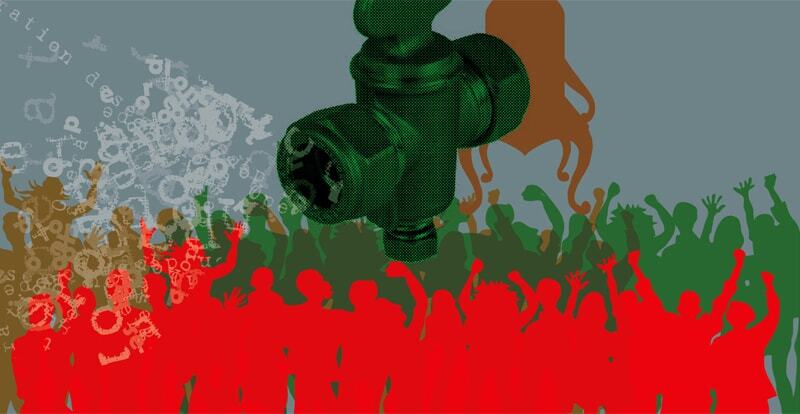
Illustration by Abro The sentiment that ‘revolution was just around the corner’ serves as a poignant distillation of the 1960s ‘counterculture’ zeitgeist. It was a unique historical moment, where global currents of youthful middle-class dissent converged to create a sense of inevitability that the old order was about to collapse. There is a distinct sense of melancholy attached to this sentiment today, stemming from the fact that the revolution never actually materialised. The capitalist structures and political hierarchies that drew the fire of youthful protestors proved resilient. The survival of the status quo was largely due to the durability of the modern state. When pushed hard, governments effectively reinforced their ‘law and order’ platforms, a strategy that successfully appealed to a more cautious general public. They prioritised stability over radical change, allowing the state to reassert control. Capitalism demonstrated a remarkable capacity to co-opt the rebellion. Instead of being dismantled by the ‘rebellion’, the market absorbed it, rapidly transforming the potent symbols of revolution into mass-produced commodities. This allowed individuals to buy the aesthetic of a revolutionary without ever actually threatening the financial institutions that issued them loans and credit. However, despite the political failures of the era’s uprisings, they did usher in some social shifts. As noted by the American sociologist Todd Gitlin, while the movements of the 1960s failed to topple governments, a “cultural revolution” effectively took root, fundamentally altering how society perceives authority, gender roles, racial dynamics and environmental stewardship. From the counterculture of the 1960s to today’s ‘Gen Z revolutions’, mass uprisings have repeatedly failed to dismantle power because the modern state has learned how to absorb dissent, co-opt its language and rebrand itself without changing its core But it is also true that the state gained a sophisticated understanding of how to manage dissent energised by middle-class youth. In the decades that followed, governments learned to neutralise modern, youth-led uprisings by absorbing their energy. According to the American political scientist Christian Davenport, the evolution of state power since the 1970s has seen a sophisticated shift toward the “professionalisation of state survival”, moving away from blunt, reactive force in favour of nuanced containment. Modern states now prioritise strategies of co-optation and absorption, expertly identifying the leaders and aesthetic language of youth movements to bring them into the fold. One way of doing this is by inviting activists into ‘advisory’ committees. This aids the state to effectively dissipate radical energy through institutionalisation. The state then allows for symbolic concessions, such as the resignation of a single unpopular official. This satisfies the activists’ immediate hunger for change but without threatening the underlying power structure. The most recent example in this regard is Bangladesh . This management of dissent extends into the digital realm as well. The initial advantage held by youth activists in this area has been increasingly eclipsed by state-directed information management. And anyway, the digital landscape often gets flooded with a clutter of noises, so much so that a movement’s core message becomes diluted or misunderstood by the wider public. Most post-1970s movements have taken on a bourgeoisie character. Therefore, the state strategically exploits the socio-economic stakes that the activists have in the existing system. Dissent has become the specialised vocation of the bourgeoisie. This is why it fails to achieve the critical mass necessary for systemic change. This is why, in most cases now, the state often treats dissent as a pressure valve to be managed. The 1974 ‘Carnation Revolution’ against a fascist regime in Portugal is remembered as a popular uprising. It really wasn’t. According to the American political scientist Samuel P. Huntington, it was a ‘top-down’ transition initiated by the military. It was a coup d’etat. By leading the change from within, the rebel officers ensured that the transition remained institutional and controlled, effectively neutralising the more revolutionary working class elements. This pattern, what Harvard University political scientist Tarek Masoud calls “decapitation without dismantling”, defines the subsequent ‘revolutions’ of the late 20th and early 21st centuries. In these instances, high-visibility, youth-led middle class protests succeeded in removing unpopular leaders, yet the underlying state machinery and power structures remained largely untouched. These uprisings functioned as pressure valves. Examples include 2003’s ‘Rose Revolution’ in Georgia, 2004’s ‘Orange Revolution’ in Ukraine, 2011’s ‘Arab Spring’ (2011), 2022’s ‘Sri Lankan Aragalaya’ and last year’s uprisings in Bangladesh, Nepal and Madagascar . The newest trend in this regard are the so-called ‘Gen Z Revolutions.’ These cases prove that, unless an uprising targets the entire administrative and economic infrastructure, the state will simply rebrand itself while maintaining the old power dynamics. Targeting the entire infrastructure hasn’t happened since the revolutions in France (1789), Russia (1917), China (1949), Cuba (1958), Nicaragua (1979) and Iran (1979). The American historian Crane Brinton established a rigorous “fever chart” for true revolutions, requiring a progression from the collapse of the old regime to a “Thermidor”, or the consolidation of an entirely new order. In contrast, most modern uprisings fail to reach this final stage. Learning from the upheavals of the 1960s, the state no longer tries to simply crush dissent. It manages it. By allowing an unpopular figurehead to be removed, the state provides a psychological victory to the protesters. Uprisings in this regard are better described as pressure valves than revolutions. When the media labels these events as ‘revolutions’, it misses the fact that the underlying power structure is often stronger the day after the uprising than it was the day before. Pakistan is an excellent example of this. The power structure actually grew stronger after the May 9, 2023 uprising staged by the supporters of the now jailed populist Imran Khan. Such events function as pressure valves because they provide an outlet for the energy of middle-class youth. But this energy fails to crystallise into an actual revolution. The so-called ‘Gen Z Revolutions’ will also eventually be absorbed back into the systems they ‘fought’. The old machinery will re-assert itself, often rebranding the same power under the new, popular language of the ‘revolution’. Nevertheless, while the term ‘pressure valve’ might suggest a failure to achieve total victory, this mechanism is arguably more vital to the long term health of a nation than a ‘Thermidorian’ revolution. The true danger of a systemic overthrow is the almost inevitable descent into a reign of terror or a vacuum of power that invites civil war, economic collapse, and permanent instability. Therefore, the preservation of certain deep-rooted instruments of the state are necessary for the survival of the nation. By allowing pressure valves, these instruments allow for a change without destroying the hardware of the state. A society can move towards reform more effectively through incremental institutional change than through a total rupture that risks leaving the society in a state of permanent chaos. Published in Dawn, EOS, January 11th, 2026