


 The Better India
 One Woman Sarpanch Rebuilt a Maharashtra Village With 116,000 Trees and Solar Power
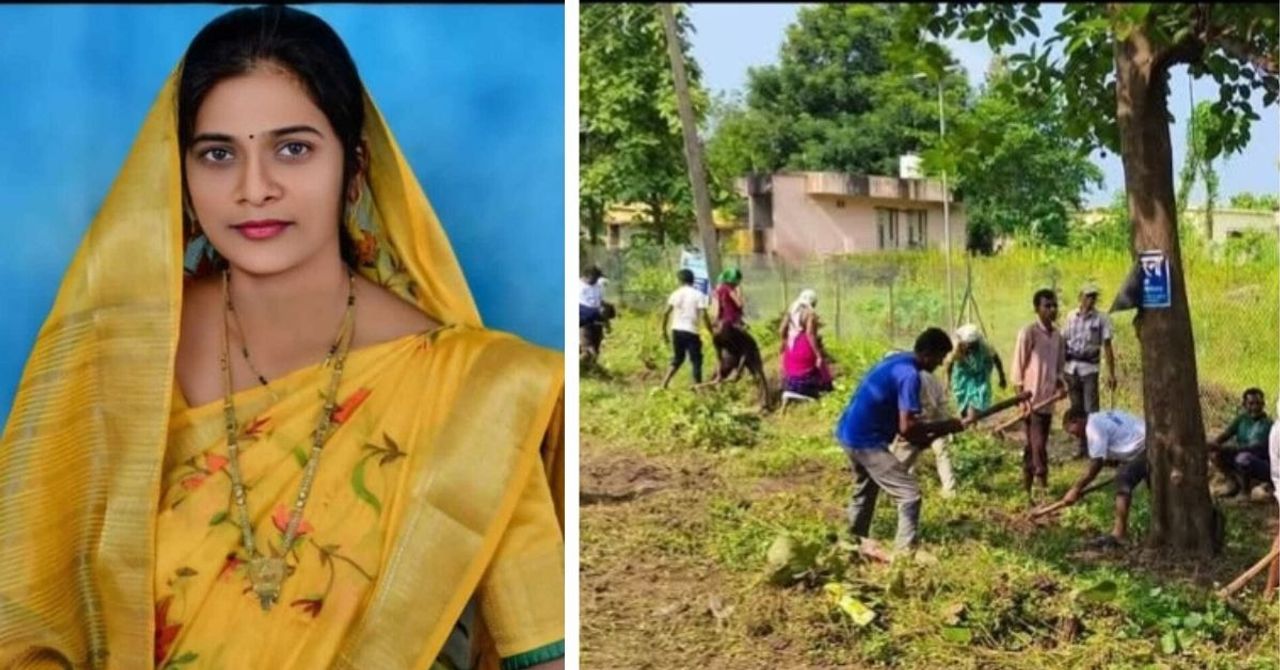
In 2025, Dawwa village in Gondia's Sadak Arjuni taluka in Maharashtra made history as the first in India to win the Climate Action Special Panchayat Award (CASPA), securing a Rs 1 crore prize for grassroots climate efforts . Since December 2023, the village also secured additional honours, including the Sant Gadge Baba Award and state recognitions such as the Majhi Vasundhara Award in June 2024. The total accolades were worth Rs 1.61 crore. Dawwa’s progress is now visible in every direction. Paddy yields are up, orchards are thriving, and livestock numbers have grown. Women-led SHGs are local engines of change. Public places and schools are powered by solar energy. What began as a single mother’s quiet act of resilience has grown into a model of rural leadership — where climate action, gender empowerment, and community participation converge. Dawwa today stands as proof that the smallest village can blaze a trail in sustainability — one rooted in empathy, inclusion, and hope. Class 12 graduate who became a sarpanch Amid this atmosphere of transformation emerged Yogeshwari Chatrugan Chaudhary, whose life was reshaped by tragedy. Married in 2003, she arrived in the village as a bride after passing her Class 12. With the support of her husband, Yogeshwari went on to pursue a B.A., B.Ed., and D.Ed. (Craft). She was working as a schoolteacher when, in 2017, her husband passed away suddenly, leaving her to raise their young child alone. Deeply troubled by the worsening condition of Dawwa — degraded soil, failing crops, and the steady migration of youth — Yogeshwari felt the village needed decisive leadership from within. After her husband’s demise, she recalls, “I had no elder support. It was just my child and me. I could have given up, but I chose to rebuild.” Her resilience soon found expression in public life. Deeply troubled by the worsening condition of Dawwa — degraded soil, failing crops, and the steady migration of youth — Yogeshwari felt the village needed decisive leadership from within. Armed with education but no political backing, she decided to step forward herself. In December 2023, Yogeshwari Chatrugan Chaudhary assumed the role of sarpanch of Dawwa (S) Gram Panchayat, winning the election by a strong margin on the strength of community trust and support. She became the village’s first woman sarpanch, transforming personal loss into a mission to rebuild her village. Dawwa then versus now Before Yogeshwari took over as the sarpanch of the village, the villagers experienced poor soil, shrinking forests, and erratic rains, making farming unreliable. Located 35 kms from Gondia town, Dawwa seemed locked in a cycle of low yield, limited opportunity, and mounting uncertainty. Today, paddy shoots shimmer beside teak saplings and blossoming orchards. The green abundance hides the struggle villagers faced a few years ago. “We were farming the way our grandparents did,” recalls farmer Santosh Patle, “but the land was giving us less each year.” Women, too, were sidelined from decision-making. “We wanted to contribute, but there was no platform,” remembers Mamta Katre, now a self-help group leader. Yogeshwari leaned heavily on community participation and guidance from former sarpanch Shri Bahekar, who mentored her through the administrative and procedural challenges of governance. Yogeshwari began her tenure not with declarations but dialogue. “Our village has 3,418 people and 796 households,” she notes. Through open meetings with the panchayat and villagers, she listed the priorities — from water security to afforestation. Committees on biodiversity, sanitation, disaster management, water management, and disaster preparedness were formed to ensure every household had a voice and to help her navigate the early uncertainty of leadership. Without political muscle, Yogeshwari leaned heavily on community participation and guidance from former sarpanch Shri Bahekar, who mentored her through the administrative and procedural challenges of governance. Linking Dawwa with Maharashtra’s Majhi Vasundhara 4.0 sustainability campaign — a statewide environmental initiative by the Government of Maharashtra’s Environment and Climate Change Department — gave the village direction and recognition. Within months, Dawwa earned its first Smart Gram Award. “We wanted eco-friendly living to become the way of life,” she says. Farming smarter, sharing power Her next mission was to revive farming. She formed five farmer groups and 38 women’s self-help groups (SHGs), introducing solar-powered irrigation, farm schools, and diversification. Solar-powered irrigation was made possible by tapping into Maharashtra government schemes such as Magel Tyala Saur Krushi Pump Yojana and Mukhyamantri Saur Krushi Pump Yojana, which provide heavy subsidies for off-grid solar agricultural pumps. Farmers owning less than five acres receive up to 95 percent subsidy for a 3 HP pump, while those with more land can install 5 HP pumps at a fixed, highly subsidised contribution of around Rs 30,000. Greening Dawwa has become a living testament to how collective will can spark ecological renewal However, Yogeshwari explains that access to these schemes is not automatic. “It requires repeated follow-ups, paperwork, and constant engagement with officials,” she says. She personally pursued applications, coordinated documentation, and lobbied departments to ensure Dawwa’s farmers were approved, helping overcome cost barriers that would otherwise have made solar irrigation unaffordable. The “farm schools” she introduced refer to Shetishalas or Farmer Field Schools, run in collaboration with the Agriculture Department and ATMA. Here, small groups of farmers learn directly on demonstration plots through season-long, crop-specific training — observing soil preparation, sowing, pest control, and harvesting in real time rather than through theory alone. Diversification, Yogeshwari explains, meant moving away from dependence on a single crop. Paddy fields were complemented with orchards, vegetables, livestock rearing, and tree plantations, spreading risk while improving incomes and soil health. Her own eight-acre farm — five acres of teak and three of paddy — became a demonstration site for modern methods. “If I can do it, others can too,” she told farmers, urging women to manage their own plots. “We are no longer just helpers,” says Mamta. “We make decisions, manage accounts, and run farms.” Once a migrant labourer who had moved to Mumbai from Dawwa, Digambar Lanjewar shares, “We learned that saving energy is as important as generating it. Ours might be the only village in the district with a high-tech gym and a library.” Today, Digambar is a full-time farmer in the village. Ecological renewal Greening Dawwa has become a living testament to how collective will can spark ecological renewal . What was once a landscape struggling with degradation is now flourishing with over 116,000 trees rooted across its common lands, each one a symbol of resilience and hope. Two nurseries nurture young saplings while thousands of seed balls, scattered by hand, carry the promise of future forests. In every home, waste is no longer discarded thoughtlessly but carefully segregated and composted, closing the loop of sustainability. Electric vehicles hum quietly through the lanes, gathering waste without smoke or noise, while bans on plastic and firecrackers have lifted a burden from the air and soil. At night, solar mini-grids and home systems cast a warm glow across more than 400 households, proof that clean energy can power both community and imagination. Together, these efforts have transformed Dawwa into a beacon of ecological harmony, where restoration is not just policy but a way of life. Dawwa village in Gondia's Sadak Arjuni taluka in Maharashtra made history as the first in India to win the Climate Action Special Panchayat Award (CASPA), securing a Rs 1 crore prize for grassroots climate efforts. Resistance came when Yogeshwari built an immersion tank to keep festival idols from polluting local water bodies. Some villagers even called the police. She stood her ground. “My duty isn’t confined to roads or drains,” she says. “It’s about safeguarding the — earth, air, water, fire, and space — for our village’s future.” Two years later, the villagers collectively submerge their idol in the tank constructed by their own hands. Recognition beyond borders Yogeshwari Chaudhary recalls the scepticism when she nominated Dawwa for CASPA. “People laughed in disbelief — no village from our district had dared to try,” she says with a quiet smile. “For every project I document, I geotag my photos using a smartphone or Bhuvan app,” explains Chaudhary. This GPS verification ensures transparency and accountability in government-funded work. Gram Vikas Vibhag’s junior engineer Kishore Bansode highlights key achievements: soak pits in every home, recharge shafts along the nullah that elevated groundwater levels, CCTV for safety, and widespread plantations. Patle adds, “In the last two years, we’ve seen progress unseen in fifty.” Standing under the shade of the teak she helped plant, Yogeshwari reflects on the journey. “We planted hope along with these saplings,” she says, “and now our village is growing stronger every day.”