


 Dawn.com
 Why do so many people in Pakistan suddenly have a button phone? (It’s not for the vibes)
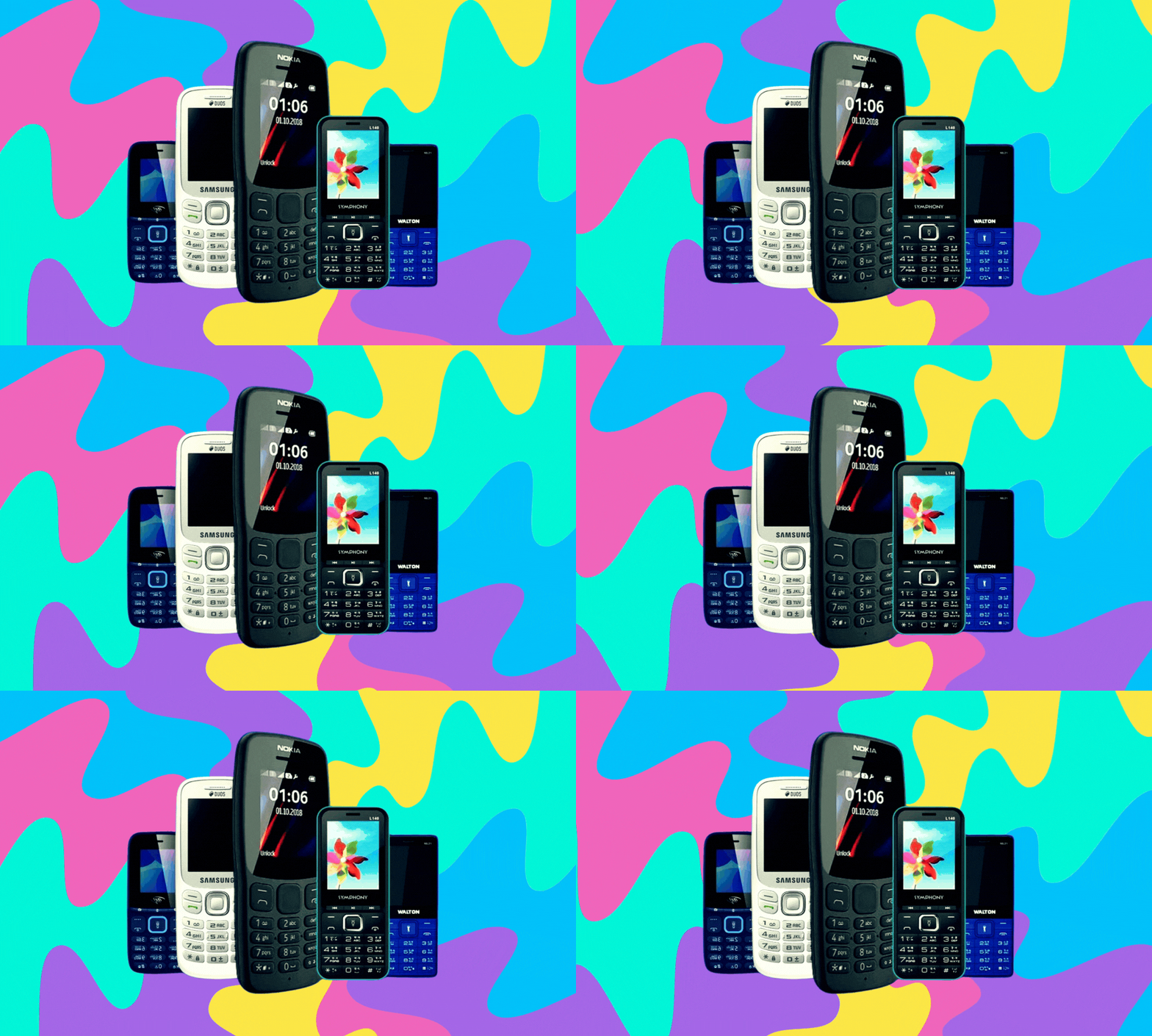
Years ago, when I got a feature phone at the age of 12 — my very first cellphone, a hefty little brick — I quickly developed the terrible habit of slamming it on the ground for dramatic effect. It was a cool way to punctuate very ordinary statements, I thought. In reality, though, it was a ridiculous joke; a silly imitation of television drama that got old really fast, but was mostly inconsequential since the phone was a little black Nokia 2220, cheap but sturdy. Its only worthwhile feature was the single greatest game in mobile phone history — Pinball Club (sorry Snake fans). You could throw that thing off the second floor of your house at least half a dozen times before any real damage occurred, not exactly how I’d handle my current, delicate, shatter-prone smartphone — 80 per cent glass screen, 100pc pain in my clumsy neck. Today, these small, stocky phones are making a resurgence. In the US, folks call them ‘dumbphones’ tied directly to their use case as tools for social media cleanses. In Pakistan, or more specifically, at the Saddar Mobile Market in Karachi, shopkeepers refer to these devices as ‘button phones’ and maintain a diverse collection of brand-new and second-hand options for potential customers to peruse, and — spoiler alert — they happen to be pretty popular around here. Built to last Of the 12.05 million mobile phone units assembled during the first five months of 2025, 54pc or 6.53 million were 2G feature phones, according to data shared by the Pakistan Telecommunications Authority (PTA). During the same period, 94pc of the mobile phone demand was met through local manufacturing and assembly, compared to the five-year (2020-2024) average of 77pc and the nine-year (2016-2024) average of 52pc, per media reports. Hence proven: the button phone market in Pakistan is alive and pumping. But to learn more, I walked along the margins of the Saddar Mobile Market eyeing road-facing stores looking for stubby boxes of G’Five, Vivo, and the occasional second-hand Nokia — the Godsend button phone to end all button phones. Directness seemed most appropriate, so upon locating a store that not only dealt with button phones, but had a front counter laden with refurbished landline telephones, I presented the question with what the sophisticated may excuse as ‘straightforwardness’: “Who even buys button phones nowadays?” Stupid question; I saw it on Naveed the salesman‘s face. “The elderly, the older generation, don’t care about smartphones; they don’t like them,” he said, almost as if stating the obvious. Set in their ways, the 16.5m Pakistanis over the age of 60, as per the latest census in 2023, seem to swear by button phones for communication. Look no further than your own grandparents. “I could put my SIM card in any set I wanted,” said Muhammad Ilyas, an elderly salesman. He stood by his store counter at the mobile market, holding a worn-out, ancient-looking CAT button phone. Behind him, sleek and shiny smartphones were laid out neatly on a shelf to entice customers. They do not attract Ilyas, though. “I don‘t really need one,” he said, pointing toward them. “I have this phone, and I’ll probably use it for years … because it will last forever.” Gen Z and security concerns The elderly are, however, not the only target market for button phones. As it turns out, Gen Z — for all their tech-savvy and screen-addicted ways, their social media branding, and apparent diminishing attention span courtesy the constant doom-scrolling — are also as ready and willing customers. Granted, they are not as lucrative a consumer group as the tech-averse boomers, but Gen-Z, especially those in Pakistan, do have their own vested interest in maintaining a button phone. For one, security. Karachi reported about 13,213 phone snatching cases in the first nine months of 2025, according to the Citizens Police Liaison Committee, maintaining its legacy as ‘phone-snatching central’. “Younger people prefer to keep button phones when they’re outside,” said Muhammad Irfan, who sells second-hand smartphones and tablets. He sells roughly 20 button phones a month, and a majority of them are to the younger generation. It is a creative security measure. Simply put, a button phone a day keeps snatchers away. Enter taxes and button phone loopholes The sight is not strange; that one friend (or in my case, four) taking out their iPhone, the latest model, at the lunch table for ‘foodgram’. But this phone seldom rings, unless they have managed to secure the WiFi password of the restaurant. For the menial tasks — calls and messages — they have a substitute, usually a button phone. This is yet another creative loophole that many millennial and Gen Z iPhone enthusiasts have adopted to dodge paying exorbitant taxes just to keep their SIMs alive. Pakistan tech laws require all imported devices to be registered with the PTA, threatening to block users’ SIM cards otherwise, using its Device Identification Registration and Blocking System that tracks compliance. The regulation is not only restricted to imported phones but is also applicable to foreigners who travel to Pakistan with their unregistered devices. But does this only impact iPhones? Why the correlation? Because iPhones are very expensive, more so than your average Android-run device. Even the most recent depreciated valuations of older iPhone models by the Directorate General of Customs Valuation range from Rs70,000 to Rs350,000. Of course, buying the phone is one thing; the taxes that follow are another bane. Consider the iPhone 16 Plus (512GB) that was valued at $1,050 — a little over Rs300,000 — in the April 2025 valuation. For Pakistanis, an additional Rs87,219 would be required to pay off the necessary duty as per the Federal Board of Revenue’s ‘ Rate of Duty and Taxes on Mobile Phones (2021-22) ’. No wonder Gen Z is suddenly so interested in the ‘so-2010’ button phones. Endlessly appealing iPhones But here is what bothers me. Is it really worth purchasing a six-figure iPhone and then spending more money on getting its life jacket (button phone) too? According to Midhat, a software engineer and recent proud owner of a non-PTA-approved iPhone 15 Pro worth Rs140,000, it is. There are two reasons: security and features. “If someone steals my iPhone and it’s screen-locked, they can’t break into it like other phones,” she explained. “Sure, there is software you could use to break into it, but that would ruin its IMEI number.” Other brands, such as Samsung, she continued, are improving their features, but they aren’t a match to the iPhone when it comes to data security. “It also has some great features that you can’t find on other phones, like the camera.” There is some irony here, though; you can’t get a phone stolen if it never leaves the house with you. Midhat shared that she doesn’t take her iPhone everywhere with her. “It’s such an expensive phone. You can’t take it out in Karachi. Most people I know just keep it at home and use another phone for everyday purposes.” Rameesha, another iPhone enthusiast and a customer experience consultant, added that there was no sense in spending thousands on PTA registrations because, like most tech, iPhones too depreciate merely with months, given the speed at which Apple keeps updating their models. However, particularly with iPhones, there is a “bitter reality” that is often overlooked. “They are widely recognised as a status symbol. It’s a good visual to have,” Rameesha told Dawn . Pull out an iPhone in a room full of people, and the aura flips. And so, whether for safety, money or status, the verdict is in: button phones, once obsolete, have made a comeback in the Pakistani tech scene with quiet confidence. While they may not promise flashy cameras, seamless functionality or social clout, they are unbreakable (quite literally) and will keep you out of trouble, mostly. In a city where carrying an expensive smartphone can feel like a liability, the button phone is the perfect jugaar .