


 Dawn.com
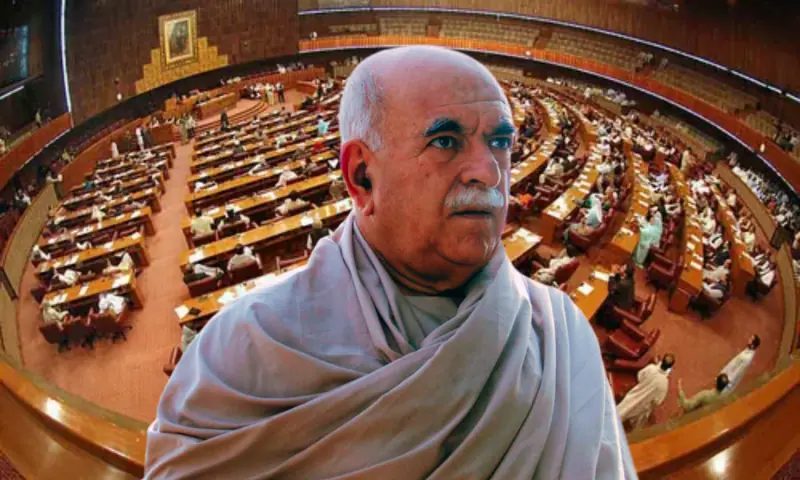
 Mahmood Khan Achakzai, a political figure since Bhutto era, steps in as new NA opposition leader
It was the afternoon of October 7, 1983, and former dictator General Ziaul Haq’s martial law was in effect, when a young man decided to lead a procession in Quetta to demand the restoration of democracy. Despite grave life threats, his stance remained firm, even when four of his supporters were shot dead, and dozens were injured by the authorities. Today, the man, Tehreek Tahafuz Ayeen-i-Pakistan (TTAP) chief Mehmood Khan Achakzai, has been appointed leader of the opposition in the National Assembly. His name for the slot was recommended by incarcerated PTI founder Imran Khan last year. In the past few years, Mehmood Khan’s name has appeared in the mainstream media one time too many. But who is this man, and what is his story? Entry into politics Mehmood Khan, whose name and face have been a mainstay of the opposition benches for decades, was born in the village of Inayatullah Karez, Gulistan, in Balochistan’s Killa Abdullah Khan, which at the time was part of the Quetta-Pishin district. He received his early education in Gulistan and completed his F.Sc. from Science College, Quetta, before graduating with a degree in Civil Engineering from the Peshawar University of Engineering. A major but tragic turning point in his life came on December 2, 1973, when his father, Khan Abdul Samad Khan, was martyred in Quetta because of his political stance. Khan Abdul Samad Khan Achakzai had parted ways with the National Awami Party (NAP) after the abolition of One Unit, when instead of forming a united Pashtun province by merging the Southwestern Pashtun belt with the Northwestern Pashtun belt — or restoring British Balochistan (the Pashtun-majority province) — the party accepted the merger of British Balochistan with the Brahui confederacy or states union to constitute what is today Balochistan. This decision was taken after General Ayub’s resignation, when NAP leaders had already been released, but Abdul Samad Khan Achakzai was still in prison. In protest, Khan Abdul Samad Khan Achakzai formed a new party called the Pashtunkhwa National Awami Party — a decision that ultimately led to his assassination. Ironically, the strongest opposition did not come from the NAP leadership or the Pakistani establishment but also from Afghan President Daoud Khan, who disliked Abdul Samad Khan’s argument of forming a separate “Pashtunistan province” by uniting all Pashtun areas. It was during this period, after completing his education, that young Mehmood Khan was thrust directly into a political storm. Following his father’s assassination, he was nominated in the subsequent by-election, which was not just a political contest. It was painted as a clash between Afghan President Daoud and then-prime minister Zulfikar Ali Bhutto. The rise of the maverick In January 1974, just a few days before the election, Mehmood Khan received a message that a senior Afghan official wanted to meet him. Along with two companions — one of whom had been his slain father’s deputy — he went to a border village near Chaman, where the governor of Kandahar arrived in a Mercedes. The conversation began politely, but when Mehmood Khan refused to change his stance, he was bluntly warned that this election was actually a contest between Daoud and Bhutto, and that he should withdraw and rejoin the NAP. While his colleague could not withstand the pressure, the young and fiery Mehmood Khan displayed what has been described as remarkable courage. “This is the political legacy of my leader and father. It is the principled stance for which he was martyred. If President Daoud considers this a contest with Bhutto, then tell Daoud he has already lost,” he had said. At a time when fear prevented anyone else from taking up the party’s leadership, this heavy responsibility fell on the young shoulders of Mehmood Khan. From the very beginning, he swam against the tides, one reason why he remains the only politician in the country who, without the support or patronage of any domestic or foreign establishment, has sustained his political existence solely through his own resilience and the sacrifices of his workers. One purpose In fact, Mahmood Khan Achakzai has played a central role in shaping and leading various opposition political movements in Pakistan, consistently standing for democratic rights, constitutionalism and federalism. During General Ziaul Haq’s dictatorship, he was an active participant in the Movement for the Restoration of Democracy (MRD), where he allied with progressive and democratic forces to resist military rule. In the late 1990s, he co-founded the Pakistan Oppressed Nations Movement (PONAM), uniting nationalist parties from smaller provinces to struggle for provincial autonomy and equal rights within the federation. Later, as part of the All Parties Democratic Movement (APDM), he joined mainstream political forces in opposing General Pervez Musharraf’s military regime and demanding free and fair elections. More recently, Mehmood Khan was seen as a prominent figure in the Pakistan Democratic Movement (PDM), a broad alliance of opposition parties formed to challenge authoritarianism, uphold parliamentary supremacy, and ensure the sanctity of the Constitution. In 2025, he launched the Tehreek Tahafuz-e-Aain-e-Pakistan, a new political platform aimed at uniting diverse political and social forces to safeguard the 1973 Constitution, strengthen democratic institutions, and promote civilian supremacy. His continuous involvement in these movements reflects his lifelong commitment to democracy, provincial rights, constitutionalism and rule of law in Pakistan’s political landscape.