


 Dawn.com
 Pakistan, US expand military engagement amid renewed defence ties
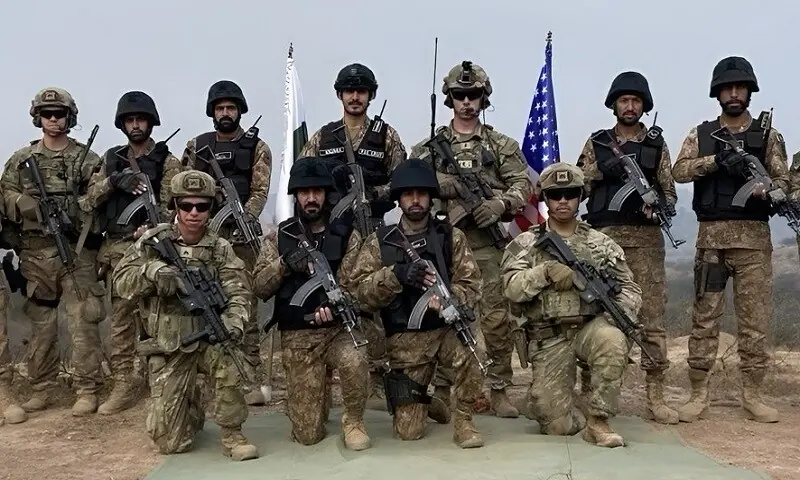
Military-to-military ties between Pakistan and the United States appear to be strengthening, marked by renewed joint training, major defence sales and unusually warm rhetoric from President Donald Trump towards Pakistan’s military leadership. According to a statement issued by the US Central Command (Centcom), American and Pakistani troops this week concluded joint training at Pakistan’s National Counter-Terrorism Center in Pabbi. “This week, US and Pakistan Army Soldiers completed training at Pakistan’s National Counter-Terrorism Center during Exercise Inspired Gambit, which focused on combined infantry skills and tactics, and counterterrorism operations. Training exercises like this between the US and Pakistan strengthen our long-standing defense ties,” the statement said. The exercise comes amid broader signs of re-engagement between the two defence establishments. In December, the United States approved the sale of advanced technology and upgrade packages for Pakistan’s F-16 fighter aircraft, a deal valued at approximately $686 million. The approval followed regional tensions after Pakistan and India fought a brief but intense five-day conflict in May 2025. Pakistan is believed to operate 70 to 80 F-16s, including upgraded Block-15 aircraft, former Jordanian jets, and newer Block-52+ models. US officials have long described the F-16 programme as a cornerstone of bilateral military cooperation. Political signaling from Washington has also drawn attention. President Trump has repeatedly praised Pakistan’s army chief, Field Marshal Asim Munir, referring to him publicly as his “ favourite field marshal ”. In a year-end news briefing on December 31, Trump said that Pakistani leaders had credited him with preventing a wider catastrophe following the India-Pakistan conflict. “The head of Pakistan and a highly respected general — he is a field marshal — and also the prime minister of Pakistan said that President Trump saved 10 million lives, maybe more,” Trump said. During the Sharm el-Sheikh Peace Summit on the Middle East in October 2025. Trump also acknowledged Prime Minister Shehbaz Sharif, who was standing behind him, before again referring to Munir. These remarks marked at least the tenth instance since June that Trump, who returned to the White House in January for a second term, publicly praised Pakistan’s army chief. In June 2025, Trump hosted Field Marshal Munir at the White House for a lunch meeting — the first time a sitting US president formally received the head of Pakistan’s army. The meeting took place amid worsening disagreement with India over Trump’s repeated claim that he personally halted the May conflict between the two nuclear-armed neighbours. Analysts say Washington’s renewed focus on the Middle East, particularly Gaza and Iran, combined with the performance of Pakistan’s air force during the May conflict with India, encouraged the United States to improve its ties with Pakistan’s defence establishment. Pakistan has also signalled its willingness to participate in a US-led international stabilisation force for Gaza, a controversial proposal advanced by Trump, further underlining Islamabad’s interest in closer security cooperation. Pakistan was once a key US ally and was designated a major non-NATO ally following the September 11, 2001, attacks. Relations frayed in subsequent years, as US officials accused Islamabad of duplicity during the US-led war on terror. But early in his second term, Trump struck a markedly different tone. Addressing a joint session of Congress in March, he publicly thanked Pakistan for arresting one of the alleged perpetrators of the Abbey Gate bombing at Kabul airport in August 2021, which killed 13 US service members. Recent military exercises, arms sales and high-level engagement suggest that defence ties between Washington and Islamabad are entering a new, more pragmatic phase.