


 Business Recorder
 Ex-Air Commodore explains why Pakistan’s JF-17 excels in today’s fighter jet market
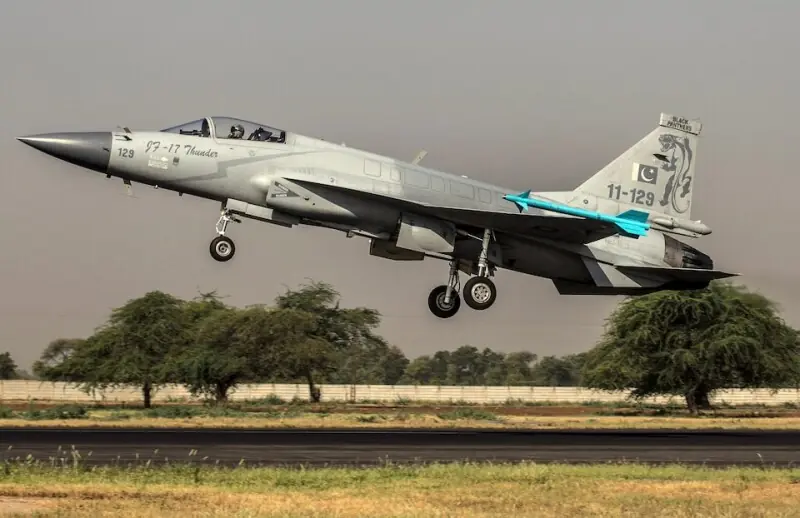
Former Air Commodore Abbas Petiwala, a recipient of the Tamgha-e-Imtiaz (Military) and Sitara-e-Imtiaz (Military), has said that the proven combat record, advanced capabilities and cost-effectiveness of the JF-17 Thunder have made the aircraft an attractive option for countries seeking modern fighter jets. Speaking exclusively to Business Recorder , Petiwala said the first factor any country evaluates before purchasing a combat aircraft is its war record. “Alhamdulillah, the war record of the JF-17 has been proven time and again,” he said, referring to the recent clash with India during which, he claimed, the aircraft demonstrated its operational effectiveness. Several countries have shown interest in acquiring the celebrated JF-17 fighter jet, which bolstered its prestige after demonstrating its capabilities in the May 2025 war against the neighbouring rival. The light combat aircraft is jointly developed by Pakistan and China and produced in Pakistan. It is pertinent to mention that Pakistan and Saudi Arabia are in talks to convert about $2 billion of Saudi loans into a JF-17 fighter jet deal, deepening military cooperation months after the two nations signed a mutual defence pact last year. Similarly, Pakistan also held detailed discussions with Bangladesh on the potential procurement of JF-17 fighter jets and Super Mushshak training aircraft. Pakistan has also secured a $4 billion weapons pact with the Libyan National Army. Moreover, a high-level Indonesian defence delegation met the Pakistan Air Chief to discuss strategic aviation cooperation, including the JF-17 Thunder fighter jet. Talking to Business Recorder , Petiwala highlighted the evolution of aerial combat, recalling that fighter aircraft from the 1960s to the 1980s, such as the Sabre and F-104 Starfighter. “To fly those aircrats, you had to go near the enemy’s jet. We called it within visual range, i.e. within 10 miles.” Modern warfare, he said, has shifted towards beyond-visual-range (BVR) combat. “In developing countries, BVR capability was limited to around 30-40 miles. Today, with the advanced radar system, you can detect the enemy’s aircraft at a distance of 150-200 miles.” “All these capabilities are in JF-17.” From both defensive and offensive perspectives, he said, the aircraft can lock onto targets from long distances and engage them effectively. The war veteran shared that the contemporaries of JF-17, including American and European fighter jets available on the market, are priced between $70 million and $90 million. “Whereas the JF-17 is priced at approximately $25-30 million per unit,” he said. Beyond price, Petiwala said countries also assess the strength of an aircraft’s supply chain and training ecosystem. “Pakistan Air Force is self-reliant in terms of training” and has also provided training to several foreign air forces, he said. Noting the industrial foundations behind the development of JF-17, Petiwala pointed to the establishment of the Pakistan Aeronautical Complex (PAC) at Kamra in the 1970s. “The PAC was initially focused on overhauling Chinese and French aircraft, including Mirage, A5 and F7. After developing the expertise, those overhauling facilities were converted to manufacturing facilities, which allowed us to minimise the cost of production,” he said.