


 The Advocate
 How a 'Mary Tyler Moore' episode and a gay actor broke new ground 53 years ago this month
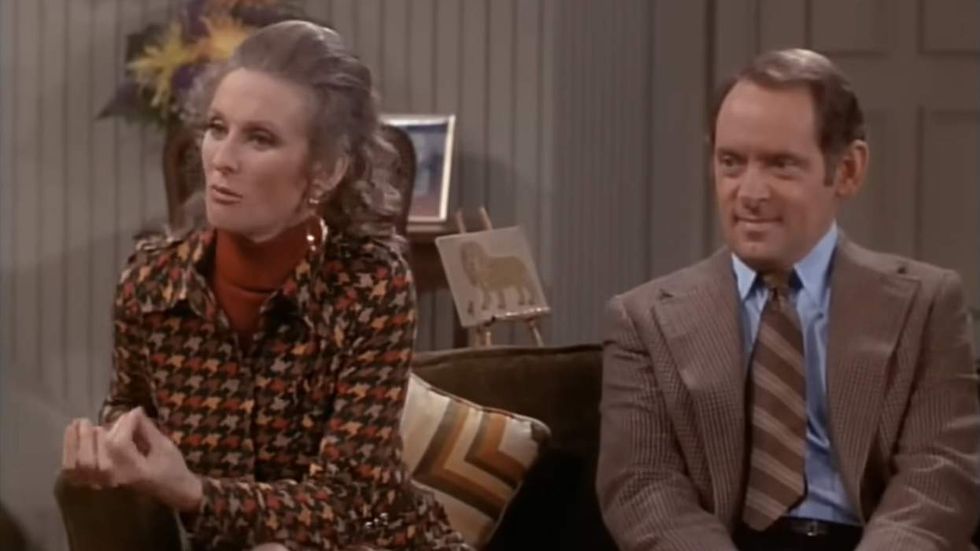
The Mary Tyler Moore Show was one of the most popular television series of the 1970s. It was a sophisticated comedy about the life of a single woman working at a TV station in Minneapolis. It wasn’t an issue-oriented show like All in the Family or Maude, but it got points across in subtle ways, making Mary more of a feminist as the series went on and tackling anti-Semitism, divorce, workplace discrimination, and, in a way, homophobia. Actually, in the third-season episode My Brother’s Keeper, it showed that an attractive, likable man can be gay — and it’s no big deal. My Brother’s Keeper first aired January 13, 1973. Phyllis Lindstrom (Cloris Leachman), Mary’s somewhat overbearing landlady, gets a visit from her brother, Ben Sutherland, a composer and musician who lives in New York City. Phyllis is always eager to find husband material for Mary Richards (Mary Tyler Moore’s character), so she tries to kindle something between Ben and Mary. Phyllis is dismayed, however, when Ben hits it off more with Mary’s sardonic neighbor and best friend, Rhoda Morgenstern (Valerie Harper). Phyllis considers Mary pretty much the ideal young woman and Rhoda pretty much the opposite — “that dumb, awful girl,” although Rhoda’s really not dumb or awful at all. Related: Valerie Harper Was the Friend Every Gay Man Wanted Toward the end, at one of Mary’s notoriously bad parties, Phyllis grills Rhoda about what’s going on between her and Ben. She doesn’t buy Rhoda’s honest answer that they’re just having a lot of fun, so Rhoda tells her they’re getting married. Phyllis believes her and is devastated. Later, Rhoda assures Phyllis she was joking and that Ben isn’t her type. “What do you mean, not your type?” Phyllis says. “He’s attractive, he’s witty, he’s single—” Rhoda responds, “He’s gay.” Phyllis is shocked at first, but then she’s so relieved that she hugs Rhoda. Phyllis and Ben cozy up at the piano before the credits roll. Related: Remembering Cloris Leachman, LGBTQ+ Icon and Ally The episode was written by Dick Clair and Jenna McMahon, one of four they wrote for MTM. They went on to be staff writers for The Carol Burnett Show, where they created the characters who were spun off into Mama’s Family, and they also created the sitcoms The Facts of Life and It’s a Living. Clair was gay, and it’s too bad there isn’t more information about him out there; most of what’s available just lists his credits and the fact that he had his body cryogenically frozen after his death from AIDS complications at age 57 in 1988. However, there is much more information on Robert Moore, the gay actor and director who played Ben, and he made many contributions to gay representation as well as to popular culture in general. (He was no relation to Mary Tyler Moore.) He acted in a few Broadway shows, most notably in a supporting role the 1965 hit comedy Cactus Flower, starring Lauren Bacall. His one big-screen acting credit was 1970’s Tell Me That You Love Me, Junie Moon, a tale of three misfit friends; Moore played a gay paraplegic alongside Liza Minnelli and Ken Howard. - YouTube www.youtube.com But he really made his mark as a director. In 1968, he directed his friend Mart Crowley’s groundbreaking play The Boys in the Band, a slice of gay male life that was a hit off-Broadway. Some have criticized Crowley’s characters as self-loathing bitchy queens, but over the years the story has come to be seen as an indictment of the societal and internalized homophobia that has shaped these men. It finally got a Broadway production in 2018, then was made into a Netflix film in 2020. Moore was passed over for the original 1970 film adaptation, which was directed by William Friedkin. There are various explanations for that, either that the studio wanted a straight director or didn’t want one without film or TV experience, according to Decider. Still, Moore won accolades, including the Vernon Rice Award, now known as the Drama Desk Award, for directing the play. Vernon Rice was a critic who championed off-Broadway productions. Related: The Boys in the Band Playwright Mart Crowley's Queer Legacy Moore also got plenty of directing work on Broadway , such as 1968’s Promises, Promises, Neil Simon’s adaptation of Billy Wilder’s classic film The Apartment, and three other Simon shows, Last of the Red Hot Lovers (1969), The Gingerbread Lady (1970), and They’re Playing Our Song (1979). He was nominated for five Tony Awards as a director: for Promises, Promises, Last of the Red Hot Lovers, They’re Playing Our Song, Ira Levin’s Deathtrap (featuring a gay relationship), and another project starring Lauren Bacall, Woman of the Year. He never won, but five nominations make for an impressive achievement just the same. He was a prolific TV and film director as well. When Rhoda got spun off into her own show, aptly titled Rhoda, he directed 26 of the first 32 episodes, among them the sensation of 1974, “Rhoda’s Wedding.” It drew more than 52 million viewers, “estimated to be over half of the entire American TV-viewing audience,” Decider noted. Moore’s big-screen credits as director include three films written by Neil Simon — the comedy-mysteries Murder by Death and The Cheap Detective and the semi-autobiographical romance Chapter Two. He additionally directed a TV movie of Tennessee Williams’s Cat on a Hot Tin Roof, starring Sir Laurence Olivier, Maureen Stapleton, Robert Wagner, and Natalie Wood — the latter being friend and benefactor to numerous gay men, particularly Mart Crowley. Moore died of AIDS-related pneumonia in 1984 at age 56. He likely would have done much more had he lived longer, but he still left a considerable body of work. That MTM episode holds up but also comes with a sense of missed opportunity. “If only Ben and Rhoda could have been the Will and Grace of the ’70s,” as Brett White wrote in Decider. But they were worthy predecessors to the Will and Grace of the 1990s and 2000s.