


 Dawn.com
 The transition from ‘dollar stores’ to ‘discount shops’
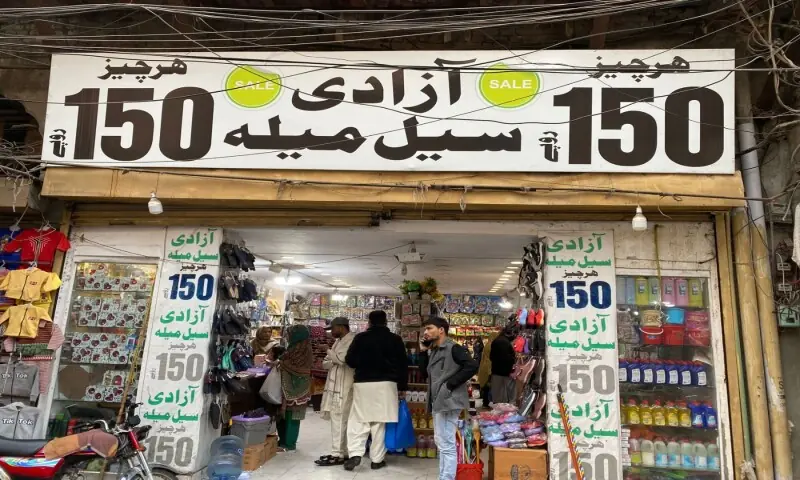
While the government’s recent Household Integrated Economic Survey revealed an overall decline in household consumption patterns, the fact that the cost of living is rising exponentially hardly comes as news to ordinary citizens. Faced with the prospect of daily-use items, groceries and other essentials becoming more and more expensive, it seems that one of the ways city-dwellers are coping with inflation is by changing where they shop. Once considered a novelty, the ‘dollar’ or ‘discount’ store, and its counterpart ‘fixed price’ shops are now emerging as a ubiquitous entity in markets across Lahore and Karachi. These outlets, which are also known as ‘sale shops’ or ‘fair-price shops’, can be considered Pakistan’s version of ‘fixed-price’ shops (such as the Poundland chain in the UK). After having their hey-day in the 2000s and 2010s, such stores had petered out post-Covid. But now, with the rising prices of commodities, the fixed-price concept is seeing a resurgence in popularity, with customers not just coming in to buy trinkets and toys like they used to. In fact, when Dawn visited a number of such stores across Lahore and Karachi, it emerged that people are primarily stacking their baskets with daily-use and household items from these stores. Their purchases can include accessories, crockery, cosmetics, handbags, jewellery items, kitchen utensils, toys, cleaning supplies, stationery, or even socks. During visits to the Saddar, Kharadar, Garden, and Bahadurabad areas in Karachi, and Anarkali, Gulshan-i-Ravi, Fortress Stadium, and Icchra in Lahore, Dawn found people from all walks of life shopping at these outlets. Despite not being definitely mapped, these ‘sale shops’ have a strategic advantage: a fixed price for all items ranging between Rs100 and Rs280, with only a few integrating a minor selection of costlier items. But with the dollar hovering around the Rs280 mark – still quite steep for the average city-dweller – most stores have had to abandon the mandatory peg to the prevailing exchange rate, settling for a more affordable price tag that is lower than the actual rate of the greenback on the open market. In Lahore’s Old Anarkali Bazaar, for example, such shops stock a variety of products, including jewellery items, cosmetics, toys, kitchen utensils, handbags, crockery, and even mobile accessories. A woman working the storefront at an Rs190 store in Lahore gave the example of a well-known shampoo brand that usually retails for Rs1,500. But at her store, she said, the same product could be obtained for Rs190. While it wasn’t clear whether the product she was selling was ‘genuine’ or a knock-off, for many shoppers, the distinction mattered little. At a dollar store in Karachi’s Saddar area, which is selling all items for Rs280 – not too far from the actual value of the dollar – a woman shopper told Dawn she was there to buy “quality essentials at a reasonable price”. Looking to purchase a set of teacups, she said that she wasn’t happy with the price point of traditional utensil vendors and found this option more suited to her needs. Comparing the fixed-price shop to weekly bazaars that pop up over the weekends, she said that rather than being open on specific days, the fact that these stores are open all week round adds to the convenience factor. But a visit to the Clifton Sunday Bazaar revealed that the vendors there were making hay by stocking a wider variety of clothing and household essentials. ‘Sale’ shops, by contrast, seem to be capturing the customers that would previously flock to the ‘landa’, or second-hand market. De-dollarisation of discount stores As the prevailing exchange rate has made dollar-pegged pricing unsustainable for shoppers, owners of these ‘fixed price’ stores have rushed to cap their prices in rupees to maintain the aura of affordability. Shopkeepers in Old Anarkali told Dawn that the outlets were previously branded as ‘one dollar shops’, and that the signage had recently been changed to ‘sale shops’, while the pricing model remained unchanged. Stores that haven’t localised their business model have struggled to compete. This was evident from Dawn ’s survey of ‘dollar stores’ mapped in key parts of Karachi, including DHA and Clifton, which had long since gone out of business. The owner of one such erstwhile store, who Dawn reached out to through the contact listed on Google Maps, said they had closed when $1 was being exchanged for about Rs180. According to him, even with prices capped at Rs170, demand was not as strong, and the business wasn’t able to keep pace with the rising prices of goods either. A ‘dollar store’ in Karachi. — Muazam Ali Tahir At the same time, a shopkeeper in Kharadar, who Dawn spoke to, says that they have now opened two more branches for their iteration of a Rs200 discount store, where prices range from Rs40 to Rs200. Meanwhile, a shopkeeper selling cups and plates at Clifton’s Sunday Bazaar told Dawn that the dollar impact was not felt much in ‘landa’ prices. Nadeem ul Haque, former vice chancellor at the Pakistan Institute of Development Economics, told Dawn that this trend of ‘localised’ dollar shops, shows how market forces work. He said that the concept was born out of excess local supply, which is linked to the “global industrial overload” catering to those whose purchasing power has been reduced in recent years. Header image: A discount store in Lahore’s Anarkali Bazaar. — Imran Gabol