


 The Advocate
 How Democratic candidate and influencer Kat Abughazaleh is taking on America's rising far-right
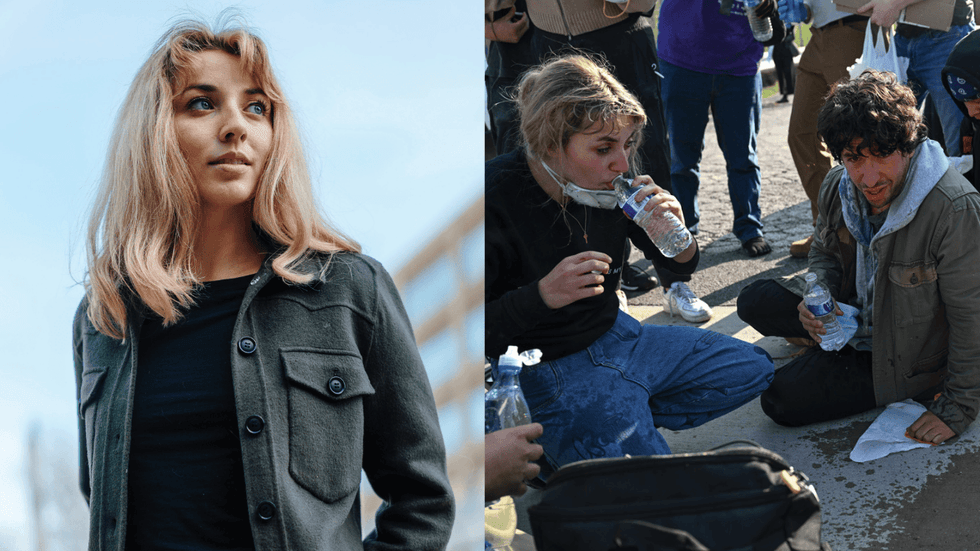
Ka t Abughazaleh has spent much of her early adulthood warning that the far right’s fringe was becoming the center of American political power. Now, at 26, the Palestinian American LGBTQ+ creator, who built her own national platform through trenchant video explainers and through her work with a media watchdog, has stepped directly into the arena, running for Congress in Illinois’s Ninth District. Her campaign, her strategy, and even her federal indictment are all unfolding against the backdrop she’s spent years documenting. She laughs when asked when the decision truly clicked. “I wish I had a cooler moment for myth-making purposes,” she says, “but my planner just says, ‘I guess I’m running for Congress now.’” Her frustration was cumulative. After years of tracking the rise of online extremists, many of whom later migrated into the Trump administration, she grew alarmed watching her own party treat them as serious nominees rather than existential warnings. “People in the disinformation and anti-extremism space had been telling Democrats about this for years,” she says. “January 6, COVID misinformation, where anti-trans panic would lead. They didn’t listen.” Abughazaleh, who is bisexual, leans into her identity as part of the LGBTQ+ community, and she frames today’s attacks on queer and trans people as part of a familiar authoritarian playbook. “This is what every authoritarian regime does,” she says. “They go after visible minorities, queer folks, and Jews.” That pattern is personal. She’s watched the right weaponize anti-LGBTQ+ disinformation while Democrats, in her view, too often retreat from defending their own values. “I’m very disgusted by Democrats who decide to play into those fears,” she says. “Instead of anticipating the attacks and saying, ‘That’s not real, you’re weird,’ they play into it.” She points to some Democrats ceding ground on issues dealing with transgender kids playing sports or having access to gender-affirming care. Abughazaleh’s rise is a distinctly Gen Z phenomenon: a digital creator and journalist who began as a researcher at Media Matters for America, then built her own audience with candid, sharp-edged videos that treated viewers like adults. “I don’t get my information from video — I go straight to the transcript,” she says. “But a lot of people do. So I started making explainers, and they took off.” Kat Abughazaleh (far left) and other protestors react after being tear-gassed on September 19, 2025 in front of an ICE facility in Broadview, Illinois. Joshua Lott/The Washington Post via Getty Images She never adopted the stylized delivery common on TikTok or Instagram. “I didn’t have that basis of how someone ‘should’ deliver information,” she says. “I was just communicating the way I wanted to be communicated to.” Her refusal to sand down her edges has made her stand out and, at times, a target. During a recent public event, a right-wing activist approached her with a gift bag of holy water, declaring her a demon. Abughazaleh took the moment in stride. “With my background covering the far right, I’m better equipped to handle being a candidate than a lot of elected officials,” she says. “I knew something weird was about to happen.” Her most viral moment came after a September protest at an Immigration and Customs Enforcement facility in Broadview, Illinois. Video showed Abughazaleh, who notes that many people do not realize she is Palestinian, being slammed to the ground by officers. “When I got thrown to the ground, people were horrified,” she says. “Because in America, the expectation is that that’s not supposed to happen to small blond women.” She points to her roots and smiles. “It’s dyed,” she admits. She used the moment not to center herself but to redirect attention toward detainees. “People inside don’t have beds, hot meals, hygienic facilities,” she says. “We’ve been told they’re allowed one bathroom break a day and beaten if they soil themselves.” The Department of Homeland Security did not respond to The Advocate ’s request for comment. Weeks later, she was indicted by federal prosecutors, who allege that she and others surrounded and damaged a government vehicle during the demonstration. She has pleaded not guilty and calls the case nakedly political. “These charges are bogus,” she says. “They see I am the most effective candidate in my race at fighting their regime, and so they’re trying to get me on federal charges.” The indictment even misspelled her name multiple times. “They couldn’t copy and paste,” she says. She expected backlash — just not so soon. “The best training for running for Congress right now is covering Nazis,” she says. “They picked the wrong person if they’re trying to get me to shut up.” Her headquarters is less a traditional campaign office than a mutual-aid hub. “People can come in and get coats, Narcan, first-aid supplies, toothbrushes, baby formula — whatever they need, no questions asked,” she says. Volunteers coordinate through the Discord chat app. Her campaign also redirected funds to support district food banks during the government shutdown, tagging rivals and challenging them to match her contributions. “We want to change how people see campaign funds,” she says. “If everyone invested in the community, we could make that the expectation rather than the exception.” Kat Abughazaleh Eliana Melmed And she insists on personally running her social media: posting, scripting, approving texts and emails. Only recently has she begun letting someone help edit her videos. “It’s very intimate,” she says. “Here’s this thing where I say something 10 times — now you pick the best one.” A recent Data for Progress poll found that 31 percent of likely Democratic voters in the district were still undecided, and Abughazaleh and former state Sen. Daniel Biss were tied at 18 percent each as of press time. The poll also showed a stark generational and ideological divide — younger voters and the “very liberal” overwhelmingly gravitate toward Abughazaleh, while older and more moderate Democrats skew toward Biss. Abughazaleh is explicit that she doesn’t want a long tenure in Congress. “I wouldn’t be running if it weren’t this exact moment,” she says. Her platform revolves around two concepts: anti-authoritarianism and “basic existence” — a framework that joins housing, health care, climate policy, LGBTQ+ rights, and economic justice as inseparable. “I’m so sick of treating all these issues like they’re separate,” she says. “Every person deserves to afford housing, groceries, and health care, with money left over. We’re the richest country in the world — there’s no reason we can’t.” But the first priority, she says, is confronting the erosion of democratic norms. “Authoritarianism is a bunch of really boring moments between horrors,” she says. “Every day is a different horror.” She’s willing to take risks that other Democrats resist. “If you need someone to bring out a progressive idea and you’re worried about reelection, I’ll be your scapegoat,” she says. “We need to stop worrying about reelection and worry about what’s actually happening.” Amid everything — campaigning, scrutiny, indictments — Abughazaleh is determined to stay human. She talks fondly about knitting, manga, guitar, embroidery, and the long hours she spends with her cat, Heater. “Politicians are people,” she says. “Do things you enjoy. Be a person. We’re all people.” It may be the simplest explanation for her resonance: a candidate who refuses to treat politics as performance and who understands the internet not as spectacle but as the terrain on which power is now contested. “I want action, not words,” she says. “And I’m done waiting.” This article is part of The Advocate ’s Jan-Feb 2026 issue, which hits newsstands January 27. Support queer media and subscribe — or download the issue through Apple News+, Zinio, Nook, or PressReader.