


 SAgovnews
 Afreximbank commits $8 billion to bolster SA’s economy
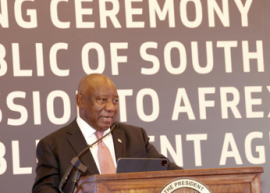
Afreximbank commits $8 billion to bolster SA’s economy By Nosihle Shelembe South Africa’s strategic partnership with the African Export–Import Bank (Afreximbank) has unlocked a US$8 billion commitment to drive industrial growth, create jobs, and strengthen the economy by adding more value to South Africa’s natural resources. The commitment paves the way for expanding local manufacturing and mineral processing, investing in critical infrastructure such as energy, developing industrial parks and special economic zones, and improving access to regional and continental markets under the African Continental Free Trade Agreement (AfCFTA). South Africa’s strategic partnership with the multilateral financial institution was advanced during the signing ceremony of the Instrument of Accession in Johannesburg earlier this month, when South Africa became a full sovereign member (Class A shareholder) of the bank. This elevated status grants the country a stronger voice in the institution’s governance, including greater influence over its strategic direction, institutional structure, and leadership appointments. In addition, sovereign membership provides access to the bank’s intervention facilities, often used to assist African Member States and their private institutions whenever there is market failure, global financial, economic, and geopolitical crises. Headquartered in Cairo, Egypt, the multilateral financial institution was established in 1993 to facilitate, promote, and expand both intra-African and extra-African trade. According to the bank, its programs, instruments and services are available to large corporates, governments, financial institutions and other clients which are any other entity which may not necessarily be classified as a government, large corporate or financial institution that may be “supported if the underlying transaction or project fits with the Bank’s mandate and meets the lending requirements and policies of the Bank.” The accession process followed legal and constitutional steps, including Cabinet endorsement and parliamentary approval, as outlined in Section 231(2) of the Constitution, which pertains to international agreements. The Presidency affirmed that sovereign membership helps South African companies, banks, and State-Owned Enterprises (SOEs) secure better trade finance. It provides more funding for trade under the AfCFTA. It also encourages more cross-border projects and investments, stronger partnerships with other African financial institutions, and access to different risk management tools. “Afreximbank plays a pivotal role in promoting and financing cross-border trade within Africa, with [the] AfCFTA as a key driver of its mission. By attaining Class A status, South Africa will be better positioned to leverage Afreximbank’s network, resources, and financing instruments to support local businesses in accessing broader African markets,” the Export Credit Insurance Corporation of South Africa said. The corporation is a state-owned national export credit agency under the ambit of the Department of Trade, Industry and Competition (dtic). South Africa became the 54th state to accede to the Bank’s Establishment Agreement, marking a historic milestone as the two partners seek to unlock trade opportunities within a global financial architecture that is rapidly fragmenting due to protectionist policies and shifting trade blocs. The agreement enables South Africa to leverage the bank’s stronger investment grade rating and Preferred Creditor Status. This offers more protection than standard commercial debt. It offers more competitive financing and risk coverage for South African exporters, state-owned enterprises, and private companies. Providing support Afreximbank President and Chairman of the Board of Directors, Dr George Elombi said the bank is keen on supporting South Africa. “We have put together what we consider an important package of US$8 billion for South Africa. We will do whatever it takes to support the government and the private sector in building a local economy that serves all South Africans, and that looks out to the wider African continent as a natural source and destination of wealth,” Elombi said. With a continental market of about 1.4 billion people, African countries can leverage the African Continental Free Trade Area to boost intra-African trade in manufactured goods while sourcing raw materials from within the continent. “We do not have to reinvent the wheel. Let us look within the continent for sources of development,” Elombi said. Development and supporting small businesses The bank plans to invest in the development of critical infrastructure, including energy generation and transmission, which are vital for industrial production. In the energy sector, the bank could co-finance projects that support the just energy transition, particularly through climate finance mechanisms. According to the Presidential Climate Commission, a just transition to a low-carbon economy will benefit all South Africans by driving economic growth, creating jobs, and increasing our energy security, while addressing the serious threat of climate change. The bank’s programmes are also designed to support SMME development across all strategic sectors, like automotive components, pharmaceuticals, and agro-processing. SMMEs could receive access to Afreximbank-backed trade finance and training programs. Afreximbank funding could be leveraged to integrate SMMEs into regional supply chains, fostering job creation and industrial growth. “The bank also has initiatives to promote e-commerce readiness for SMMEs to tap into digital trade across the continent. In the area of mineral beneficiation, funding support could target developing local smelters, refineries, and processing plants for gold, platinum, and battery minerals, including lithium,” a document by the dtic read. In a drive towards a private sector-led transformation of the South African and the continent’s economies, Afreximbank will work with institutions such as the Industrial Development Corporation (IDC), the Development Bank of South Africa (DBSA), the Public Investment Corporation (PIC), and commercial banks such as Rand Merchant and Standard Bank. Deepening trade President Cyril Ramaphosa said the decision to accede to the bank affirms the government’s commitment to African industrial development and to deepening trade, investment, and development across the continent. “Accession brings us a step closer towards the incubation of a South African Export–Import Bank. Working closely with Afreximbank and building on the experience of our Export Credit Insurance Corporation, we are laying the foundations for a national institution that will support exporters, crowd in investment, and provide financing aligned to our industrial priorities. “This is a strategic investment in our ability to compete and to support South African firms across the export lifecycle. It will help to ensure that our participation in African and global trade is sustained, resilient, and developmental,” the President said. South Africa’s strategic partnership with the bank is expected to enhance the Export Credit Insurance Corporation's capacity to deliver on its mandate of facilitating South African exports, particularly in high-value sectors, while contributing to the broader continental agenda of economic integration and development. The Export Credit Insurance Corporation provides insurance that enables South African exporters to offer their services and products on the international market, with a particular focus on emerging markets in Africa that are considered too risky for conventional insurers. The government has mandated the entity to make South African exporters attractive to international buyers to attract foreign income, stimulate domestic economic growth, and create local jobs. “As the continent’s largest regional contributor to intra-African trade - accounting for 19.1% of total African trade in 2024 - South Africa is well positioned to leverage Afreximbank’s trade infrastructure, technical expertise, and pan-African footprint to expand its export relationships across the continent,” Afreximbank said. - SAnews.gov.za Neo Tue, 02/24/2026 - 11:30 1 view