


 The Better India
 How One Woman Farmer Turned 1 Acre Into Rs 7 Lakh Profit With Scientific Santra Farming
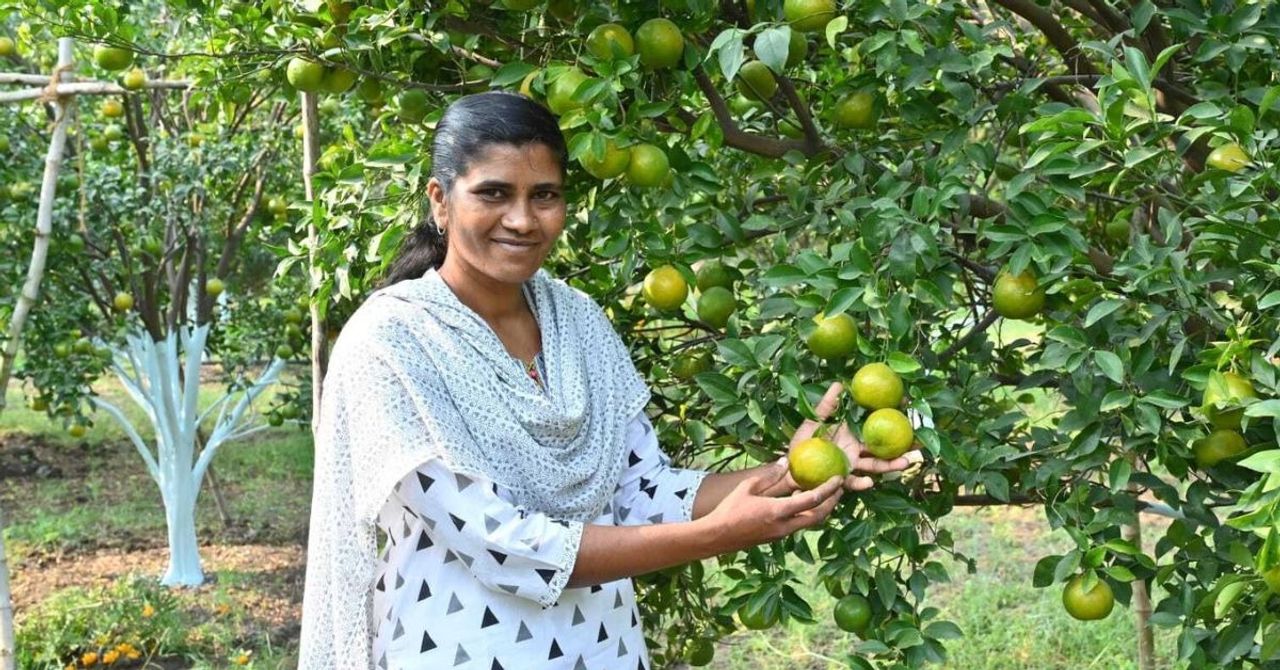
When record-breaking rains lashed Amravati last year, orchards across the district sagged under the strain. Water pooled at the roots, flowers dropped prematurely, and fruit blackened before ripening. In Karajgaon village, farmers walked through their groves with worry etched across their faces. And then there was one acre that refused to surrender. In that patch of land, rows of Rangpuri Nagpur Santra shimmered under the sun. Branches bent low, heavy with uniform, golden fruit. The air carried the sharp citrus scent of ripeness, not rot. Neighbours walked the rows in disbelief. While orchards around it struggled, this one had flourished. This is the story of 38-year-old Bharti Arunrao Pohorkar from Karajgaon, Taluka Chandur Bazar in Amravati — a young woman farmer who turned just 1 acre and 4 gunthas of family land into a Rs 7 lakh harvest through scientific precision and sheer grit. Chandur Bazar taluka has 17,000 hectares under citrus cultivation. Yet, it was Bharti’s orchard alone that witnessed such an unprecedented bumper harvest. Bharti lives with her mother, Sumitra (68), on land gifted by her maternal grandparents. After earning an MCom from Sant Gadge Baba Amravati University (SGBAU) and trying part-time accounting, she chose full-time farming — a rare path for educated women in the region. “Office work didn’t cover farm labour costs,” she recalls. “I realised I had to take charge myself for this land to make profit.” Chandur Bazar taluka has 17,000 hectares under citrus cultivation. Yet, it was Bharti’s orchard alone that witnessed such an unprecedented bumper harvest. She began with chilli and onion crops before planting 180 grafted Rangpuri Nagpur Santra trees on well-drained black soil, leveraging Vidarbha’s citrus reputation. While the saplings grew, she intercropped onions for income. Labour shortages meant she handled everything herself — weeding, irrigation, spraying. “Most days, it’s just my mother and me,” she says. “People said this isn’t women’s work, but the trees gave the answer .” That answer came in 2023 with the Best Young Woman Farmer Award at Bhaktidham, Chandur Bazar. “It felt like a message,” she smiles. “Treat your orchard like a laboratory and trees like family, and results follow.” Science beneath the soil Rangpuri Nagpur Santra demands timely irrigation and integrated nutrient and pest management. It thrives in Vidarbha’s mild winters (10–15°C), hot summers (above 35°C), and 1,000–1,200 mm of rainfall. Grafted on Rangpur lime rootstock, Bharti’s trees gain vigour and resilience. Nagpur Santra is prone to alternate bearing: heavy “on” years exhaust reserves, leading to poor “off” years marked by weak flowering and fruit set. Irregular irrigation, poor pruning, pests, and diseases intensify this cycle. Walk through Bharti’s orchard and it reads like a manual written in living ink: 140 of 180 trees supported by bamboo stakes against heavy fruit loads and storms; rows of marigolds between citrus lines; trunks tinted with Bordeaux blue; traps glinting quietly in the sun. Bharti uses basin irrigation, delivering water directly to the roots — frequent for young trees and every seven to 10 days for mature ones , except during deliberate stress for bahar (bloom) induction. “Trees should never feel shock except for flowering,” she says. “Nutrition must be steady, not feast or famine.” Post-harvest, she prunes dead, diseased, or crowded branches to improve light penetration and encourage healthy shoots. Taming alternate bearing “I refused to accept it as fate,” Bharti says. “Farmers said, ‘Santra hai, alternate bearing to hoga hi.’ But if we manage company balance sheets, why not a tree’s energy?” She treats her orchard like a ledger: split-dose nutrition, post-harvest pruning, and fruit thinning to prevent overload. Removing excess flowers and weak fruits ensures manageable crop loads and preserves reserves for the following season. Water is critical during flowering and fruit set. “Seven days of stress can ruin a year.” She monitors soil moisture closely, using growth regulators and specialised sprays to reduce fruit drop. Orchard sanitation — clearing diseased twigs, fallen fruit, and weeds — keeps the trees vigorous. This discipline has helped smooth alternate bearing, stabilising both yield and income. Orchestrating monsoon bloom Her biggest test came with Mrig Bahar (monsoon bloom) amid uncooperative weather. At seven years old, her orchard required controlled water stress for uniform flowering. Unseasonal May rains threatened to disrupt timing. She fed the crop with a nutrient spray, added zinc to boost its health, and applied medicine to prevent fungal disease. This countered excess moisture while still inducing bloom. When the monsoon showers finally arrived, the trees responded with fresh shoots. She followed with fertiliser, nutrients, and insecticide, producing strong, uniform blooms. Tiny fruits now dot the canopy. Rangpuri Nagpur Santra demands timely irrigation and integrated nutrient and pest management. It thrives in Vidarbha’s mild winters (10–15°C), hot summers (above 35°C), and 1,000–1,200 mm of rainfall. “These are my report cards,” she smiles. Fellow citrus farmer Pushpak Khapre, a recipient of the Vasantrao Naik Sheti Mitra Samman — a prestigious recognition in Maharashtra given to farmers, individuals, or organisations who make outstanding contributions to agriculture and farmer welfare — praises her approach. “Bharti Tai guides Mrig Bahar with precision amid unpredictable monsoons. Her orchard is a living lab of adaptation.” Fortress against pests and disease Pests such as nematodes, fruit flies, fungi, citrus greening, and sap-suckers threaten months of work. Bharti’s defence blends ecology and science. Marigolds intercropped between trees are her “silent soldiers”. They suppress soil nematodes through toxic root compounds, improve soil health, and provide additional income through flower sales. Yellow sticky traps and solar-powered light traps hang like sentries, luring and capturing fruit flies before they can lay eggs. Tree trunks are painted with a sky-blue wash of lime and copper sulphate — an age-old shield against gummosis and canker. “Old wisdom and new science are not enemies,” she notes. “They are best friends.” Her spray schedule is guided by restraint: monthly applications of bio-fungicides and bio-insecticides form the first line of defence, supplemented only when necessary with targeted systemic chemicals. “I am not ideologically against chemistry,” she clarifies. “I am against careless, calendar-based spraying that kills life in the soil. The rule is minimum, and at the right time.” Soil health is maintained through farmyard manure , green manures incorporated after two months, and biofertilisers such as Azotobacter and PSB to support nitrogen, phosphorus, and microbial life. “Alive soil solves half the pest problems.” A grove of lessons Walk through Bharti’s orchard and it reads like a manual written in living ink: 140 of 180 trees supported by bamboo stakes against heavy fruit loads and storms; rows of marigolds between citrus lines; trunks tinted with Bordeaux blue; traps glinting quietly in the sun. “Each is a tool — bamboo, marigolds, traps, sprays, pruning,” she says. “I talk to my trees with water, nutrients, stress, and protection. They reply through growth and fruit.” This season’s Rs 7 lakh income, despite erratic rains, stands as proof. Last year’s harvest was barely seven tonnes; this year, it touched 15 tonnes. Experts agree. Pests such as nematodes, fruit flies, fungi, citrus greening, and sap-suckers threaten months of work. Bharti’s defence blends ecology and science. “Bharti has turned struggle into strength. Through organic orange farming and guidance from government agencies, she secured excellent yields despite tough conditions — an inspiration for all,” says Praveen Mohod, Taluka Agriculture Officer, Chandur Bazar. Neighbour and citrus farmer Roshan Sherwatkar (38) calls her “a walking encyclopaedia of Santra cultivation,” noting how freely she shares her knowledge. Her orchard has become something of a pilgrimage site for farmers. What sets Bharti apart is not only technique, but temperament. “People think ‘sustainable’ means low profit,” she says, her voice steady. “But working with the trees, understanding their language, cuts your costs and lifts your quality. That is real profit. That is resilience.” As the sun dips over Vidarbha’s citrus belt, her grove glows amber against the horizon — not just with fruit, but with proof. In a climate-stressed landscape where uncertainty has become routine, Bharti Pohorkar has shown that science, patience, and an intimate dialogue with the land can steady even the most fragile seasons. In Karajgaon, resilience hangs from the branches — round, bright, and unmistakably golden.