


 Dawn.com
 Trump keeps the world guessing on his Iran options during annual State of the Union speech
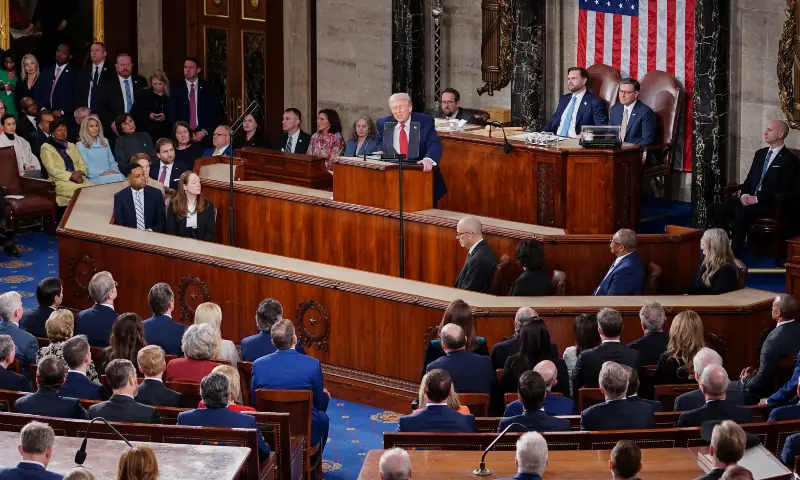
WASHINGTON: US President Donald Trump opened the foreign-policy portion of his State of the Union address tonight with a carefully calibrated message on Iran, stating that his “preference is to solve this problem through diplomacy” while warning he would “never” allow Tehran to acquire a nuclear weapon. The formulation, which projected readiness for talks while keeping the option of military force deliberately ambiguous, reflected his broader doctrine of “peace through strength.” Trump argued that a rebuilt US military and higher defense spending by NATO allies had strengthened Washington’s hand. At the same time, he asserted that Iran was developing missiles capable of reaching the United States and complained: “We haven’t heard those secret words (from Iran): ‘We will never have a nuclear weapon.’” He blamed Tehran for pursuing a “sinister nuclear program” and claimed that earlier US strikes had “obliterated” Iran’s nuclear weapons capabilities. Trump’s Tuesday night State of the Union address lasted one hour and 47 minutes — the longest before a joint session of Congress in at least six decades, according to the American Presidency Project. As American television commentators noted, the president turned the annual constitutional ritual into an extended political performance aimed at boosting his approval ratings and energising Republican voters ahead of this year’s midterm elections. Trump also briefly brought South Asia into the address, highlighting his peacemaking role in ending the May 2025 war between Pakistan and India, claiming that his efforts “saved millions” of lives by preventing the conflict from turning nuclear. “Pakistan and India … it would have been a nuclear war. Thirty-five million people, the Prime Minister of Pakistan said, would have died if not for my involvement,” he declared. Repeating his claim that he had halted eight wars in his first 10 months in office, he snapped at skeptics in the chamber: “Isn’t it funny? Sick people,” while glancing toward those who laughed. Despite weeks of the largest US military buildup in the Middle East in two decades, Trump did not signal whether he was prepared to order a strike on Iran. He waited more than an hour before addressing the issue and avoided any reference to the scale of American deployments in the region, underscoring a speech that, even on foreign policy, largely followed a domestic political script. Trump accused Tehran and its allies of being responsible for roadside bombings that “have killed US service members and civilians.“ He also referred to the killing of General Qasem Soleimani, saying “we took out Soleimani” and that it had a “big impact”. Within the same sweep of foreign affairs, he hailed what he called a “colossal victory for the security of the United States” in Venezuela and introduced Enrique Marquez, an opposition lawmaker freed from prison after the US abduction of President Nicolás Maduro, telling a relative in the gallery: “I’m pleased to inform you that not only has your uncle been released, but he is here tonight.” The address began with a campaign-style flourish — “Our nation is back: bigger, better, richer, and stronger than ever before!” — and quickly led to a sharply polarised spectacle. When Trump asked those who believed “the first duty of the American government is to protect American citizens, not illegal aliens” to stand, Republicans rose and applauded for several minutes while Democrats remained seated, prompting him to say: “You should be ashamed of yourselves, not standing up.” Representatives Ilhan Omar and Rashida Tlaib repeatedly shouted, “You have killed Americans!” and “You should be ashamed!” as the speech continued, while Al Green was escorted from the chamber earlier after waving a protest sign reading “Black People Aren’t Apes,” an apparent reference to a video Trump had reposted on Truth Social depicting the Obamas as apes. Trump directed much of his gaze toward the Republican side, basking in applause, but as he moved into immigration, crime, election security, and gender issues, he increasingly addressed Democrats directly, saying: “These people are crazy, I’m telling ya, they’re crazy … Democrats are destroying our country, but we’ve stopped it just in the nick of time.” On immigration, he renewed attacks on Somali Americans, referring to “the Somali pirates who ransacked Minnesota” and arguing that “importing these cultures through unrestricted immigration and open borders brings those problems right here to the USA, and it is the American people who pay the price.“ On economic policy, he criticized a recent Supreme Court decision against his tariffs as “very unfortunate” and said the duties would remain in place under “fully approved and tested alternative legal statutes,” adding: “Congressional action will not be necessary.” Turning to prices, he blamed Democrats for inflation and told Americans: “Just hold on a little while we’re getting it down, and soon you will see numbers that few people would think were possible to achieve.” He also urged passage of the SAVE America Act, requiring proof of citizenship for voter registration, a measure Democrats have pledged to block in the Senate. At another point, Trump took aim at New York Mayor Zohran Mamdani as the “new communist mayor of New York City,” before adding in a softer aside: “I think he’s a nice guy. Bad policy, but nice guy.” For much of the evening, the visual tableau — a president speaking almost exclusively to one side of the chamber while the other jeered — mirrored the substance: an address that fused campaign mobilisation at home with selective, carefully timed signals abroad, particularly on Iran, where the decisive choice between diplomacy and force remained conspicuously unstated.