


 Business Recorder
 Rebalancing act: key outcomes of German leader’s China trip
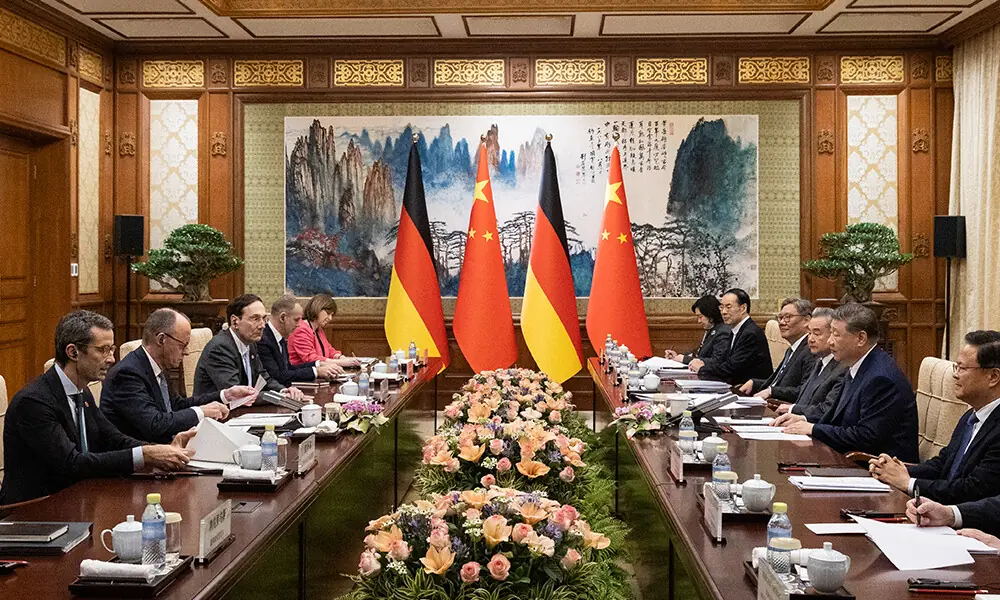
BEIJING: German Chancellor Friedrich Merz urged Beijing to press Russia for an end to the Ukraine war and raised the issue of Europe’s yawning trade gap with China as he followed a string of Western leaders to court President Xi Jinping. Here are key outcomes of the German leader’s inaugural trip to China that ended Thursday: Trade Travelling with dozens of business leaders, Merz told reporters that economic competition “played an important role” in conversations during his visit. European businesses complain that China, with its low domestic demand, is flooding Europe with cheap goods. Germany’s trade deficit with China hit a record 89 billion euros ($105 billion) last year. “This dynamic is not healthy,” Merz admitted after talks on Wednesday. READ MORE: Germany’s Merz meets Xi in China, seeking closer ties “We want to reduce these imbalances, which have arisen primarily from overcapacity in China,” he said, vowing that more German officials would visit the country this year. While Merz stressed the need to reduce dependence and trade imbalances, China raised concerns about what it calls Berlin’s “over-securities” of trade and high-tech exports. READ MORE: Germany’s Merz meets Xi in China, seeking closer ties Merz’s visit was a “success for both sides”, said Wang Dong, a professor at Peking University’s School of International Studies. “Germany secured strong economic and business deals, while China deepened strategic communication with Europe’s key power.” Companies from both sides reached more than 10 agreements this week across industries including autos, energy and finance, according to the Chinese commerce ministry. But the visit “did not exceed expectations,” said Philippe Le Corre, a China-Europe relations expert at the Asia Society Policy Institute’s Center for China Analysis. “Bilateral trade is unbalanced and increasingly so,” he said. “I don’t expect Chinese investments to come soon and help rebalance that deficit.” Airbus orders Merz said China had agreed to purchase up to 120 additional Airbus aircraft, adding that it “demonstrates how worthwhile such trips can be”. He did not specify when those purchases would take place. Airbus is Europe’s largest aerospace company, and China is a key export market. The new Airbus deal would follow a raft of orders announced by Chinese firms at the end of last year. Air China, Shanghai-based Juneyao Airlines and Spring Airlines, as well as Hong Kong-listed China Aircraft Leasing Group Holdings (CALC) announced purchases totalling around 150 jets. Airbus has yet to publicly comment on the deal announced by Merz. It did not respond to an AFP request. Ukraine Merz told reporters following talks with Chinese leaders on Wednesday that he urged Beijing to exert influence on its ally Russia to end the war in Ukraine. “Signals from China are taken very seriously in Moscow,” Merz said. “China’s voice is heard in the world.” Xi said that diplomacy was “key to the issue” and that it was necessary to address the “legitimate concerns” of all sides, according to Chinese state news agency Xinhua. Merz added that Germany wanted China to avoid supplying Russia with dual-use goods its military could use against Ukraine. “I hope that in my talks I was able to foster a little understanding for the fact that the leadership of this country should also contribute to ending the war in Ukraine,” Merz told reporters before he left China on Thursday. China’s ‘great power’ rise Merz is the latest in a string of Western leaders to visit China since December. “China has risen to the ranks of the great powers,” Merz said. “That is also changing our relationship with China.” Britain’s Keir Starmer, France’s Emmanuel Macron and Canada’s Mark Carney also visited Beijing, as they recoil from a mercurial United States. “European countries now see China as a stable, indispensable partner – not just an economic player, but a critical factor in their foreign policy calculus,” said Peking University’s Wang. Merz said Germany’s trade policy was “not in isolation” from Europe. But visits by individual European leaders are not as strong as a coordinated push, Asia Society’s Le Corre warned. “Beijing has been trying to ignore EU institutions for the past few years,” he said. “Beijing is always keen to ‘divide and rule’.”