


 Dawn.com
 Israel’s ‘expansionist mindset’ bereft of any regard for international law, Dar tells OIC moot
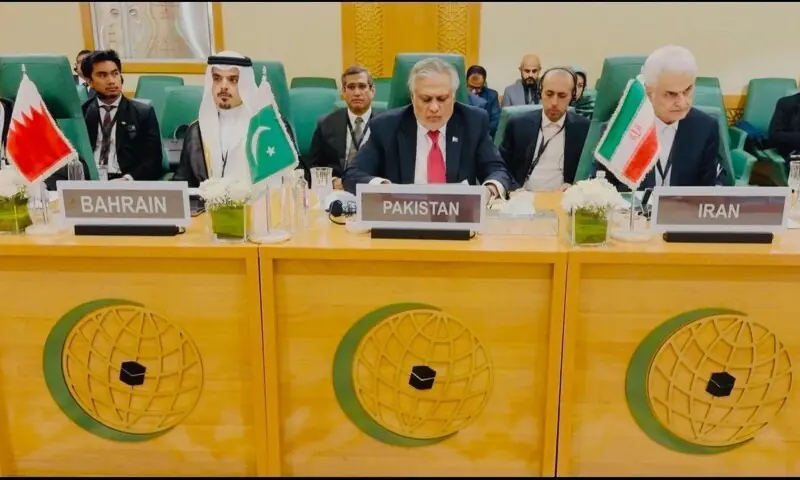
Deputy Prime Minister and Foreign Minister Ishaq Dar on Friday condemned Israel’s recent actions in the occupied West Bank of converting the territory’s areas into “state property”, highlighting that the country’s “expansionist mindset” held no regard for international law. The minister made the statement while addressing a meeting of the executive committee of the Organisation of Islamic Council (OIC) in Jeddah, Saudi Arabia. The meeting was taking place against the backdrop of the Israeli government approving a proposal to register large areas of the occupied West Bank as “state property” for the first time since the occupation of the territory in 1967. Addressing the meeting, the foreign minister took note of the “latest illegal measures taken by Israel to convert areas of the occupied West Bank into so-called state property”, stressing that Israel’s actions reflected “an annexationist and expansionist mindset bereft of any regard for international law or humanitarian norms”. At the outset of his address, Dar highlighted the continued ceasefire violations committed by Israel, its expansion of illegal settlements in the occupied West Bank and annexation attempts, which he maintained posed a threat to any “prospect for a just and lasting peace in the Middle East”. He recalled that in September 2025 at the UN General Assembly (UNGA), “leaders and foreign ministers of a group of eight Islamic countries, including Pakistan, engaged with the president of the US to end the bloodshed in Gaza and [..] secure a permanent and sustainable ceasefire and advance a comprehensive peace process with Palestinian brothers and sisters”. He further recalled that during the consultation held, the group of eight countries was “given assurances that annexation of the West Bank will not take place”. However, the minister told the moot that “on the ground, Israel continues with brazen impunity to expand illegal settlements”. He maintained that Israel’s actions amounted to a violation of “international law, the UN Charter, and the UN Security Council Resolution 2803”. “These violations embolden further aggression, erode regional stability and trample the rights and dignity of Palestinians,” he added. Dar called on the international community to “act decisively” to halt the violations being committed by Israel, and “uphold international law, as well as ensure delivery of the assurances made” in September 2025. He recalled that a joint statement was issued along with eight other Islamic countries, which Dar said, “clearly highlighted our shared concern on Israel’s continued violation of the ceasefire and attempts to impose unlawful sovereignty, expand settlements, and enforce a new legal and administrative reality in the occupied West Bank”. The foreign minister reiterated that “Pakistan remains fully engaged as part of the group of eight other Islamic countries to secure a permanent and sustainable ceasefire, immediate start of the reconstruction and a credible time-bound political pathway towards an independent Palestinian state”. Dar vowed that Pakistan will continue to “remain at the forefront in advancing the Palestinian cause”. He outlined that the OIC member needed to “collectively ensure the immediate reversal of all Israeli measures aimed at the de facto annexation of the occupied Palestinian territory, including the occupied West Bank”. He also called for the “protection of holy sites, including Al Aqsa Mosque”, as well as the “an immediate end to displacement (of Palestinians) and demographic manipulation”. Dar stressed the need for the “full implementation” of the UNSC resolution 2803. The foreign minister called for the immediate “reconstruction and recovery of Gaza with full Palestinian ownership” and “accountability for war crimes and violations of international humanitarian law”. Recalling the recent statement made by US Ambassador to Israel Mike Huckabee, suggesting he would not be opposed to Tel Aviv taking over large swathes of the Middle East, the foreign minister maintained that such statements were “ irresponsible, deeply concerning and condemnable”. “At a time when initiatives such as the Board of Peace and the Comprehensive Plan to end the Gaza conflict [..] seek to chart a credible political horizon, remarks of this nature directly contradict those objectives and weaken collective diplomatic efforts.” Dar held that Pakistan stood with “its brotherly Arab nations in defending their territorial integrity and will continue to oppose any attempt at legitimising occupation”. Further, drawing parallels between Palestine and India-occupied Kashmir, Dar called on the OIC moot to “step up its efforts for a just resolution” for the dispute. In his concluding remarks, the foreign minister reiterated Pakistan’s stance on the Palestinian cause, stressing that the people needed “concrete measures to end their suffering and to secure liberation from Israeli occupation”. “Pakistan, along with its brotherly OIC countries, stands ready to rise to this challenge with unity, resolve and purpose,” he added. On February 25, OIC — along with Pakistan, the Arab League and 20 other Muslim and European countries — jointly condemned Israeli attempts aimed at the “unacceptable de facto annexation” of Palestinian land in the occupied West Bank. Dar arrived in Saudi Arabia on a two-day visit a day earlier. He is also expected to hold bilateral meetings with his counterparts from OIC member states on the sidelines of the ministerial meeting, the Foreign Office said on Thursday, adding that he would “undertake brief visits to the Holy Cities” as well.