


 Axios
Axios Iran retaliates after U.S.–Israel strikes, triggering regional fallout across Middle East
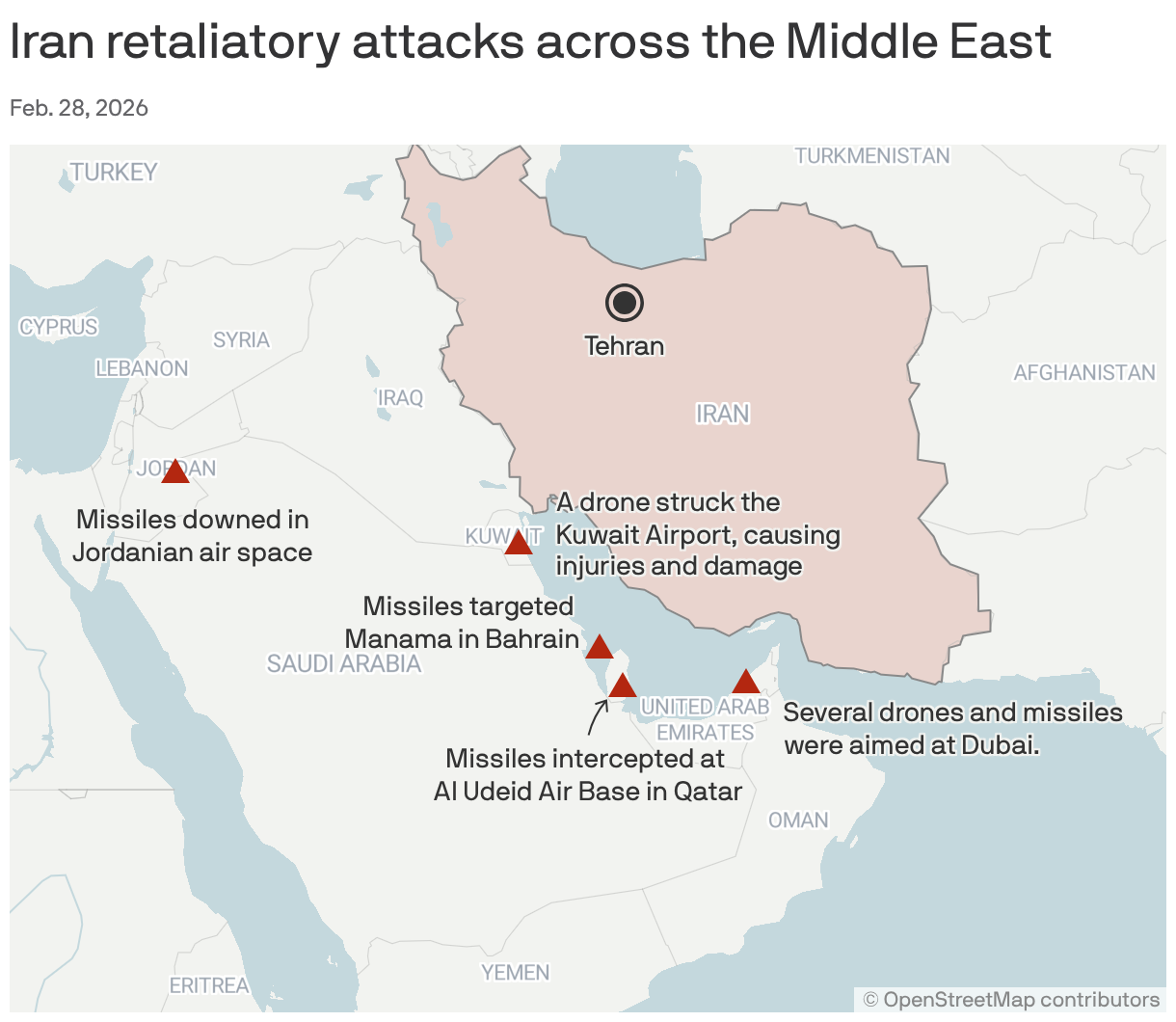
Data: Media reports and government statements; Map: Axios Visuals The U.S.–Israel military operation against Iran Saturday shook the wider Middle East, driving Iranian retaliation and wayward intercepts into Arab cities, airports and oil corridors, from Dubai to Kuwait City. The big picture: Iran's retaliation campaign has included aiming ballistic missiles and drones at U.S. bases and Israel — and is spilling into neighboring Arab states that host American forces or sit under flight paths. Those include the United Arab Emirates (UAE), Qatar, Kuwait, Bahrain and Jordan. Zoom in: In the UAE, Iranian missiles and intercepts sent debris over Abu Dhabi and the Palm Jumeirah area of Dubai, leading to multiple injuries, and shutting down flights at Dubai's main airports. The UAE foreign ministry said in an X post that its "air defence systems intercepted and destroyed a new wave of Iranian missiles and drones launched towards the country." State of play: In Qatar, missiles and drones aimed at Al Udeid Air Base outside Doha prompted intercepts that shook nearby neighborhoods and disrupted air traffic, per its state-run news agency. In Kuwait, a drone and missile barrage struck near the country's international airport and nearby U.S. facilities, injuring several people, damaging parts of the terminal area and forcing temporary flight suspensions . In Bahrain, missiles targeting areas near the U.S. 5th Fleet headquarters triggered evacuations and damage checks in the Juffair district of its capital, Manama. In Jordan, air defenses downed incoming ballistic missiles over its territory, jolting cities with explosions in the sky but preventing major casualties or significant damage to civilian infrastructure. What they're saying: "Iran has attacked Jordan without any justification, even as it is aware of the efforts Jordan has exerted to resolve the crisis peacefully," Jordan's foreign ministry said in a translated X post . The Saudi Arabian Foreign Ministry listed called the attacks "blatant Iranian aggression" and "flagrant violation" of the countries' sovereignty. The Dubai government warned against circulating unverified reports, after "Old clips and images of previous fires in Dubai" were circulated on social media. "We urge the public and media to exercise caution and source information solely from official channels, and to refrain from sharing rumors or unverified news, given the direct impact this has on community security and stability." Catch up quick: The regional fallout follows President Trump's 10-day ultimatum to Tehran to solidify a nuclear deal — and his decision to act after diplomatic talks failed this week. Trump had said that rejecting an agreement would bring about a military response, while the U.S. buildup in the area grew for weeks. In a video released early Saturday announcing Operation Epic Fury, Trump alleged Iran has engaged in widespread terrorism since the 1979 Islamic Revolution. "We're going to destroy their missiles and raze their missile industry to the ground," Trump said. Iranian Foreign Minister Abbas Araghchi said : "We do not understand the reasons for the U.S. attack on Iran. Perhaps the U.S. administration was dragged into it. "Here is what I do know: Iran will punish those who kill our children. Our enmity is not with the American people, who are being lied to yet again." What to watch: The killing of Iranian Supreme Leader Ali Khamenei in an Israeli strike Saturday, according to Israeli sources, sets off an immediate succession crisis with no clear answer, Axios' Barak Ravid reported . Go deeper: 4 reasons why the U.S. attacked Iran with Israel What to know about Ali Khamenei, Iran's supreme leader How world leaders are reacting to U.S.-Israel strikes on Iran