


 Business Recorder
 Afghanistan: Operation to persist till objectives achieved, NA told
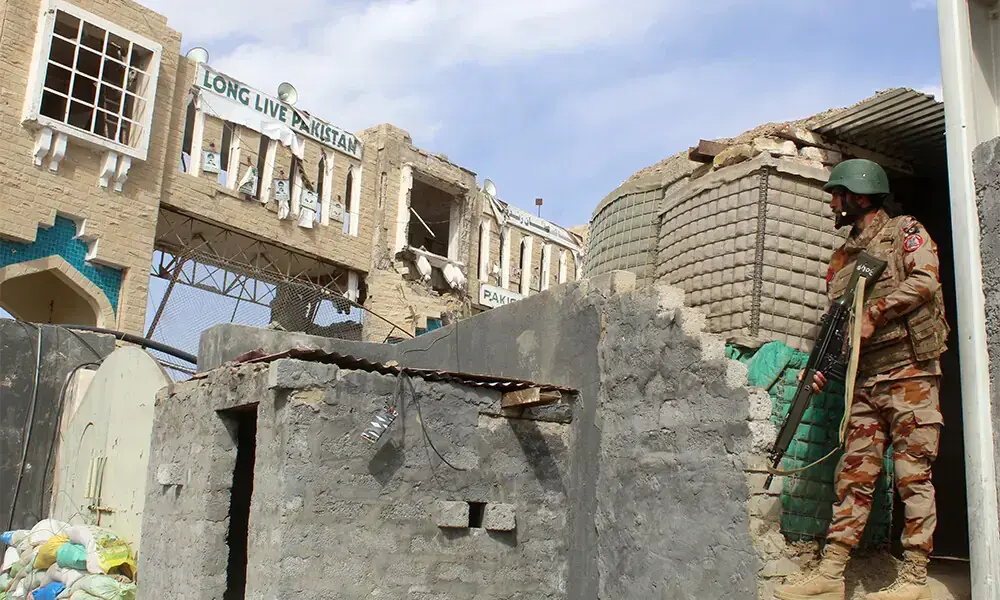
ISLAMABAD: Pakistan will continue its Ghazab lil-Haq military operation until Afghanistan guarantees its soil will no longer be used for terrorism or cross-border attacks, Federal Minister for Parliamentary Affairs Tariq Fazal Chaudhry told the National Assembly on Wednesday. Speaking in the National Assembly, the minister highlighted the severe security threat from terrorism originating in Afghanistan, revealing that since the Taliban’s takeover in 2022, over 8,500 Pakistanis, including civilians and security personnel, have been killed in attacks. He emphasised that recent deadly attacks in Tirah, Bannu, and Bajaur districts were directly linked to Afghan-based militants, prompting Islamabad to take decisive military action to protect its sovereignty and security. The remarks followed a high-level in-camera briefing earlier in the day, where Prime Minister Shehbaz Sharif had convened a session for heads of parliamentary and political parties to discuss regional issues, including Afghanistan, Iran, and broader security concerns. Chaudhry highlighted that the government sought to include opposition leaders in the briefing, stressing that it was not intended to promote any political agenda but to address national security and forge a cohesive strategy for Pakistan’s future. He underscored that the session was meant to build a rational policy and bring together various political perspectives for the country’s collective security. About Pakistan’s air strikes inside Afghanistan, he said that Islamabad had repeatedly shared evidence with the Taliban government about militant safe havens operating on Afghan soil. Despite numerous diplomatic engagements in Doha and Istanbul, including offers of resources to help combat terrorism, Afghanistan had failed to provide sufficient guarantees or take tangible action against these terror networks, the minister added. In the same breath, he raised the issue of India’s involvement in sponsoring terrorism within Pakistan. He accused India of fuelling violence along the Pakistan-Afghanistan border and warned that Pakistan would hold those across the border accountable for any future attacks or martyrdom, insisting that military operations would persist until their objectives were met. He said Pakistan had made multiple diplomatic efforts to resolve the Afghanistan issue, with both the Deputy Prime Minister and Foreign Minister visiting Afghanistan several times to urge the Taliban to curb cross-border terrorism. Turning to broader regional issues, Chaudhry condemned the recent Israeli aggression against Iran, particularly the attack that led to the martyrdom of Iranian Supreme Leader Ali Khamenei. Describing Iran as a brotherly Islamic country, he expressed concern over the rising instability in the region, warning that continued escalations could severely affect regional economies, especially driving up oil and gas prices. He reiterated Pakistan’s support for Tehran in the face of external threats, underscoring the need for regional de-escalation. The issue of Iran’s security was also raised by Ali Muhammad of the opposition PTI, who strongly condemned the Israeli-US attack on Iran. He warned that Israel’s and the US’s actions could potentially pave the way for further aggression in the region, with Pakistan possibly being the next target. He criticised Prime Minister Shehbaz Sharif’s previous endorsement of Trump’s potential nomination for the Nobel Peace Prize, accusing him of being complicit in policies that have destabilised the Middle East. In a similar vein, Dr Farooq Sattar of Muttahida Qaumi Movement (MQM-P) called for an in-camera session of parliament to brief lawmakers on the latest developments in the region. He stressed the importance of ensuring that Pakistan’s position is not swayed by external propaganda and called for a unified national stance on security matters. Members of both the opposition and treasury, including Iqbal Afridi of PTI and Ijaz Jakhrani, Mirza Ikhtiar Baig, Shabbir Ali Bijarani, and others, expressed strong condemnation of the Israeli and US actions against Iran. Many lawmakers echoed the sentiment that the threat to Pakistan’s sovereignty is intensifying, and a unified national approach is required to safeguard the country’s interests in an increasingly volatile region. Copyright Business Recorder, 2026