


 Business Recorder
 Asian shares surge, led by KOSPI; Treasuries fall as war concerns ebb
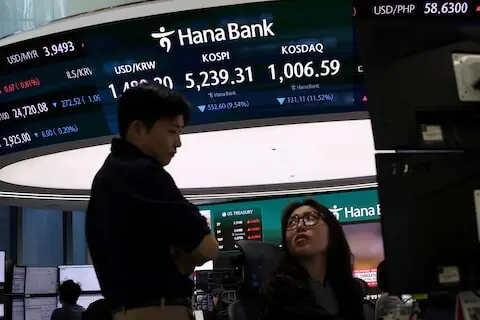
TOKYO: Asian shares rallied on Thursday with a decline in U.S. Treasuries pointing to a tentative recovery in risk appetite that has been hammered by the escalating war in the Middle East. South Korea’s KOSPI gauge recovered its steep losses in the prior session following a rally on Wall Street on hopes the United States and Iran will seek an off-ramp from hostilities. Oil and gold traded higher. China set its growth target at a slightly lower pace than the previous year in a closely watched, wide-ranging economic plan. The U.S. Senate backed President Donald Trump’s military campaign against Iran, suggesting no quick resolution to a war that has roiled financial markets, transportation networks, and energy production. “Geopolitical risk can flare up again very quickly, so any early gains we see this morning across Asia-Pacific region share markets may not last,” Paco Chow, dealing manager at Moomoo Australia and New Zealand, said in a note. “The outlook will remain cautious until we see oil flows return to normal.” MSCI’s broadest index of Asia-Pacific shares outside Japan jumped 2.9%. South Korea’s KOSPI led regional benchmarks with a 10.4% surge, while Japan’s Nikkei jumped 2.9%. The yield on benchmark US 10-year notes rose 2.7 basis points to 4.109%, as the 30-year bond yield rose 3.1 basis points to 4.7479%. The U.S.-Israel war on Iran widened sharply on Wednesday after a U.S. submarine sank an Iranian warship and NATO air defences destroyed an Iranian ballistic missile fired towards Turkey. But equity markets in Europe and the U.S. took solace from a pledge by Trump to provide protection to shippers and a New York Times report that Iranian intelligence had reached out to the CIA early in the war about a path towards ending it. Iran later rejected the report, while in the U.S., the Republican-led Senate voted to block a bipartisan resolution aiming to stop the air war. Concerns about energy supply continued to drive up oil prices. U.S. crude rose 3.01% to $76.91 a barrel and Brent rose to $83.43 per barrel, up 2.49% on the day. Spot gold rose 0.84% to $5,178.42 an ounce. “The market continues to trade on headlines, and we’re likely to see further volatility ahead,” Henry Russell, a London-based economist for ANZ, said on a podcast. “We’re seeing energy supply still facing constraints with production facilities going offline and more likely to follow if this conflict persists any longer.” China set its economic growth target for 2026 at 4.5%-5%, a slight downgrade from the 5% pace achieved last year, leaving room for efforts to curb industrial overcapacity and rebalance the economy. Beijing also released its 15th five-year plan, pledging investments in innovation, high-tech industries, and a “notable” increase in household consumption. China’s blue-chip CSI300 Index gained nearly 1% in early trading, while the Shanghai Composite Index added 0.4%. The greenback took a breather after recent gains on safe-haven demand. The dollar index , which measures the greenback against a basket of currencies, was flat at 98.81. The Japanese yen advanced 0.2% to 156.75 per dollar. In cryptocurrencies, bitcoin fell 0.78% to $72,774.53 while ether declined 0.94% to $2,130.43.