


 Business Recorder
 US President demands Iran’s ‘unconditional surrender’
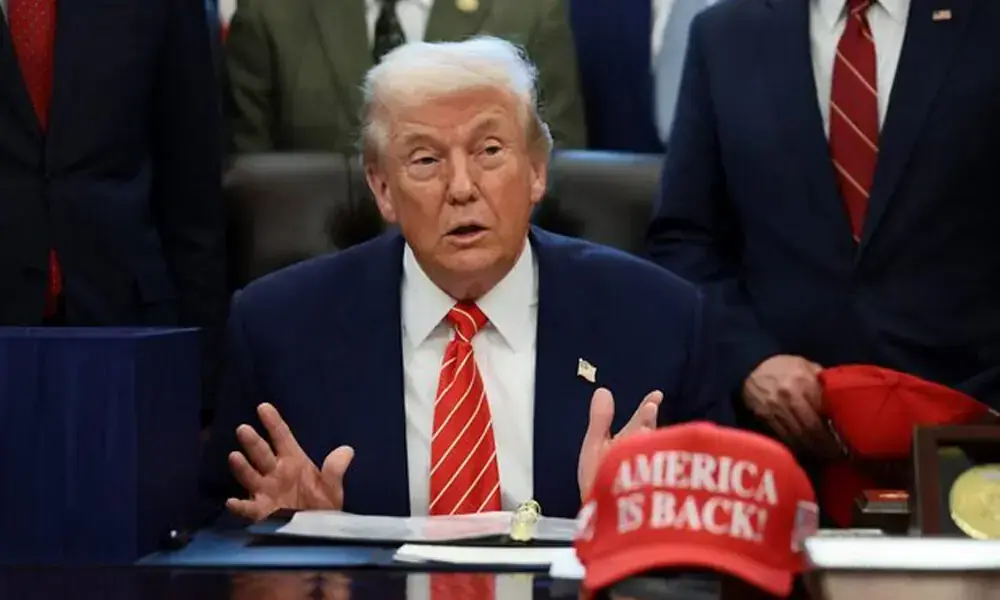
BEIRUT/WASHINGTON/JERUSALEM: US President Donald Trump demanded Iran’s “unconditional surrender” on Friday, a dramatic escalation of his demands a week into the war he launched alongside Israel, which could make it more difficult to negotiate a swift end to it. Trump made the remarks on social media just hours after Iran’s president announced that unspecified countries had begun mediation efforts, one of the first signals of any diplomatic initiative to end the conflict. “There will be no deal with Iran except UNCONDITIONAL SURRENDER!” Trump wrote. “After that, and the selection of a GREAT & ACCEPTABLE Leader(s), we, and many of our wonderful and very brave allies and partners, will work tirelessly to bring Iran back from the brink of destruction, making it economically bigger, better, and stronger than ever before.” The surrender demand, and the likelihood that this would complicate any quick path to ending a conflict that has interrupted global energy supplies, caused immediate shock in financial markets. European share markets, open at the time of Trump’s post, suffered a sudden swoon. Wall Street opened sharply lower soon after. On Thursday Trump had told Reuters in a telephone interview that he was demanding the right to help select Iran’s new supreme leader, to replace Ayatollah Ali Khamenei, killed in the war’s first day. On the ground, Israel pursued a major expansion of the war in Lebanon, pounding the capital Beirut on Friday after ordering an unprecedented evacuation of the entire southern suburbs of the city. It also launched a new wave of attacks on Iran, saying 50 of its warplanes had struck a bunker still being used by Iran’s leadership beneath Khamenei’s destroyed Tehran compound. Iran’s President Masoud Pezeshkian posted on X: “Some countries have begun mediation efforts.” He did not identify the countries or provide further details. “Let’s be clear: we are committed to lasting peace in the region, but we have not the slightest hesitation in defending the dignity and authority of our country,” he added. Under Iran’s system, the president is subordinate to the supreme leader, but Pezeshkian is now serving on a panel that has assumed Khamenei’s duties. Israel has extended its bombing to Lebanon to root out Hezbollah, the Shi’ite militia allied to Iran that has been a dominant faction in Lebanese politics since the 1980s and part of a wider, but now weakened, “axis of resistance”. Hezbollah fired on Israel this week to avenge the death of Khamenei. “We’re sleeping here in the streets - some in cars, some on the street, some on the beach,” said Jamal Seifeddin, 43, who fled Beirut’s southern suburbs and spent the night on the streets in the capital’s downtown district. “No one even brought a blanket.” Israel has intervened in Lebanon repeatedly over decades, most recently in a campaign that weakened Hezbollah in 2024. But the ferocity of Friday’s strikes had little precedent.