


 The Advocate
 From abomination to somebody: What Jesse Jackson meant to Black queer boys in the Back pew
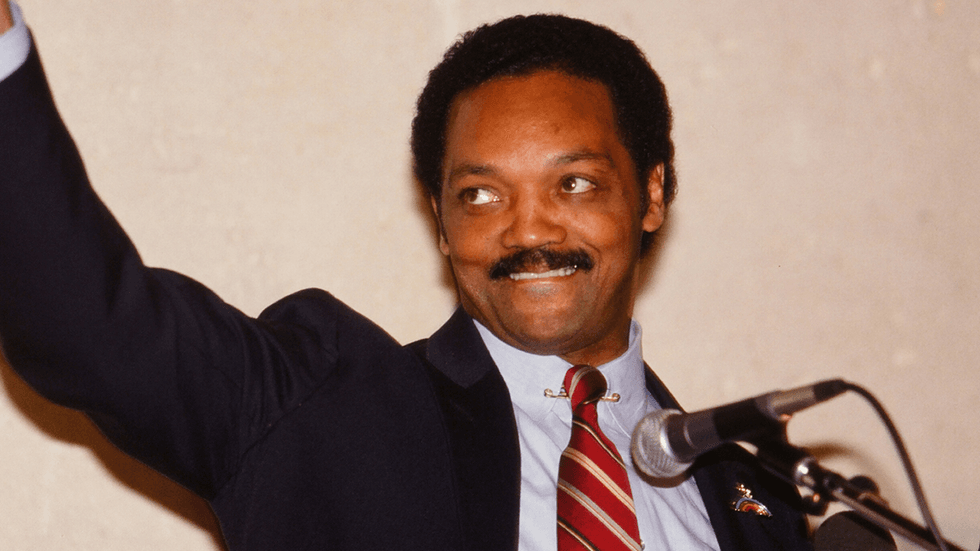
By the time the new millennium arrived, I was a dark-skinned teenage boy questioning my sexuality, fingers perched on the coveted Hammond organ keys of my Southern Baptist church, afraid of Black men in pulpits. I followed them as expected in the magical oratorical inflective moments where they’d holler, “yes, Lord” and “say amen, church,” and in their damning declarations that lesbians, gays, bisexuals, and transgender folk were loved by God, but not like that. The first time I saw Jesse L. Jackson, he looked like the other preachers I later feared, resented, and still divinely revered. I was sitting too close to the boxy brown apartment living room television, watching his episode of A Different World . Dwayne Wayne, my favorite character, and the entire cast looked upon this man with tears in their eyes as he told them, and us, that we were “somebody,” that hope was a discipline, not a feeling. I knew they weren’t acting. Neither was he. I knew Rev. Jackson was black as collard greens, Blue Magic grease, Sam Cooke, spades, and sweet tea. I knew he sounded like the reverends I grew up with. I knew he was different than them. In Black church culture, our reverends were the closest any of us could get to God—the respect was immediate, biblical, intense, immense. My mother, Valerie J. Golden, a young organizer in Steinbeck Country, had once knocked doors in segregated Salinas with his name on her cinnamon lips, a Jesse Jackson ’88 button pinned to her thin body, carrying campaign literature to homes that both welcomed and forbade her entrance. What she remembers most about his 1988 visit to Salinas is how brown the crowd was. As a regional member of the Rainbow Coalition, she had the honor to walk Rev. Jackson to the podium alongside now-California Senator Anna Caballero and local Mexican gay rights advocates. The Hispanic community in Salinas showed up to hear his rousing “Keep Hope Alive” call-and-response, and migrant lettuce workers respected that he prayed with César Chávez, who endured a 36-day water-only fast against pesticides and for the United Farm Workers’ grape boycotts—a cross-racial collaboration that displayed the reverend’s heart for people different than him. Fifteen years later, one of his biographers and confidants would become my mentor, and I would come to understand that the same reverend who inspired my mother to earn her own threatening calls was one of the first big, tall Black men, like me, to say the words “lesbians and gays” from a national political convention pulpit—on purpose. Journalist Eugene Scott later wrote about Jackson’s role in championing LGBTQ rights in the Black community in the Boston Globe . Rev. Jackson wrestled with what it meant for the dark-skinned Baptist kids hiding behind organ pews during the choir’s selection, “God Put a Rainbow in the Sky.” The parallels were too blinding, too on-the-nose, and would surely out these youths. This was the same man who would later say people are judged by “how you treat the least of these,” that you must love your neighbor as yourself, and that making the Bible “toxic” to justify oppression would never stand the test of love and justice. I did not realize then, sitting on the borrowed organ bench, that Rev. Jackson had already slipped out of the long black robe and white preaching tabs of a lineage of civil rights heroes who looked like him. Decades before I learned the language to call myself queer, he stood in California’s gay capital, San Francisco, saying, “The rainbow includes lesbians and gays. No American citizen ought to be denied equal protection from the law.” He made the remarks during the 1984 Democratic National Convention as part of his broader Rainbow Coalition message. He insisted that queers, and subsequently Black queer boys, were essential in the American tapestry—the covenant we keep reciting but rarely sign in permanent ink. I would later learn that he had his own private wrestlings with God, which propelled him to shift from classic Black theological ideologies that carried hand-me-down hesitations about marriage, along with his own insistence that Black suffering was no metaphor for any other struggle. “You cannot compare the gay struggle with the struggle to end slavery after 246 years… For those who abuse the scriptures, it won’t stand the test of love and justice,” Jackson said while discussing marriage equality in a 2012 interview with TIME. And, for the first time, Black queer folk had an unmistakable sacred figure who held both Blackness and queerness in his calloused, prayer-scarred palms. We could see ourselves finally as both Black and queer, knowing that our queerness would never usurp the fact that we were descendants of the stolen merchandise from the Trans-Atlantic slave trade. Our queerness could never usurp that. As Rev. Jackson struggled out loud with his views on the LGBTQ+ community, I was a depressed sophomore Black Studies student at California State University, Northridge. In 2004, when he said in one breath that gays deserved the right to choose their partners and in the next that “in my culture, marriage is a man-woman relationship,” he was speaking during a conversation with The Advocate about LGBTQ rights and marriage equality. I heard the footsteps of every Black man I loved who could march for my right to vote but not to live fully. It wasn’t that I needed his permission to love a man; it was that I needed to see a gargantuan Black preacher, formed by the same Southern Baptists sanctuaries that hurt me, say out loud that he was willing to change. This was a change we simultaneously saw within the historic 8-year run of the first Black president, Barack Obama, who assuredly owed his ability to campaign and be considered, at all, to Rev. Jackson’s earlier bids. Rev. Jackson’s change, however, did not heal my depression. That belonged to queer friends, Black women, expensive therapists, and my own faith—built in the phoenix ashes of a rebirthing young spirit. But his public repentance—the changing of his mind and thought evolution in front of cameras—gave me the understanding that Black men were not unforgivable, not fixed in stone. It said, “I was wrong, and I will be different.” Rev. Jackson modeled permission to admit that the theology that raised you could be revised, that Black masculinity could mean more than what came historically from Baptist pulpits. As a boy hearing “abomination” more than “love,” or my own name, it mattered to the actualized queer Black man I would become that one 6’3” football player turned international theologian was willing to change his mind, and the minds of many Blacks, in public, on television. In many ways, this is my attempt to reckon with that: what it means when a Southern Baptist preacher, shaped by the same Bible that bruised me, decided his God would no longer be used to erase me or any other Black boy. Rev. Jackson’s evolution didn’t end homophobia in the Black church. There are still 2026 remnants of anti-LGBTQ+ rhetoric sweating from Sunday morning sermons, where pastors call us “an agenda” from their pulpits while quoting Jackson on every other kind of justice. These men will invoke his “keep hope alive” while refusing to speak our names, as if they misunderstood the literal and metaphorical association of rainbows in his delivery. Long before it was safe, Rev. Jackson visited AIDS hospices, held the hands of the dying, took an HIV test in public, and launched campaigns to get a million Black people tested—insisting that the disease was not a divine verdict on anyone’s desire. Today, as new anti-LGBTQ+ laws rise like grandma’s biscuits, Black trans youth are murdered and disappeared, and hard-won rights are stripped away, it feels like we need him to come back and preach one more sermon. We need our Black men in pulpits to protect us too. We need straight Black men to include us when we battle to stay alive. We need Black institutions to move forward in Rev. Jackson’s divinely bulldozed path and serve the invisible among us— “the least of these.” His death on February 17, 2026, was rightly mourned as the passing of a civil rights maverick, but it was also a back-pew funeral for Black queers who didn’t know they needed him until he was gone. Learn more about NAACP Image Award–winning poet and writer James B. Golden and explore his books and poetry at www.jamesbgolden.net