


 The Advocate
 Virginia Republican names bill for swimmer whose fifth-place tie with trans athlete launched lucrative career
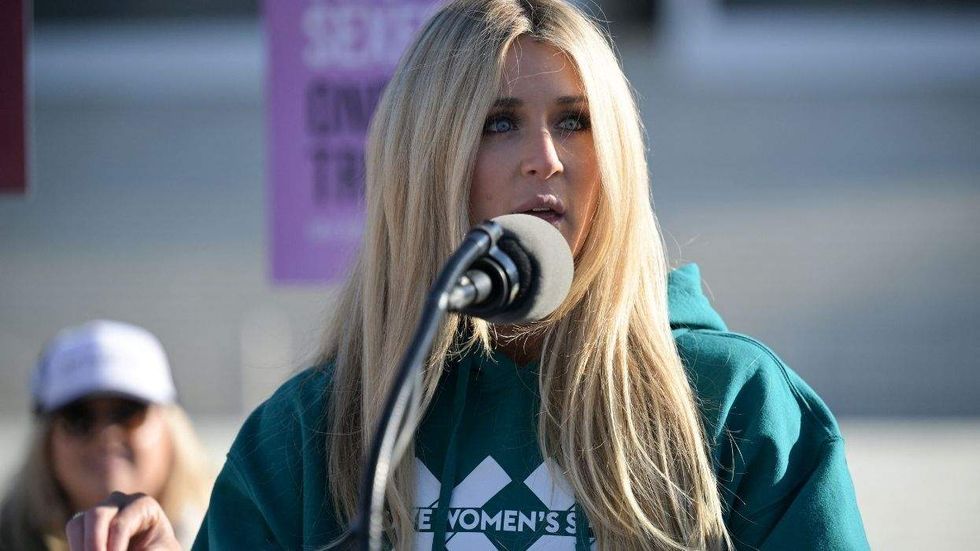
A Virginia Republican has introduced federal legislation named for a swimmer whose national prominence began with a tie for fifth place. Keep up with the latest in LGBTQ + news and politics. Sign up for The Advocate's email newsletter. Rep. John McGuire on Monday announced the Riley Gaines Act, a bill that would allow female athletes to sue colleges, universities, and athletic associations that permit transgender women to compete in women’s sports. He represents Virginia’s 5th Congressional District, a largely rural swath of central and southern Virginia that includes Charlottesville, Danville, and Lynchburg. The proposal is named for Riley Gaines, a former University of Kentucky swimmer who rose to national attention during the 2022 NCAA Women’s Swimming and Diving Championships. At that meet, Gaines tied for fifth place in the 200-yard freestyle with Lia Thomas of the University of Pennsylvania. Thomas went on to win the 500-yard freestyle, becoming the first out transgender athlete to capture an NCAA Division I national championship. Related : Georgia judge tosses out most of failed college swimmer Riley Gaines’s NCAA lawsuit over trans athletes Related : Simone Biles deactivates X account after comments about transgender athletes For Gaines, the race proved consequential, though not in the way elite athletic careers typically unfold. Gaines’s highest individual finish at the NCAA championships was that fifth-place tie. After graduating in 2022, she did not pursue competitive swimming. Instead, the moment became the starting point for a national profile built on opposition to transgender participation in women’s athletics. In the years since, Gaines has testified before state legislatures and Congress, appeared on conservative television programs, and become a fixture at political rallies and policy forums focused on restricting trans acceptance in society. What began as a single NCAA race has evolved into a lucrative career. Gaines, 25, was the highest-paid employee of the conservative nonprofit Leadership Institute in 2024, receiving $474,313 in reportable compensation as director of the organization’s Riley Gaines Center, according to the group’s IRS Form 990 tax filing . McGuire’s proposed legislation would create a new federal cause of action allowing female athletes to sue institutions that “negligently or recklessly” allow transgender women to compete in women’s athletics. Under the bill, athletes could seek damages for physical injury as well as for lost scholarships or professional opportunities tied to the competition. Related : AOC tells Riley Gaines to 'get a real job' instead of attacking trans people Related : From Riley Gaines to OU, conservatives are making their failures everyone else's problem “Female athletes deserve to feel safe and protected in the sports they love,” McGuire said in a statement announcing the bill. “Instead, they are at risk of serious injury and losing scholarships and professional opportunities due to the unfair advantage created by competing against a male in a female sport.” A growing body of peer-reviewed research finds no consistent evidence that transgender women hold an athletic advantage over cisgender women, particularly after hormone therapy. Courts would also be required to award attorneys’ fees to prevailing plaintiffs who bring such cases under the law. The legislation arrives amid a broader federal campaign by President Donald Trump’s administration to erase gender-diverse people from American life. LGBTQ+ advocacy groups say policies targeting transgender athletes are based on exaggerated claims about participation in women’s sports and have been used as part of a broader effort to limit transgender rights in schools and public life. Related : Trump’s health department launches ‘vile’ anti-trans website featuring right-wing influencer In 2025, Trump signed an executive order directing federal agencies to interpret Title IX as barring transgender girls and women from competing in female sports categories. The order threatened federal funding for schools that fail to comply and set off a series of federal actions aimed at aligning athletic policies with that interpretation. Federal agencies have since pressured institutions, including the NCAA and the U.S. Olympic Committee, to revise their policies governing transgender athletes. The administration has also pressed universities to revisit records and awards won by transgender athletes. In July 2025, the University of Pennsylvania agreed to modify its swimming record books as part of a federal resolution with the Department of Education. The agreement stripped Thomas of her accolades, restored titles and records to cisgender swimmers who competed against her, and included formal apologies to athletes who said they were disadvantaged. Gaines has become one of the most visible public faces of that broader campaign. In 2025, the Department of Health and Human Services featured Gaines in a government video promoting a federal webpage that defines sex strictly as male or female and frames transgender inclusion in sports as a threat to women’s athletics.