


 Business Recorder
 Volatility at bourse, KSE-100 lowers marginally
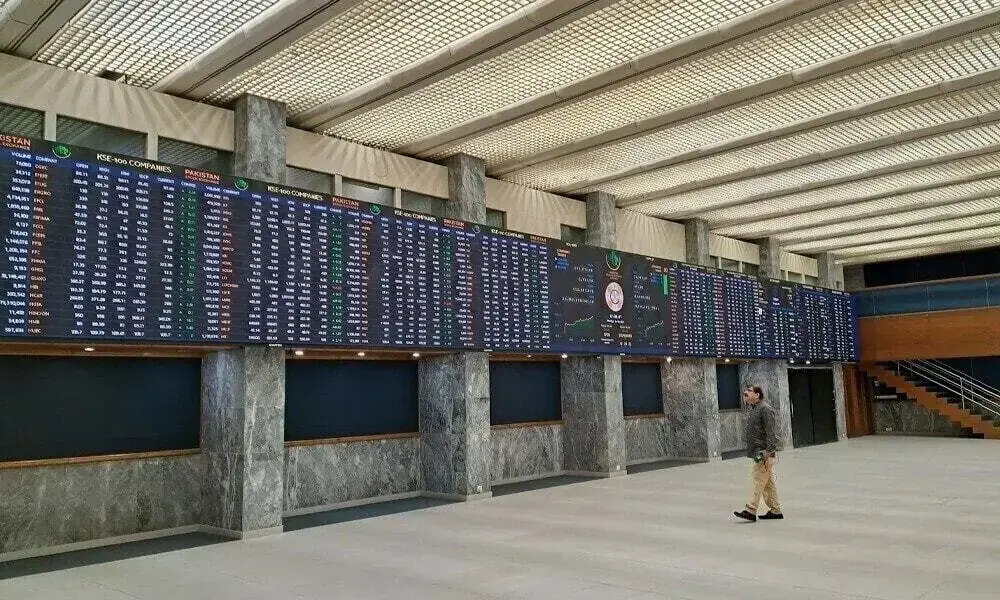
A volatile trading session was observed at the Pakistan Stock Exchange (PSX) with the benchmark KSE-100 Index shedding over 100 points during trading on Tuesday. At 11:30am, the benchmark index was hovering at 149,014.03, down by 164.63 points or 0.11%. Selling was observed in key sectors, including automobile assemblers, cement, fertiliser, oil and gas exploration companies and refineries. Index-heavy stocks, including ARL, NRL, MARI, OGDC, FFC, HBL and NBP, traded in the red. Pakistan recorded a current account surplus of $427 million in February 2026, according to data released by the State Bank of Pakistan (SBP) on Monday. “The surpluses reflect strong remittance inflows, improving value-added exports, and disciplined imports (growth-driven), strengthening macroeconomic stability and easing pressure on external financing,” said Finance Minister’s advisor Khurram Schehzad. “Though challenges exist given the regional conflict, however, Pakistan’s stabilised external account with adequate buffers is a key milestone for sustainable economic recovery and investor confidence,” the advisor said. On Monday, the PSX witnessed a sharp sell-off as the benchmark KSE-100 Index plunged, as investors remained wary due to persistent volatility in international oil prices and broader uncertainty in global markets. The KSE-100 Index closed at 149,178.66 points, registering a steep decline of 4,687.51 points or 3.05%. Globally, stocks climbed in early Asian trading on Tuesday, pressing for a second day of gains as investors confronted a crowded central bank calendar and an unrelenting Middle East conflict. Markets are on edge, trying to price in the economic damage from US President Donald Trump’s war with Iran and the policy reaction it could trigger. MSCI’s broadest index of Asia-Pacific shares outside Japan was up 0.9%, led by a 2.4% gain for South Korea’s Kospi, while Japan’s Nikkei 225 rose 0.3%. S&P 500 e-mini futures slipped 0.3%. On Wall Street on Monday, the S&P 500 rose 1.0% to snap a four-day losing streak on gains for AI stocks, though the index remains 3% below its level before the conflict began. This is an intra-day update