


 Dawn.com
 Jailed PTI leaders criticise lack of economic restructuring measures amid Gulf conflict
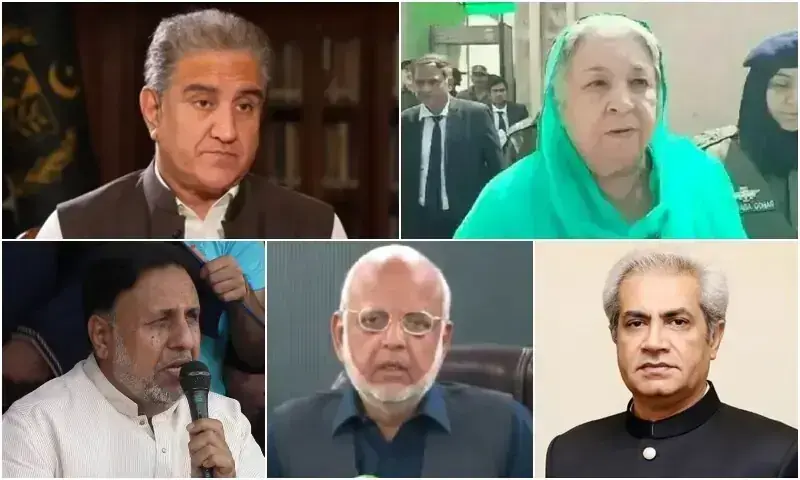
LAHORE: Pakistan’s fragile economy, already reeling from the shock of rising oil and gas prices, has been further exacerbated by a lack of economic restructuring measures, the five senior PTI leaders incarcerated in Kot Lakhpat Jail said on Tuesday. In an open letter shared by their counsel Rana Mudassar Umer, PTI leaders Shah Mahmood Qureshi, Dr Yasmin Rashid, Ejaz Chaudhry, Mian Mahmoodur Rasheed and Omar Sarfraz Cheema said that Pakistan’s hard-earned macroeconomic stability, gained by “squeezing” ordinary citizens over the last three years, would wither away in the next three weeks if the Gulf conflict were to persist. It also said that uncertainty and the shock of rising oil and gas prices had scrapped the chances of a staff-level agreement with the International Monetary Fund (IMF). Commenting on the country’s economic situation, the leaders said it was becoming increasingly difficult to meet the performance criteria agreed upon at the time of budget formulation for the current fiscal year. “Exports remain sluggish and revenue collection far beneath the budget target. Lack of economic restructuring measures and internal confusion on economic strategy have compounded the fragile economic situation. The combined effect of higher energy prices, rising freight [and] insurance costs, and supply disruptions could reduce our exports further,” the letter said. It added that the country’s economic stability was linked to political stability and observed that “the current political environment and business as usual is no longer an option”. The PTI leaders urged the government to understand and accommodate the complexities of federalism. They pointed out that Pakistan produces only one barrel of oil out of 10 that it consumes, warning: “If the global prices fluctuate around $100 per barrel, our import bill will increase considerably and our GDP growth will drop significantly. This will not just widen our trade deficit, it will intensify pressure on our foreign exchange reserves.” They added that a rise in diesel prices at the time of wheat harvesting and an increase in the prices of gas and fertilisers at the beginning of the Kharif season would hit farmers hard. The rise in the cost of two critical agricultural inputs “will have a direct and immediate impact on agricultural productivity and purchasing power of the majority of our population living in the rural areas”, the letter said. Cotton production has fallen far short of government estimates, it claimed, compelling the textile sector to rely on imported expensive cotton lint. A rise in the price of synthetic fibres due to an increase in the price of petroleum products would have a “devastating impact on our textile sector”, the largest industrial employer of Pakistan. “Our food imports have increased by over 18 per cent and our food exports have dropped by over 34pc in the first eight months of this fiscal year,” the leaders said. Over the last few years, they said, remittances had exceeded the country’s exports and become a vital pillar of its financial stability. “They were expected to approach nearly $42 billion this fiscal year that play a crucial role in financing Pakistan’s trade deficit, servicing external debt and supporting domestic consumption,” the letter read. Stating that almost 55pc of the country’s remittances are generated by 5.5 million Pakistanis employed in Gulf states, the PTI leaders expressed fear that prolonged instability in Gulf states would slow down investments and tourism, reducing job opportunities for migrant workers and obviously impacting remittances. “Double-digit inflation over the last three years has eroded the purchasing power of the majority of our population. Higher fuel prices will translate into higher inflation,” they stated, adding that the State Bank of Pakistan (SBP), through its monetary policy , had forced the inflation down to 7 per cent, but it was now on the rise again. “A persistent demand of the business community for a reduction in the policy rate will be difficult to meet in the present circumstances, vitiating investment climate and business confidence further,” the PTI leaders observed. They also said that investments in Pakistan from friendly Gulf states “will have to be reassessed”. “Without ensuring security of Chinese personnel working in Pakistan, we will not be able to attract Chinese investments or promote industrial relocation of labour-intensive industries from China to Pakistan,” they suggested. The PTI leaders urged the government to check the rising wave of terrorism and defeat the menace of foreign-sponsored terrorism. “Governance and law and order has to be improved to attract meaningful investments into Pakistan,” they stressed. “A shift from an annual to a monthly rollover of foreign deposits with the State Bank is concerning; with the Gulf states distracted by the Middle East conflict and a fear of a global recession, rollovers will become increasingly difficult to re-negotiate,” the letter added. It explained that stabilisation achieved through an IMF prescription had always resulted in slower growth, because it focused on managing the fiscal deficit. The PTI leaders stressed that a country with a large youth population, rising rates of unemployment and a large section of its population living beneath the poverty line could not afford “the burden of wasteful government expenditure and wrong development priorities”. They also emphasised that waterways should have been given preference over motorways. “At a time when domestic fiscal discipline is critical, what message are we sending to international financial institutions by purchasing luxury aeroplanes and luxury vehicles for our ruling elite?” the letter read. The incarcerated PTI leaders stressed that Pakistan was required to re-prioritise its government expenditures and to reflect on the political attitudes. “If Pakistan has to move forward, political interests have to be subservient to our national needs,” the letter concluded.