


 Axios
Axios Gabbard defers to Trump when asked if Iran posed "imminent threat"
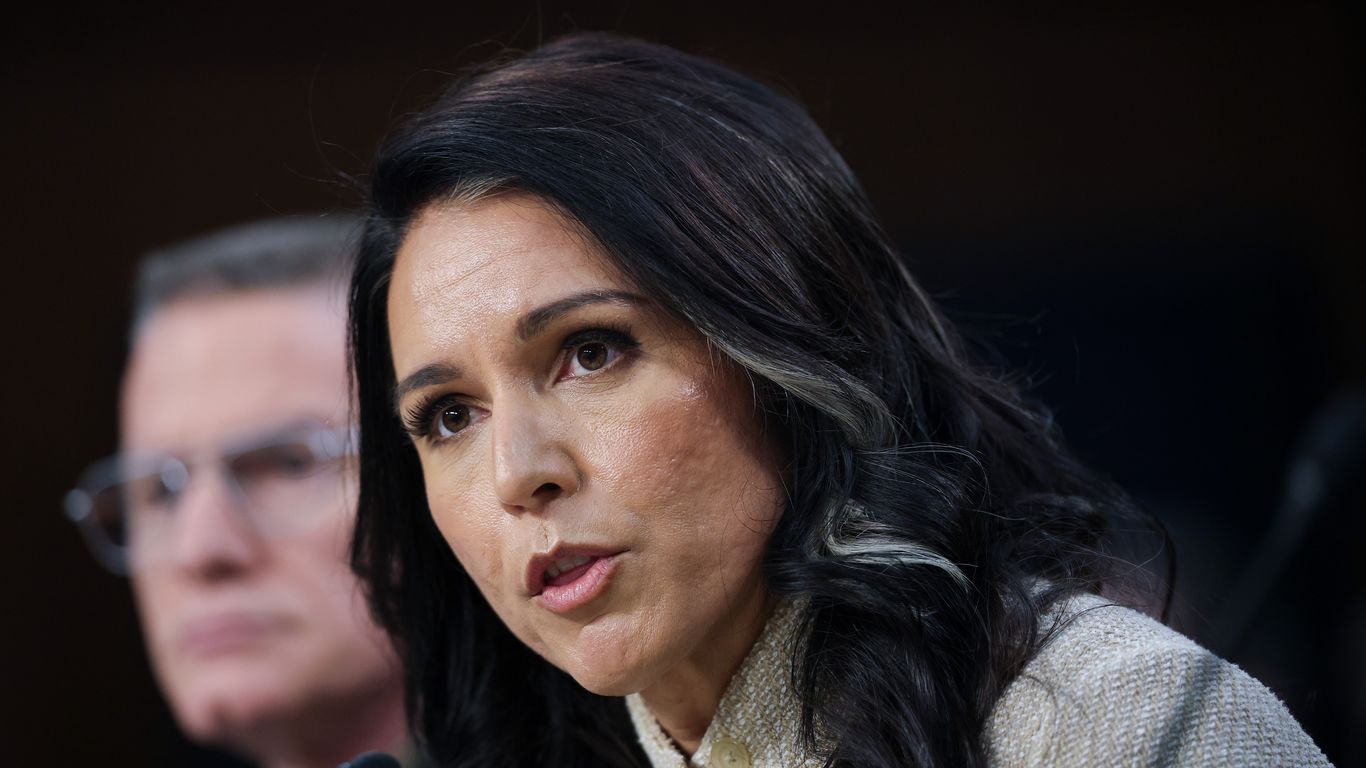
Director of National Intelligence Tulsi Gabbard said that only the president can determine if a nation poses an "imminent threat" during a Wednesday Senate hearing on worldwide threats. Why it matters: The spotlight on Gabbard, who has been largely quiet about the U.S.-Israeli strikes on Iran , has intensified after top aide Joe Kent , who directed the National Counterterrorism Center, announced his resignation in a scathing letter about the war. The White House said that Iran posed an imminent nuclear threat, but offered no public proof of what spurred the strikes. Driving the news: Sen. Jon Ossoff (D-Ga.) asked Gabbard whether it was the intelligence community's assessment that the Iranian regime posed an "imminent nuclear threat," to which she said the IC assessed that Iran maintained the intention to rebuild its nuclear enrichment capabilities . Pressed again, she replied, "the only person who can determine what is and is not an imminent threat is the president." "It is not the intelligence community's responsibility to determine what is and is not an imminent threat," Gabbard said, going on to argue that it provides the input with which the president makes decisions on imminent threats. Ossoff disagreed. Thought bubble: Gabbard's contention that only the president can determine whether there is an imminent threat to the U.S. is surprising coming from the head of the intelligence community, Axios National Security Editor Dave Lawler writes. While it is the president's decision whether to respond to a threat, the intelligence community frequently provides assessments of the severity of potential threats to the homeland. In fact, Gabbard made the remarks in a hearing about the intelligence community's assessments of global threats. Between the lines: Kent, the first senior Trump administration official to walk away over the war in Iran, claimed in his letter that Trump launched the war under pressure from Israel , despite Iran posing "no imminent threat" to the U.S. Trumpworld swiftly pushed back, with Taylor Budowich, a Trump adviser and former deputy White House chief of staff, calling Kent a "crazed egomaniac" who "just wanted to make a splash before getting canned." But Gabbard's history of strong opposition to war with Iran — and her hushed reaction to the ongoing conflict — has left analysts scrutinizing her stance as the war aggravates the right's "America First" friction. In the hours after Kent's resignation, Gabbard said in a statement that "President Trump concluded that the terrorist Islamist regime in Iran posed an imminent threat and he took action based on that conclusion." Worth noting: Trump still has full confidence in Gabbard, press secretary Karoline Leavitt told Fox News. Zoom out: CIA Director John Ratcliffe said during the hearing that he disagreed with Kent, noting he thinks Iran has been "a constant threat to the United States for an extended period of time, and posed an immediate threat at this time." In the text of her prepared opening statement, Gabbard said the Iranian regime appears intact but "largely degraded" by the U.S. and Israeli strikes. Her written statement also stated that as a result of the prior U.S. military attack on Iranian nuclear facilities, Iran's nuclear enrichment program was obliterated and that there had "been no efforts since then to try to rebuild their enrichment capability." But when speaking on Wednesday, Gabbard said that Iran was trying to recover from the damage to its nuclear infrastructure and had refused to comply with nuclear obligations. Go deeper: U.S. weighs sending special forces to seize Iran's nuclear stockpile