


 Daily Finland
 Merz urges US and Europe to 'repair and revive' alliance
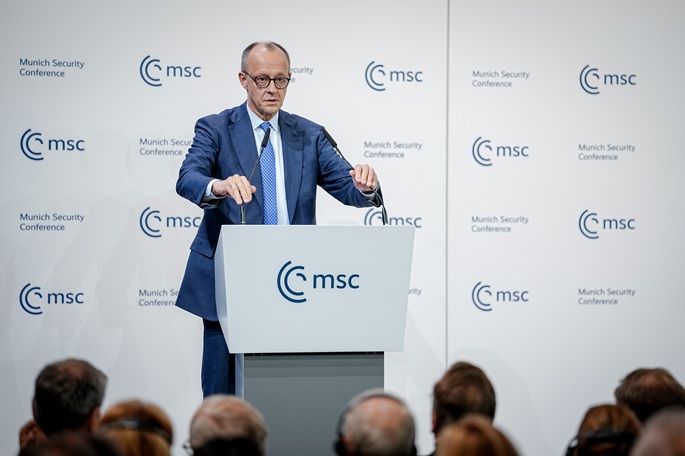
German Chancellor Friedrich Merz said Friday a "rift" had grown between the United States and Europe but urged both sides to "repair and revive" the partnership. Merz's speech opened this year's Munich Security Conference, where USPresident Donald Trump's volatile foreign policy seems to loom over the entire agenda. It also set the tone for three days of debates over decades-old trans-Atlantic ties and the future of the Western security framework. Merz said the old rules-based international order "no longer exists" and has given way to a far more uncertain era defined by "great power politics" and national interests. He described Russia's war on Ukraine as the "most glaring expression" of the new reality, while accusing China of exploiting dependencies and reshaping the international system to suit its own purposes. "If there was a unipolar moment after the fall of the Berlin Wall, it is long gone," Merz said. "The US claim to leadership is challenged, perhaps even lost." The chancellor drew a sharp distinction between Europe's political direction and developments in the United States under Trump. He said the "culture war of the MAGA movement is not ours," rejected tariffs and protectionist trade policies and reaffirmed support for international institutions and climate agreements because "we are convinced that we can only solve global challenges together." Merz suggested the US-Europe relationship was under severe strain, but not beyond saving. Switching from German to English to address "our American friends," Merz added: "In the era of great power rivalry, even the United States will not be powerful enough to go it alone." "Being a part of NATO is not only Europe's competitive advantage. It is also the United States' competitive advantage. So let's repair and revive trans-Atlantic trust together. Europe is doing its part." Europe could only assert itself in this new world order through economic and military strength, Merz said in the speech titled "A Programme for Freedom." Network of global partnerships Merz's remarks in Munich marked his first appearance at the conference as chancellor and amounted to a warning that Europe must adapt quickly to a world in which traditional alliances can no longer be taken for granted. The recent crisis sparked by Trump's bid to acquire Greenland shook NATO, while repeated tariff threats and deep disagreements over democratic values have widened the divide. At the same time as Merz urged a reset with the Trump administration, he said Germany would forge new partnerships to reduce reliance on China and the United States. "As important as European integration and the trans-Atlantic partnership remain for us, they will no longer be sufficient to preserve our freedom," said Merz. He also made it clear that partnerships with countries that do not share all Western values must be possible: "That is one of the lessons of these days, weeks, and months." He named Canada, Japan, Turkey, India and Brazil as particularly important partners, saying they played "key roles." He also cited South Africa, the Gulf states and others, saying: "We want to move closer to these countries, in mutual respect and with patience." French-German nuclear talks As debates intensify over Europe's security architecture, Merz also said he had begun confidential talks with French President Emmanuel Macron on European nuclear deterrence. He stressed that any European nuclear umbrella would be "strictly embedded" in Germany's existing role in NATO's nuclear sharing arrangement and would serve as a "self-sustaining, strong pillar of the alliance," not a replacement for it. Germany is bound by the 1990 Two Plus Four Agreement, which committed the country to renounce the manufacture, possession and control of nuclear, biological and chemical weapons. France remains the European Union's only nuclear-armed member state. Record number of leaders in Munich The high-level talks, which run through Sunday, will also focus heavily on Ukraine, where Russia's full-scale war enters its fifth year later this month, and on Iran, which Trump has warned could face military strikes if a nuclear deal is not reached soon. Organizers said more than 60 world leaders are expected to attend - more than ever before. They include Ukrainian President Volodymyr Zelensky, French President Macron, Danish Prime Minister Mette Frederiksen and Polish Prime Minister Donald Tusk. Around 100 foreign and defence ministers are also set to take part.